
Testimonial Examples For Colleagues: A Complete Guide To Writing Powerful Peer Endorsements

Introduction
In today's competitive talent landscape, the voices of your current employees carry extraordinary weight. When recruiting professionals seek to build employer brand and attract top-tier talent, colleague testimonials serve as powerful social proof that transcends traditional marketing messages. For modern recruiting teams managing high-volume candidate pipelines, testimonial examples for colleagues provide authentic insights into company culture, team dynamics, and growth opportunities that resonate with prospective hires.
Research from applied psychology studies demonstrates that positive organizational reputation and employee word-of-mouth significantly increase applicants' intentions to pursue employment, making structured colleague testimonials a critical component of modern recruitment strategy. This comprehensive guide explores how recruiting professionals can leverage peer endorsements to enhance candidate experience, reduce time-to-hire, and build a compelling employer value proposition.
Why Colleague Testimonials Matter in Modern Recruitment
Colleague testimonials represent one of the most credible forms of employer branding content available to recruiting teams. Unlike corporate messaging crafted by marketing departments, peer endorsements come directly from individuals who live your company culture daily, making them inherently more trustworthy to prospective candidates.
Gallup reports that business units in the top quartile of employee engagement achieve 10% higher customer ratings and 23% higher profitability, and highly engaged employees are significantly more likely to recommend their organization as a great place to work. This creates a powerful feedback loop where strong culture drives testimonials, which in turn attract candidates who reinforce that culture.
For Heads of Talent and People Operations Managers utilizing modern recruitment platforms, colleague testimonials serve multiple strategic functions. They provide candidates with realistic job previews, reduce post-hire turnover by setting accurate expectations, and demonstrate organizational values through concrete examples rather than abstract claims. When integrated into AI-powered interview processes, these testimonials can significantly enhance the candidate experience while maintaining evaluation efficiency.
The Impact on Candidate Quality and Pipeline Conversion
Recruiting professionals tracking candidate experience metrics understand that testimonials directly influence conversion rates throughout the hiring funnel. When candidates encounter authentic peer endorsements during their research phase, they develop stronger connections to your organization before ever entering the screening process. This pre-qualification effect means that candidates who proceed through on-demand interview platforms arrive with higher motivation and better cultural alignment.
Furthermore, Gallup's employee experience research shows that organizations with strong cultures see far higher rates of employees who would recommend their company to others, supporting the use of internal testimonials as a proxy for culture quality and a driver of talent attraction.
Types of Colleague Testimonials for Different Recruitment Scenarios
Not all colleague testimonials serve the same purpose in your recruitment strategy. Understanding the various formats helps recruiting teams deploy the right type of endorsement at the optimal point in the candidate journey.
Peer-to-Peer Professional Endorsements
These testimonials focus on collaboration, technical competencies, and day-to-day working relationships. They're particularly valuable when recruiting for roles requiring strong team integration or specialized technical skills.
Example 1: Technical Collaboration
'Working with Sarah on our backend infrastructure project demonstrated her exceptional problem-solving abilities. She approaches complex technical challenges with both creativity and rigor, breaking down seemingly impossible problems into manageable components. Beyond her technical expertise, Sarah's willingness to mentor junior developers has elevated our entire team's capabilities. Her code reviews are thorough yet constructive, creating a learning environment that makes everyone better.'
Example 2: Cross-Functional Partnership
'Marcus has been my go-to partner for every product launch over the past two years. His ability to translate business requirements into technical specifications is unmatched, but what truly sets him apart is his collaborative spirit. He proactively engages stakeholders early in development cycles, preventing miscommunication and ensuring our final products exceed expectations. His contributions have directly reduced our time-to-market by nearly 30%.'
These testimonials work exceptionally well when incorporated into role-specific interview processes, such as those configured through software engineer AI interviews or product manager screening workflows.
Manager-to-Team-Member Testimonials
Leadership endorsements carry particular weight when candidates evaluate growth potential and management quality within your organization. These testimonials should highlight specific achievements, development opportunities, and leadership style.
Example 3: Leadership Development
'Since joining our engineering team eighteen months ago, Jennifer has demonstrated exceptional growth trajectory. She arrived as a mid-level developer and quickly distinguished herself through her initiative and strategic thinking. I've watched her evolve from executing assigned tasks to proposing architectural improvements that have become foundational to our platform. Her promotion to senior engineer was one of the easiest decisions I've made as an engineering manager. More importantly, Jennifer exemplifies our values of continuous learning and knowledge sharing she runs our most popular internal workshop series on system design.'
Example 4: Results-Oriented Recognition
'David joined our sales team during a challenging market period, but his performance quickly proved he thrives under pressure. In his first year, he exceeded quota by 140% while maintaining the highest customer satisfaction scores on the team. What impresses me most is his consultative approach he genuinely seeks to solve customer problems rather than simply closing deals. This long-term thinking has resulted in exceptional renewal rates and numerous referrals. David represents exactly the kind of professional we want to attract and develop.'
Culture-Focused Testimonials
These endorsements emphasize workplace environment, values alignment, and the intangible qualities that define your organizational culture. They're crucial for attracting candidates who prioritize cultural fit alongside technical requirements.
Example 5: Work-Life Integration
'What initially attracted me to this company was the promise of flexible working arrangements, but the reality has exceeded my expectations. My teammates and leadership genuinely respect boundaries and understand that sustainable performance requires balance. When I needed to adjust my schedule to accommodate family commitments, the response was immediate support rather than reluctance. This isn't just policy it's practiced daily across all levels of the organization. I've never felt more productive or engaged in my career.'
Example 6: Inclusive Environment
'As someone who has worked in tech for over a decade, I can confidently say this is the most inclusive environment I've experienced. Diverse perspectives aren't just welcomed they're actively sought and integrated into decision-making processes. Our employee resource groups have genuine influence on company policies, and leadership demonstrates commitment through action rather than just statements. I've watched colleagues from underrepresented backgrounds receive sponsorship for advancement opportunities, and the resulting diversity of thought has made our products significantly better.'
When candidates engage with your recruitment process through automated workflow systems, these culture-focused testimonials can be strategically placed to reinforce your employer brand at critical decision points.
How to Craft Effective Colleague Testimonials
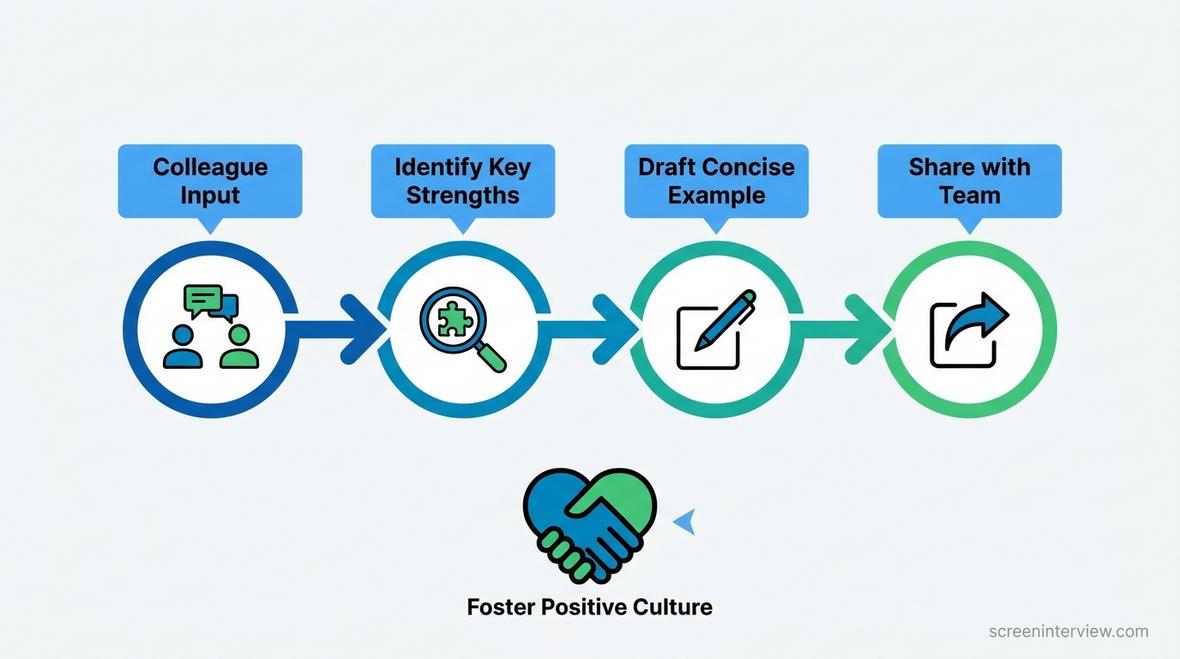
For recruiting professionals seeking to systematize the collection of high-quality colleague testimonials, establishing clear frameworks ensures consistency while maintaining authenticity.
The STAR Method for Structured Testimonials
Adapting the STAR (Situation, Task, Action, Result) framework from behavioral interviewing creates testimonials with narrative depth and measurable impact:
- Situation: Establish the context in which the colleague demonstrated excellence
- Task: Describe the specific challenge or responsibility they faced
- Action: Detail the approach, skills, or behaviors they employed
- Result: Quantify the outcome or impact of their contribution
Example 7: STAR-Based Testimonial
'During our Q4 product launch (Situation), our team faced a critical integration failure just 48 hours before release (Task). Priya immediately took ownership, coordinating with three different engineering teams across time zones to diagnose the root cause (Action). Her systematic debugging approach and clear communication kept everyone aligned, and she personally implemented the fix that allowed us to launch on schedule. This saved an estimated $200,000 in delayed revenue and preserved our market positioning (Result). Priya's performance under pressure exemplifies the problem-solving excellence we value.'
Key Elements of Compelling Testimonials
Effective colleague testimonials share several common characteristics that recruiting teams should emphasize when gathering endorsements:
- Specificity: Concrete examples outweigh generic praise
- Measurable Impact: Quantified results add credibility and context
- Authentic Voice: Natural language that reflects the speaker's genuine perspective
- Balanced Perspective: Acknowledging challenges overcome adds authenticity
- Future-Focused: Connection to ongoing growth and development
Example 8: Multi-Dimensional Endorsement
'Alex joined our data science team with strong technical credentials, but what wasn't immediately apparent was his ability to translate complex analytics into actionable business insights. I've collaborated with him on five major projects, and each time he's demonstrated the rare ability to balance statistical rigor with practical business application. For our customer segmentation initiative, his analysis identified three previously overlooked market segments that now represent 22% of our revenue. Beyond his analytical skills, Alex has become our team's unofficial mentor for junior analysts he's developed a structured onboarding program that has reduced new hire ramp-up time by 40%. His combination of technical expertise and leadership potential makes him invaluable to our organization.'
Implementing Testimonial Strategies in Your Recruitment Process
For modern recruiting professionals managing high-volume pipelines through AI interviewer platforms, strategic deployment of colleague testimonials enhances candidate experience without adding operational burden.
Integration Points Throughout the Candidate Journey
Testimonials deliver maximum impact when deployed at specific touchpoints in the recruitment funnel:
- Job Descriptions: Brief quotes highlighting team culture and collaboration style
- Career Site: Dedicated testimonial pages organized by department, role level, or theme
- Interview Confirmation Emails: Role-relevant peer endorsements that prepare candidates
- Post-Interview Follow-Up: Testimonials addressing common candidate questions or concerns
- Offer Stage: Leadership endorsements reinforcing growth opportunities and organizational vision
When utilizing interview insights platforms, recruiting teams can analyze which testimonial types correlate with higher offer acceptance rates, enabling continuous optimization of placement strategy.
Collecting Testimonials at Scale
Recruiting teams in fast-paced environments require efficient systems for gathering fresh testimonials that reflect current organizational reality. Implementing quarterly testimonial collection cycles ensures your content remains relevant and diverse.
Structured Collection Process:
- Identify high-performing employees across departments and tenure levels
- Provide clear prompts aligned with recruitment priorities (e.g., 'Describe a time when our collaborative culture led to better outcomes')
- Offer multiple submission formats (written, video, audio) to accommodate preferences
- Assign editorial support to refine submissions while preserving authentic voice
- Obtain proper consent and permissions for public use
- Tag testimonials by theme, department, and role level for easy retrieval
Organizations leveraging intelligent scheduling and automation can integrate testimonial collection into regular employee engagement workflows, reducing administrative friction.
Measuring the Impact of Colleague Testimonials
Data-driven recruiting professionals must demonstrate ROI for every initiative, including testimonial programs. Several metrics reveal the effectiveness of your peer endorsement strategy:
- Candidate Pipeline Conversion: Compare application-to-interview and interview-to-offer rates for campaigns featuring testimonials versus control groups
- Time-to-Fill Reduction: Measure whether testimonial-enriched job postings attract qualified candidates faster
- Offer Acceptance Rate: Track correlation between testimonial exposure and final acceptance decisions
- Quality of Hire: Analyze whether candidates exposed to testimonials demonstrate stronger performance in first-year reviews
- Candidate Satisfaction Scores: Survey candidates about which content elements most influenced their perception
Teams using comprehensive interview builder platforms can embed testimonial exposure tracking directly into their candidate management workflows, enabling sophisticated attribution analysis.
Avoiding Common Pitfalls in Colleague Testimonials
Even well-intentioned testimonial programs can undermine recruitment effectiveness if they fall into predictable traps:
Generic Praise Without Substance
Testimonials stating 'John is great to work with' or 'Sarah always meets deadlines' provide no differentiation or meaningful insight. Recruiting professionals should establish minimum standards requiring specific examples and measurable outcomes.
Lack of Diversity in Voices
Over-reliance on testimonials from senior leadership or a narrow demographic range sends unintentional signals about who succeeds in your organization. Actively curate endorsements representing various tenure levels, departments, backgrounds, and perspectives.
Outdated Content
Testimonials referencing former executives, discontinued products, or obsolete practices damage credibility. Implement regular review cycles to retire stale content and refresh with current examples.
Overly Polished Corporate Language
When testimonials sound like marketing copy rather than authentic peer endorsements, candidates recognize the disconnect immediately. Light editing for clarity is appropriate; complete rewriting destroys authenticity.
Advanced Testimonial Strategies for Competitive Advantage
Leading recruiting organizations are evolving beyond static text testimonials to create more engaging, multimedia experiences that resonate with diverse candidate preferences.
Video Testimonials
Short-form video endorsements (60-90 seconds) allow candidates to assess not just what colleagues say but how they say it conveying enthusiasm, organizational pride, and authentic connection through tone and body language. These work particularly well when embedded in video interview platforms where candidates are already engaging with multimedia content.
Role-Specific Testimonial Libraries
Rather than generic colleague endorsements, create curated collections addressing the specific concerns of different candidate personas. Software engineers care about technical stack and code quality; sales professionals prioritize quota attainability and compensation structure; managers evaluate team development resources.
For recruiting teams managing diverse role pipelines from data scientists to sales and marketing professionals this targeted approach significantly improves relevance and impact.
Testimonial Response Programs
Some innovative organizations invite candidates to submit questions about culture, growth, or daily work experiences, then match them with current employees who provide video or written responses. This personalized approach creates powerful connection while demonstrating organizational transparency and confidence.
Frequently Asked Questions
How long should colleague testimonials be?
Optimal length varies by format and placement. For job descriptions or email signatures, 50-75 words provide impactful highlights without overwhelming readers. For dedicated career site pages or video content, 150-250 words allow for complete STAR-method narratives with sufficient context and detail. The key is ensuring every word adds value concise specificity outweighs lengthy generalities.
Who should write colleague testimonials?
The most effective testimonials come from diverse organizational voices. Peer endorsements demonstrate collaboration and team culture. Manager testimonials highlight development opportunities and leadership quality. Cross-functional partners illustrate organizational integration. New employees offer fresh perspectives on onboarding and culture. Aim for representation across tenure levels, departments, demographics, and geographic locations to provide candidates with multifaceted organizational views.
How often should we update our testimonial library?
Leading organizations refresh testimonial content quarterly, ensuring examples remain current and reflect evolving organizational priorities. Implement annual comprehensive reviews to retire outdated content and identify gaps in representation. For high-growth companies or those undergoing significant transformation, monthly updates may be warranted to maintain alignment between testimonials and current reality.
Can colleague testimonials backfire in recruitment?
Yes, when testimonials create unrealistic expectations that don't match candidate experience post-hire, they accelerate turnover rather than improve retention. The solution is rigorous authenticity encourage testimonials that acknowledge challenges alongside successes, provide balanced perspectives, and accurately represent day-to-day reality. Candidates appreciate honesty about organizational imperfections far more than polished perfection that proves false.
How do we encourage employees to write testimonials for colleagues?
Most employees are willing to endorse colleagues but need structure and incentive. Integrate testimonial writing into performance review cycles, recognition programs, or team retrospectives. Provide templates and examples that reduce cognitive load. Recognize contributors publicly in internal communications. Most importantly, demonstrate how testimonials directly support hiring goals employees care about bringing in talented teammates who will share workload and elevate team performance.
Conclusion
Colleague testimonials represent one of the most powerful yet underutilized tools in modern recruitment strategy. For recruiting professionals managing high-volume pipelines and seeking to reduce time-to-hire while improving candidate quality, strategic deployment of peer endorsements delivers measurable competitive advantage. By implementing structured collection processes, maintaining authentic voices, and integrating testimonials throughout the candidate journey, organizations transform their employees into their most credible recruiters. When combined with modern AI-powered screening platforms, colleague testimonials create a recruitment experience that is both efficient and deeply human precisely the combination today's top talent seeks.
Ready to Transform Your Interview Process?
See how ScreenInterview can help you automate phone screens, reduce bias, and hire better candidates faster.