
Phone Interview Automation: Complete 2026 Guide To Streamlining Recruitment

Understanding Phone Interview Automation in Modern Recruitment
Phone interview automation represents a transformative shift in how organizations conduct initial candidate screenings. This technology leverages artificial intelligence and workflow automation to handle first-stage interviews without manual recruiter intervention, fundamentally changing the recruitment landscape. As hiring demands intensify and talent pools expand globally, recruiting professionals are increasingly turning to automated solutions to maintain efficiency while improving candidate experience.
Traditional phone screening consumes significant recruiter bandwidth scheduling calls, conducting repetitive conversations, taking notes, and evaluating responses. Phone interview automation addresses these pain points by deploying AI-powered interviewers that engage candidates through natural conversation, assess responses against predefined criteria, and deliver structured evaluation reports. According to Forrester AI adoption in screening, 62% of enterprises adopted AI for initial screening in 2025, with 45% market penetration in mid-sized firms, representing an 18% year-over-year increase.
The technology has evolved from rigid interactive voice response (IVR) systems to sophisticated conversational AI that understands context, follows up on candidate responses, and adapts questioning based on role requirements. For recruiting leaders managing high-volume hiring across multiple locations, telephone screening automation offers scalability that manual processes cannot match.
Core Components of Phone Interview Automation Systems
Effective phone interview automation platforms integrate several critical components that work together to create seamless screening experiences. Understanding these elements helps recruiting professionals evaluate solutions and implement them strategically within existing talent acquisition workflows.
Intelligent Scheduling and Coordination
The automation journey begins before the actual interview. Modern systems incorporate intelligent scheduling that eliminates the back-and-forth typically required to book phone screens. Candidates receive automated invitations with self-service scheduling options that respect time zones, availability windows, and interviewer capacity constraints. This foundational capability reduces time-to-interview by 40-60% in most implementations.
Integration with applicant tracking systems ensures candidate data flows seamlessly, triggering automated outreach at appropriate pipeline stages. The system manages reminder communications, rescheduling requests, and no-show follow-ups without manual intervention, freeing recruiters to focus on relationship-building with qualified candidates.
Conversational AI Interview Engine
The interview itself is conducted by advanced AI interviewer technology capable of natural language understanding and generation. These systems employ large language models trained on recruitment conversations to ask contextually appropriate questions, understand candidate responses with nuance, and provide follow-up probes when answers lack clarity or depth.
Unlike early automated systems that followed rigid scripts, contemporary phone interview automation adapts dynamically. If a candidate mentions specific experience relevant to the role, the AI can explore that area more deeply. This flexibility creates more engaging conversations while gathering comprehensive information for evaluation purposes.
Structured Evaluation Frameworks
Phone interview automation eliminates subjective bias by applying consistent evaluation criteria across all candidates. The system analyzes responses against competency frameworks, role-specific requirements, and organizational fit indicators. Scoring mechanisms can weigh different assessment dimensions according to role priorities, providing nuanced candidate profiles rather than simple pass/fail outcomes.
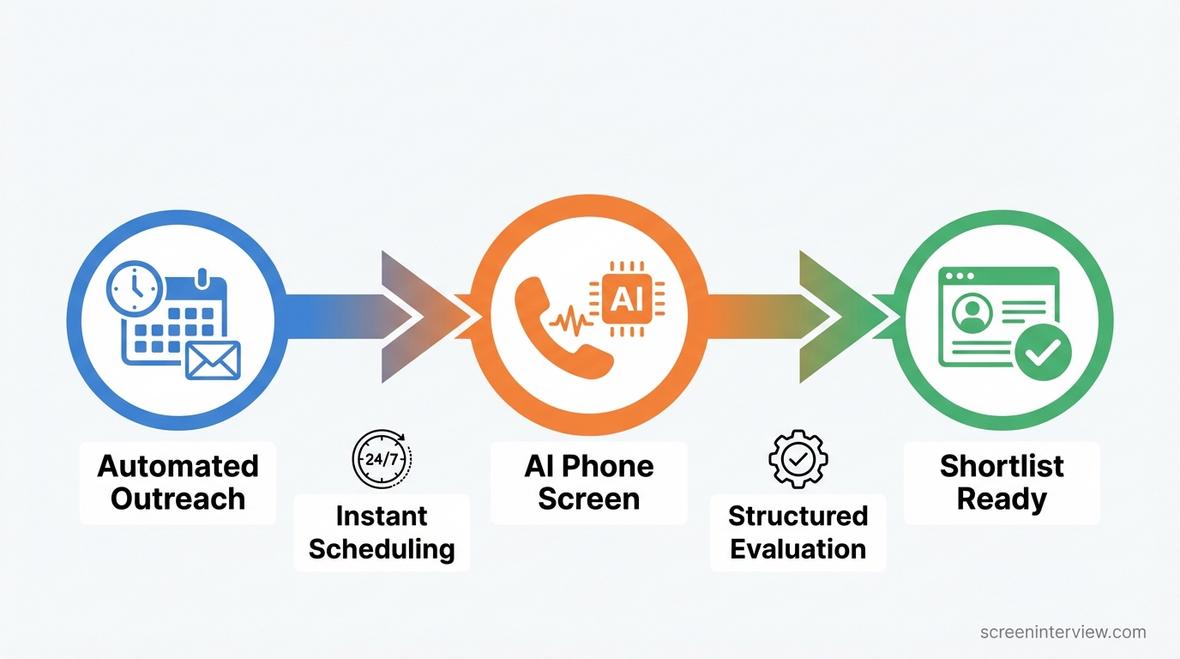
The structured evaluation process depicted in modern workflows demonstrates how automation creates consistency from initial outreach through final shortlist development. This systematic approach ensures every candidate receives identical evaluation rigor, addressing fairness concerns while improving decision quality.
Key Benefits for Recruiting Teams and Organizations
Organizations implementing phone interview automation report substantial improvements across multiple recruitment performance metrics. These benefits extend beyond simple efficiency gains to strategic advantages in talent competition.
Dramatic Time Savings and Scalability
Recruiters conducting manual phone screens typically spend 15-30 minutes per interview, plus additional time for scheduling and documentation. For high-volume roles receiving hundreds of applications, this investment becomes unsustainable. Phone interview automation handles unlimited concurrent interviews, screening dozens or hundreds of candidates simultaneously without capacity constraints.
This scalability proves particularly valuable during seasonal hiring surges, rapid expansion phases, or when filling multiple similar positions. Organizations can maintain consistent screening quality regardless of volume fluctuations, eliminating the compromises often made during high-pressure hiring periods.
Enhanced Candidate Experience
Contrary to concerns about 'robotic' interactions, well-designed phone interview automation often improves candidate experience. Immediate scheduling availability, flexible interview timing including evening and weekend options, and instant feedback create convenience that candidates appreciate. The consistency of questioning and evaluation also ensures every applicant receives equal consideration, addressing fairness perceptions.
Advanced systems incorporate natural conversation patterns, appropriate pacing, and even empathetic responses to candidate concerns. The experience feels professional and respectful while offering flexibility impossible with human-coordinated scheduling. For organizations prioritizing candidate experience and employer branding, automation can differentiate their recruitment process positively.
Bias Reduction and Fair Evaluation
Human interviewers, despite best intentions, bring unconscious biases that influence hiring decisions. Phone interview automation removes demographic signals like accent, age indicators, and other characteristics unrelated to job performance. The AI evaluates only response content against objective criteria, creating more equitable screening processes.
This capability addresses growing regulatory scrutiny around fair hiring practices while supporting organizational diversity goals. By focusing purely on competency demonstration and role fit, automated systems identify qualified candidates who might otherwise face screening bias. Organizations concerned with eliminating interviewing bias through AI technology find phone interview automation particularly valuable.
Data-Driven Insights and Continuous Optimization
Every automated interview generates structured data enabling analysis impossible with manual processes. Recruiting teams can identify which screening questions most effectively predict downstream success, compare candidate quality across sources, and optimize evaluation criteria based on actual hiring outcomes rather than intuition.
These insights support continuous improvement of screening effectiveness. Organizations can A/B test different question sets, refine competency frameworks based on performance correlations, and ensure their screening process evolves with changing role requirements and market conditions.
Implementation Best Practices for Phone Interview Automation
Successful deployment requires thoughtful planning beyond simply purchasing technology. Organizations achieving the best outcomes follow structured implementation approaches addressing both technical and human change management dimensions.
Define Clear Screening Objectives
Before implementing phone interview automation, recruiting teams should articulate precisely what they need initial screens to accomplish. Are you filtering for basic qualifications, assessing cultural fit, evaluating specific competencies, or some combination? Clear objectives inform question design, evaluation criteria configuration, and integration with subsequent hiring stages.
Different roles may require different screening approaches. Technical positions might emphasize problem-solving demonstrations, while customer-facing roles prioritize communication skills and service orientation. The interview builder functionality in advanced platforms enables customization for various role types while maintaining overall process consistency.
Design Conversational Interview Flows
Effective automated interviews balance structure with natural conversation. Rather than rapid-fire questions, well-designed flows incorporate context-setting, explanation of the process, and logical progression through topics. Candidates should understand why they're being asked particular questions and how the information will be used.
Include opportunities for candidates to ask questions or provide additional context. While the AI conducts the interview, the experience should feel collaborative rather than interrogative. Testing interview flows with internal stakeholders before candidate deployment helps identify awkward transitions or unclear questions.
Integrate with Existing Recruitment Technology
Phone interview automation delivers maximum value when integrated into broader recruitment workflows. Seamless data flow between your ATS, scheduling tools, and interview platform eliminates duplicate data entry and ensures candidate information remains current across systems.
Consider how automated interview results trigger next steps automatically advancing qualified candidates, sending rejection communications to those not meeting criteria, or flagging borderline cases for human review. The workflow automation capabilities determine how efficiently the overall process operates.
Train Recruiters on the New Workflow
Implementation success depends on recruiter adoption and effective use of automation outputs. Training should cover system operation, interpreting evaluation reports, making advancement decisions based on structured data, and handling candidate questions about the automated process.
Recruiters may initially resist automation, viewing it as replacement rather than augmentation. Framing the technology as eliminating repetitive work to free time for relationship-building and strategic activities helps overcome resistance. Demonstrating how automation improves hiring outcomes and reduces time-to-fill builds confidence in the new approach.
Technical Considerations and Platform Selection
Evaluating phone interview automation platforms requires assessing capabilities across multiple dimensions. Not all solutions offer equivalent functionality, and matching platform strengths to organizational needs determines implementation success.
Conversation Quality and Naturalness
The candidate experience depends heavily on how natural and engaging the AI interviewer sounds. Platforms vary significantly in voice quality, conversation pacing, ability to handle unexpected responses, and recovery from misunderstandings. Request demonstration interviews as a candidate to assess the actual experience your applicants will receive.
Advanced systems employ sophisticated natural language processing that understands context, manages interruptions gracefully, and maintains conversational coherence even when candidates provide unexpected answers. Lower-quality implementations may sound robotic or struggle when conversations deviate from anticipated patterns.
Customization and Flexibility
Your screening needs will differ from other organizations, and possibly across roles within your company. Evaluate how easily platforms allow question customization, evaluation criteria adjustment, and interview flow modification. Some systems offer extensive flexibility while others provide limited configuration options.
Consider whether you can create role-specific interview templates, adjust scoring weights for different competencies, and modify the process as your needs evolve. The ability to incorporate interview question generators for new role types accelerates deployment for positions you haven't previously automated.
Analytics and Reporting Capabilities
The data generated by automated interviews only creates value if you can access and analyze it effectively. Strong platforms provide comprehensive dashboards showing candidate performance distributions, question effectiveness metrics, and comparative analytics across roles, sources, or time periods.
Look for systems offering both summary reporting for quick decision-making and detailed transcripts for quality assurance or legal compliance purposes. Export capabilities enabling integration with business intelligence tools support more sophisticated analysis as your program matures.
Security and Compliance Features
Phone interview automation handles sensitive candidate data requiring appropriate security protections. Evaluate platforms for data encryption, access controls, audit logging, and compliance with relevant regulations including GDPR, CCPA, and industry-specific requirements.
For roles requiring identity verification or proctoring capabilities, ensure the platform supports these needs. Some organizations combine phone interview automation with interview proctoring for subsequent assessment stages, making integrated platform capabilities valuable.
Measuring ROI and Success Metrics
Quantifying phone interview automation impact demonstrates value to organizational leadership and guides ongoing optimization. Establish baseline metrics before implementation and track improvements across multiple dimensions.
Efficiency Metrics
Time-to-screen represents the most immediate efficiency gain measuring days from application to completed phone interview. Organizations typically see 50-70% reductions as automation eliminates scheduling delays and enables immediate interview availability. Recruiter hours saved per hire quantifies capacity returned to strategic activities, while cost-per-screen calculations demonstrate financial efficiency improvements.
Quality Metrics
Track advancement rates from phone screen to subsequent interview stages, comparing automated versus manual screening periods. Improved consistency often increases advancement rates for qualified candidates while reducing false positives. Monitor offer acceptance rates and early tenure retention to ensure automation doesn't negatively impact downstream hiring quality.
Candidate Satisfaction
Survey candidates about their experience with automated phone interviews. Questions should address scheduling convenience, interview clarity, process fairness perceptions, and overall satisfaction. High candidate satisfaction scores validate the approach while identifying improvement opportunities.
Future Trends in Phone Interview Automation
The technology continues evolving rapidly, with several emerging capabilities poised to further transform recruitment screening. Understanding these trends helps organizations plan future-ready implementations.
Multimodal assessment combining phone interviews with asynchronous video responses, work samples, or skills tests provides more comprehensive candidate evaluation while maintaining automation efficiency. Integration of predictive analytics identifying which candidate characteristics correlate with long-term success enables more sophisticated screening decisions.
Conversational AI continues improving in nuance and adaptability, with next-generation systems conducting increasingly sophisticated technical assessments and behavioral evaluations. For organizations hiring specialized roles like data scientists or DevOps engineers, automated technical screening becomes increasingly viable as AI capabilities expand.
Frequently Asked Questions About Phone Interview Automation
How do candidates typically react to automated phone interviews?
When implemented thoughtfully with clear communication about the process, candidate reactions are generally positive. Surveys show candidates appreciate the scheduling flexibility, immediate availability, and consistent evaluation. Transparency about using AI for initial screening and explaining how it supports fair evaluation addresses most concerns.
Can phone interview automation handle technical role screening?
Yes, advanced platforms can assess technical knowledge through targeted questions about methodologies, problem-solving approaches, and experience with specific technologies. While not replacing hands-on coding assessments, automated technical screens effectively filter candidates lacking fundamental qualifications before progressing to more resource-intensive evaluation stages.
What happens if a candidate has technical difficulties during an automated interview?
Quality platforms include fallback mechanisms such as alternative contact methods, rescheduling options, and human support escalation paths. Candidates experiencing issues can typically restart the interview or connect with support staff to resolve problems without being penalized in the evaluation process.
How does automation handle candidates with accents or speech variations?
Modern conversational AI is trained on diverse speech patterns and accents, enabling understanding across varied candidate populations. Unlike human interviewers who may struggle with unfamiliar accents, AI systems evaluate content rather than delivery style, often reducing accent-based bias in screening decisions.
Can we customize questions for different roles?
Yes, robust phone interview automation platforms allow extensive customization. Organizations can create role-specific question sets, adjust evaluation criteria weights, and design interview flows tailored to different position requirements while maintaining overall process consistency and fairness.
Conclusion
Phone interview automation has evolved from experimental technology to essential recruitment infrastructure for organizations competing for talent in 2026. By combining intelligent scheduling, conversational AI, and structured evaluation, these systems deliver efficiency gains, improved candidate experiences, and fairer hiring processes. Recruiting professionals implementing automation thoughtfully with clear objectives, proper integration, and ongoing optimization position their organizations to scale screening operations while maintaining quality. As AI capabilities continue advancing and adoption expands across market segments, phone interview automation will increasingly define competitive advantage in talent acquisition. Organizations beginning their automation journey today establish foundations for recruitment excellence that will compound benefits for years to come.
Ready to Transform Your Interview Process?
See how ScreenInterview can help you automate phone screens, reduce bias, and hire better candidates faster.