
How To Automate Interview Process: A Complete Guide To Streamlining Your Recruitment In 2026

In today's competitive talent landscape, hiring teams face mounting pressure to identify top candidates faster while maintaining quality standards. The manual interview process scheduling calls, conducting repetitive screenings, and coordinating feedback consumes valuable hours that recruiters could spend on strategic initiatives. Learning how to automate interview process workflows has become essential for organizations seeking to scale their hiring operations without compromising candidate experience.
Automation technology has evolved dramatically, offering sophisticated tools that handle everything from initial candidate assessments to final interview scheduling. This comprehensive guide explores proven strategies for implementing interview automation, the technologies driving this transformation, and practical steps to build an efficient, scalable recruitment system.
Understanding Interview Process Automation
Interview automation refers to the strategic use of technology to streamline repetitive tasks throughout the candidate evaluation journey. Rather than replacing human judgment, these systems augment recruiter capabilities by handling time-consuming administrative work and initial screening phases.
Modern workflow automation platforms integrate multiple recruitment functions into unified systems. These solutions coordinate candidate communications, manage assessment delivery, compile evaluation data, and provide actionable insights all while reducing manual intervention by up to 75%.
Why Automation Matters in 2026
The recruitment landscape has undergone fundamental shifts that make automation not just beneficial but necessary:
- Volume Challenges: Organizations receive 250+ applications per corporate position on average, making manual review impractical
- Time-to-Fill Pressure: Top candidates remain available for only 10 days, requiring accelerated screening processes
- Candidate Expectations: Modern applicants expect immediate acknowledgment and rapid progression through hiring stages
- Quality Requirements: Companies need standardized evaluation methods that reduce bias and improve hiring accuracy
- Remote Work Dynamics: Distributed teams require asynchronous interview methods that accommodate global time zones
These factors have made learning how to automate interview process activities a strategic priority for forward-thinking HR departments.
Key Components of an Automated Interview System
Effective interview automation requires integrating several specialized technologies that work together seamlessly. Understanding these components helps organizations build comprehensive solutions tailored to their specific hiring needs.
Intelligent Pre-Screening Questionnaires
Automated pre-screening forms the foundation of efficient candidate filtering. These systems deploy customized questionnaires that assess:
- Required technical competencies through skill-based questions
- Cultural alignment via behavioral and situational scenarios
- Availability, salary expectations, and work authorization status
- Personality traits and work style preferences
Advanced platforms like Screeninterview.com enable recruiters to configure role-specific screening criteria that automatically score responses and rank candidates based on fit.
On-Demand Video Interview Platforms
One of the most impactful innovations in interview automation is asynchronous video interviewing. On-demand interviews allow candidates to record responses to predetermined questions at their convenience, while hiring teams review submissions on their own schedules.
This approach delivers multiple advantages:
- Eliminates 90% of scheduling coordination efforts
- Provides standardized evaluation conditions for all candidates
- Enables side-by-side comparison of candidate responses
- Creates reusable interview content for panel review
- Accommodates global talent pools across time zones
AI-Powered Assessment and Scoring
Artificial intelligence has revolutionized how organizations evaluate candidate suitability. AI interview systems analyze multiple data points including:
- Verbal responses and content relevance
- Communication clarity and structure
- Technical accuracy in skill-based questions
- Behavioral indicators and soft skills demonstration
These AI interviewer solutions generate objective scoring that reduces unconscious bias and provides consistent evaluation standards across all candidates.
Automated Scheduling and Coordination
Calendar management represents one of the most time-consuming aspects of traditional interviewing. Intelligent scheduling systems eliminate this burden by:
- Syncing with interviewer calendars to identify availability
- Sending automated invitations with customizable messaging
- Managing confirmation, rescheduling requests, and reminders
- Coordinating multi-round interviews across multiple stakeholders
Interview Proctoring and Security Measures
Maintaining assessment integrity remains crucial, especially for remote evaluations. Interview proctoring technology employs multiple verification methods:
- Identity verification through photo ID matching
- Browser lockdown preventing tab switching or external resource access
- Environmental monitoring detecting unauthorized assistance
- Screen recording capturing the complete assessment session
Advanced AI proctor systems automatically flag suspicious behavior for human review, ensuring fair evaluation without requiring live monitoring.
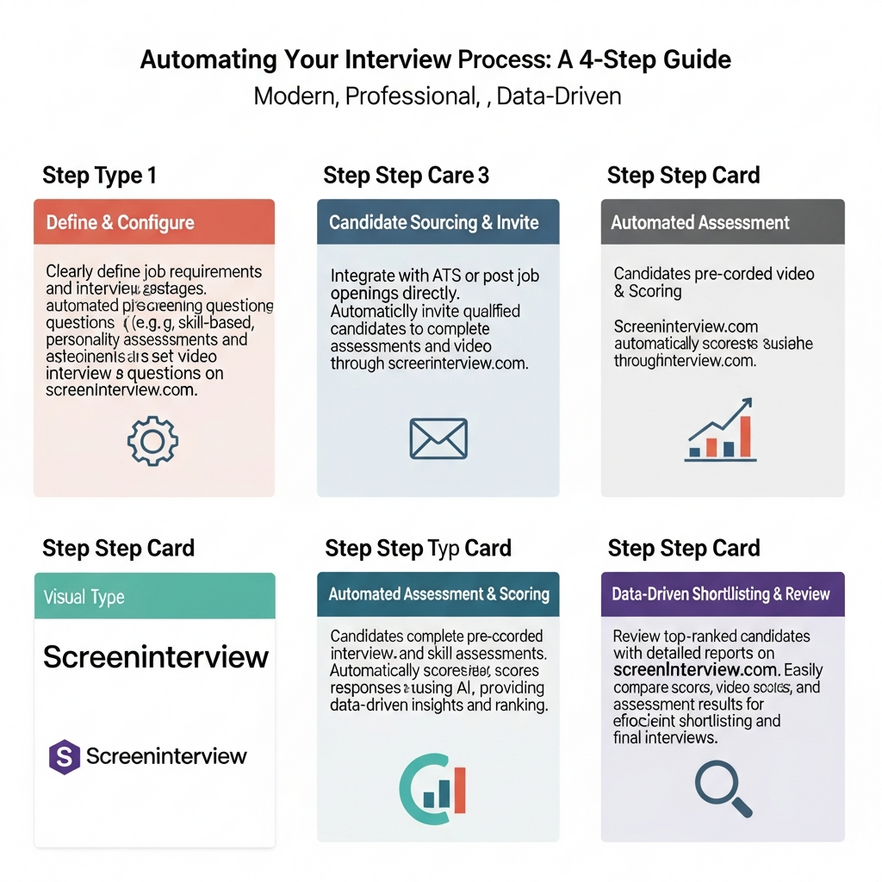
How to Automate Interview Process: Step-by-Step Implementation
Successfully implementing interview automation requires thoughtful planning and phased execution. Follow this comprehensive roadmap to transform your recruitment operations.
Step 1: Define and Configure Your Requirements
Begin by mapping your current interview process and identifying automation opportunities:
Audit Existing Workflows: Document each stage of your current process, noting time investments, pain points, and bottlenecks. Identify which activities consume the most resources and which offer the greatest automation potential.
Establish Evaluation Criteria: For each role category, define the essential competencies, skills, and attributes that predict success. Create weighted scoring rubrics that reflect your organization's priorities.
Design Question Banks: Develop comprehensive libraries of pre-screening questions, technical assessments, and behavioral interview prompts. Use an interview builder platform to organize these resources by role, seniority level, and department.
Configure Assessment Parameters: Determine appropriate time limits, question formats (multiple choice, video response, coding challenges), and passing thresholds for each evaluation stage.
Step 2: Integrate Candidate Sourcing and Automated Invitations
Connect your automation platform with candidate sources to create seamless entry points:
ATS Integration: Link your automated interview system with your applicant tracking system to automatically trigger assessments when candidates reach specific pipeline stages. This creates a continuous flow without manual intervention.
Career Site Integration: Embed assessment invitations directly into your application process, allowing candidates to complete initial screenings immediately after submitting applications.
Automated Communication: Configure personalized email templates that explain the assessment process, set expectations, and provide technical support information. Schedule follow-up reminders for candidates who haven't completed their assessments.
Multi-Channel Deployment: Enable telephone screening options for roles where voice communication is essential, providing candidates with multiple assessment formats.
Step 3: Deploy Automated Assessment and Scoring
This stage represents the core of interview automation, where technology handles the bulk of candidate evaluation:
Candidate Experience: Qualified applicants receive automated invitations containing assessment instructions, deadlines, and support resources. They complete pre-recorded video interviews, technical challenges, and personality assessments at their convenience using a secure browser environment.
AI-Driven Analysis: As candidates submit responses, artificial intelligence systems immediately begin analysis. For technical roles, platforms can evaluate software engineer AI interview responses, data scientist AI interview submissions, or product manager AI interview answers with role-specific criteria.
Objective Scoring: The system generates numerical scores across multiple dimensions technical proficiency, communication skills, cultural fit, and role-specific competencies. These scores aggregate into overall candidate rankings.
Insight Generation: Advanced interview insights platforms provide detailed analytics highlighting candidate strengths, development areas, and comparison metrics against your existing team or industry benchmarks.
Step 4: Implement Data-Driven Shortlisting and Review
The final automation stage empowers hiring teams with organized, actionable candidate information:
Automated Ranking: The system presents candidates in priority order based on composite scores and fit criteria. Recruiters immediately see which applicants meet or exceed requirements without manual sorting.
Comprehensive Candidate Profiles: For each shortlisted candidate, reviewers access consolidated dashboards containing video responses, assessment results, resume information, and AI-generated summaries. This record review capability enables rapid, informed decisions.
Collaborative Evaluation: Multiple stakeholders can review candidates asynchronously, leaving timestamped comments and ratings that aggregate into consensus scores. This distributed review process accelerates decision-making while maintaining quality.
Advancement Triggers: Configure automatic progression rules for example, candidates scoring above 85% automatically receive invitations to next-round interviews, while those below 60% receive polite rejection notices.
Advanced Automation Strategies for Specialized Hiring
Different roles and hiring contexts benefit from customized automation approaches that address specific requirements.
Technical Role Automation
For engineering and technical positions, integrate coding assessments and domain-specific evaluations:
- Deploy live coding environments where candidates solve real-world problems
- Use automated code analysis to evaluate solution efficiency, style, and correctness
- Implement role-specific interview templates for frontend developer AI interview, backend developer AI interview, or DevOps engineer AI interview assessments
- Configure technology-specific evaluations for Python, JavaScript, React, or other frameworks
High-Volume Recruitment Automation
Organizations hiring for multiple similar positions simultaneously require scalable solutions:
- Create standardized assessment batteries deployable across hundreds of candidates
- Implement automatic batching that groups candidates by assessment completion date
- Use online exam platform capabilities to conduct mass screening events
- Configure multi-tier filtering that progressively narrows candidate pools
Specialized Position Automation
Niche roles benefit from highly customized automation configurations:
- Design custom assessments for emerging fields like blockchain development, AR/VR development, or robotics engineering
- Create evaluation frameworks for non-technical positions including UX designer, sales and marketing, or leadership roles
- Implement portfolio review workflows for creative positions
Measuring Interview Automation Success
Track key performance indicators to validate your automation investment and identify optimization opportunities:
| Metric | Benchmark | Improvement Target |
|---|---|---|
| Time-to-Screen | 5-7 days (manual) | 24-48 hours (automated) |
| Recruiter Hours per Hire | 15-20 hours | 4-6 hours |
| Candidate Completion Rate | 45-60% | 70-85% |
| Interview-to-Offer Ratio | 4:1 | 2:1 |
| Quality of Hire Score | Baseline | 15-25% improvement |
Regular analysis of these metrics reveals automation effectiveness and guides continuous refinement of your processes.
Overcoming Common Automation Challenges
While interview automation delivers substantial benefits, implementation may encounter obstacles that require thoughtful solutions.
Addressing Candidate Concerns
Some applicants feel apprehensive about AI-driven evaluation. Mitigate these concerns by:
- Transparently communicating how automation enhances fairness and reduces bias
- Providing clear instructions and technical support throughout the process
- Offering practice questions to familiarize candidates with the format
- Maintaining human touchpoints at critical decision stages
- Sharing how automation enables faster feedback and progression
Managing Technical Integration
Connecting multiple HR systems requires careful planning:
- Select platforms with robust API capabilities and pre-built integrations
- Work with vendors offering implementation support and training
- Phase rollout across departments to manage complexity
- Establish clear data governance protocols ensuring GDPR and privacy compliance
Maintaining Assessment Quality
Automated systems require ongoing refinement:
- Regularly review question effectiveness and update content
- Analyze scoring accuracy by comparing automation predictions with actual hire performance
- Gather candidate feedback to identify experience improvements
- Conduct periodic audits ensuring evaluations remain bias-free and legally compliant
Future Trends in Interview Automation
The evolution of interview automation continues accelerating, with several emerging capabilities poised to further transform recruitment:
Conversational AI Interviews: Next-generation systems will conduct dynamic, multi-turn conversations that adapt questioning based on candidate responses, creating more natural assessment experiences.
Predictive Analytics: Advanced platforms will leverage historical hiring data to predict candidate success probability, attrition risk, and cultural fit with increasing accuracy.
Immersive Assessments: Virtual reality scenarios will enable candidates to demonstrate skills in simulated work environments, providing richer evaluation data than traditional interviews.
Continuous Learning Systems: AI models will automatically refine evaluation criteria based on new hire performance data, creating self-improving assessment accuracy.
Getting Started with Interview Automation
Organizations ready to implement automation should follow this practical roadmap:
Start Small: Begin with a single role category or department rather than enterprise-wide deployment. This allows you to refine processes before scaling.
Select the Right Platform: Evaluate solutions based on your specific needs. Platforms like Screeninterview.com offer comprehensive automation capabilities with flexible configuration options suitable for organizations of all sizes.
Train Your Team: Ensure recruiters and hiring managers understand how to interpret automated insights and integrate them into decision-making processes.
Communicate Transparently: Inform candidates about your automation approach, emphasizing how it creates fairer, faster evaluation while maintaining human judgment in final decisions.
Monitor and Optimize: Establish regular review cycles to assess automation performance, gather stakeholder feedback, and implement continuous improvements.
Conclusion: Transforming Recruitment Through Automation
Understanding how to automate interview process workflows represents a competitive advantage in the modern talent marketplace. Organizations that successfully implement automation achieve dramatic efficiency gains reducing time-to-hire by 50-70% while improving candidate quality through standardized, bias-reduced evaluation.
The technology has matured beyond simple resume screening to encompass sophisticated AI-driven assessment, intelligent scheduling, secure proctoring, and comprehensive analytics. These capabilities enable recruitment teams to focus their expertise on relationship building, candidate experience enhancement, and strategic talent planning rather than administrative coordination.
As automation continues evolving, early adopters position themselves to attract top talent more effectively, build stronger teams, and scale hiring operations without proportional resource increases. The question is no longer whether to automate, but how quickly your organization can implement these transformative capabilities.
Frequently Asked Questions
How much does interview automation cost?
Interview automation platforms typically offer tiered pricing based on hiring volume, ranging from $200-500 monthly for small teams to enterprise agreements for large organizations. Most providers offer per-assessment pricing as well, typically $10-30 per candidate. The investment typically delivers 300-500% ROI through reduced recruiter time and improved hiring quality.
Does automation negatively impact candidate experience?
When implemented thoughtfully, automation actually improves candidate experience by providing faster responses, flexible scheduling, and transparent processes. Studies show 78% of candidates prefer on-demand video interviews to scheduling multiple phone screens. The key is maintaining human touchpoints at decision stages and providing clear communication throughout.
Can automated interviews reduce hiring bias?
Yes, properly configured automation significantly reduces unconscious bias by applying consistent evaluation criteria to all candidates, removing identifying information during initial screening, and focusing assessment on job-relevant competencies rather than subjective impressions. However, organizations must regularly audit AI models to ensure they don't perpetuate historical biases present in training data.
How much time does interview automation save?
Organizations typically report 60-75% reduction in time spent on initial screening and coordination activities. For high-volume hiring, automation can reduce recruiter hours per hire from 20+ hours to 5-7 hours, allowing teams to process 3-4x more candidates with existing resources.
What technical skills are needed to implement automation?
Most modern interview automation platforms require minimal technical expertise. Implementation typically involves configuration through intuitive interfaces rather than coding. However, having team members familiar with your ATS and basic API concepts facilitates integration. Most vendors provide implementation support and training as part of their service.
What types of roles work best with automated interviews?
Interview automation delivers value across virtually all role types, though implementation approaches vary. Technical positions benefit from coding assessments and skills testing. Sales and customer-facing roles leverage video interview capabilities to evaluate communication skills. Even executive positions use automation for initial screening and scheduling, with human judgment emphasized in later stages.
Ready to Transform Your Interview Process?
See how ScreenInterview can help you automate phone screens, reduce bias, and hire better candidates faster.