
Hiring A Marketing Team: Complete Guide To Building High-Performance Teams In 2026

Introduction
Hiring a marketing team has evolved into a strategic challenge that demands both precision and speed. Modern recruiting professionals face the dual pressure of filling marketing roles in a competitive talent landscape while maintaining quality standards that directly impact business growth. The BLS labor market data for marketing managers projects 10% growth in marketing manager jobs from 2022-2032, with 36,400 annual openings annually a clear indicator of heightened competition for top talent.
For Heads of Talent and Recruiting Leads, the process of building a marketing team involves more than posting job descriptions and reviewing resumes. It requires a structured approach that balances strategic workforce planning with efficient candidate screening, all while ensuring a positive candidate experience. This comprehensive guide walks you through each phase of hiring a marketing team, from defining roles to leveraging AI-powered screening tools that reduce time-to-hire and eliminate bias.
Understanding Marketing Team Structure and Roles
Before initiating the hiring process, recruiting professionals must collaborate with hiring managers to map out the marketing team structure. A well-designed marketing team typically includes specialized roles that cover digital strategy, content creation, analytics, and brand management.
Core Marketing Roles to Fill
The foundation of any marketing team begins with clearly defined positions. Marketing Manager roles command median wages of $138,730 according to BLS occupational projections for marketing occupations, reflecting the strategic importance of these positions. When hiring a marketing team, consider these primary roles:
- Marketing Manager or Director: Strategic leadership role responsible for campaign oversight, budget management, and team coordination
- Content Marketing Specialist: Focuses on content strategy, blog management, and thought leadership initiatives
- Digital Marketing Specialist: Manages paid advertising, SEO/SEM, and performance marketing channels
- Social Media Manager: Oversees brand presence across social platforms and community engagement
- Marketing Analyst: Provides data-driven insights, tracks KPIs, and optimizes campaign performance
- Brand Manager: Maintains brand consistency and manages positioning strategies
Each role requires distinct skill sets and experience levels. Recruiting professionals should work closely with marketing leadership to create detailed job descriptions that reflect both technical competencies and cultural fit requirements.
Determining Team Size and Composition
Team size varies based on company stage, budget, and business objectives. Startups might begin with a lean team of 2-3 generalists, while enterprise organizations often deploy specialized teams of 15+ members across multiple functions. When hiring a marketing team, consider budget constraints, project scope, and growth trajectory to determine optimal team composition.
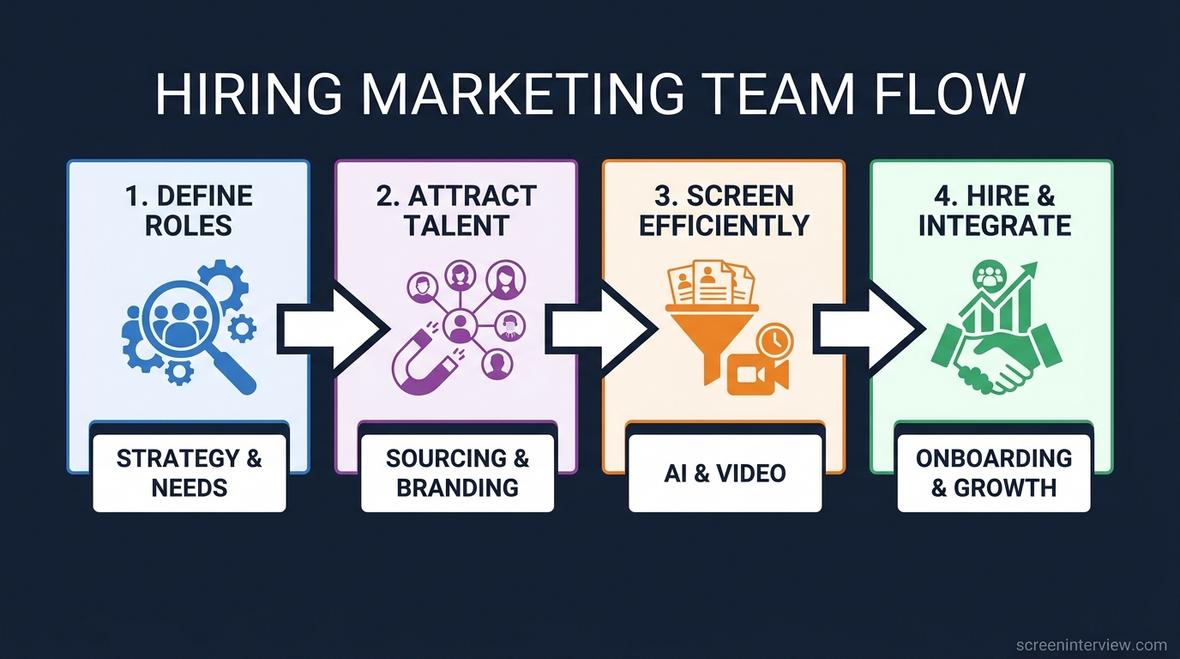
Strategic Workforce Planning for Marketing Roles
Effective workforce planning begins months before posting job requisitions. Recruiting professionals must assess current team capabilities, identify skill gaps, and forecast future hiring needs based on business objectives.
Conducting Skills Gap Analysis
A thorough skills assessment reveals which competencies exist within the current team and which require external hiring. For marketing teams, critical gaps often emerge in emerging areas like marketing automation, AI-driven analytics, and performance optimization. Document existing skills, map them against strategic goals, and prioritize roles that address the most critical gaps.
Forecasting Hiring Needs
The BLS 2022-32 employment projections overview projects faster-than-average growth for marketing specialists at 6%, with emphasis on digital skills. This data should inform your hiring roadmap. Align marketing hiring plans with product launches, seasonal campaigns, and expansion initiatives to ensure adequate staffing during critical periods.
Attracting Top Marketing Talent
With 319,200 total marketing jobs competing for talent, sourcing strategies must be proactive and multi-channeled. Recruiting professionals can no longer rely solely on job boards creative sourcing techniques separate successful hiring outcomes from prolonged vacancies.
Building Compelling Employer Brand
Marketing professionals are drawn to organizations with strong brand identities and clear missions. Showcase your company culture through authentic employee testimonials, behind-the-scenes content, and transparent communication about growth opportunities. Your careers page should reflect the same creative excellence you expect from marketing hires.
Diversifying Sourcing Channels
Deploy a multi-channel sourcing strategy that includes:
- LinkedIn Recruiter: Target passive candidates with specific marketing specializations
- Industry communities: Engage in marketing Slack groups, Reddit communities, and professional associations
- Portfolio platforms: Source content creators from Medium, Behance, and industry-specific showcases
- Employee referrals: Leverage your existing team's networks with structured referral incentives
- University partnerships: Build relationships with marketing programs for entry-level pipeline development
Consider using an AI-powered Boolean string generator to refine search queries and identify candidates with precise skill combinations.
Efficient Screening for Marketing Candidates
High-volume marketing recruitment demands efficient screening processes that identify qualified candidates quickly without sacrificing evaluation quality. Traditional resume reviews consume excessive recruiter time and introduce unconscious bias challenges that AI-powered screening solutions directly address.
Implementing Structured Screening
Research from the Forrester state of hiring report 2023 reveals AI-assisted screening cuts manual review time by 70%, with marketing hires showing 25% higher candidate satisfaction scores compared to traditional methods. Structured screening ensures consistent evaluation across all applicants while dramatically reducing time-to-hire.
Modern recruiting teams leverage AI interview technology to automate initial screening phases. These platforms conduct standardized video or phone screenings that assess both technical competencies and soft skills like communication ability critical for marketing roles.
Marketing-Specific Assessments
When hiring a marketing team, technical assessments should reflect real-world scenarios. Consider implementing:
- Campaign strategy exercises: Present a business challenge and request a brief marketing approach
- Content samples: Request writing samples or portfolio submissions relevant to the role
- Analytics interpretation: Provide sample data and ask candidates to extract actionable insights
- Tool proficiency: Assess familiarity with marketing automation platforms, CRM systems, and analytics tools
The sales and marketing AI interview platform enables customized assessment creation that evaluates role-specific competencies while maintaining standardized scoring.
Eliminating Unconscious Bias
Marketing roles often suffer from appearance and affinity bias during traditional interviews. AI interviewer technology provides objective evaluation by focusing on candidate responses rather than demographic characteristics. This approach ensures fair assessment and expands your talent pool by removing barriers that traditionally disadvantage qualified candidates.
Optimizing the Interview Process
Once candidates pass initial screening, structured interview processes maintain momentum while providing comprehensive evaluation. For marketing roles, interviews should assess strategic thinking, creativity, collaboration skills, and cultural alignment.
Multi-Stage Interview Framework
Design a streamlined interview process with clear progression:
- Initial screening: 15-20 minute automated phone screening to verify basic qualifications and interest level
- Skills assessment: Role-specific exercises completed asynchronously to respect candidate time
- Hiring manager interview: 45-minute discussion focused on experience, approach, and strategic thinking
- Team interview: 30-minute session with future colleagues to assess collaboration fit
- Final interview: Leadership conversation covering vision alignment and growth opportunities
This structure balances thorough evaluation with candidate experience, preventing interview fatigue while gathering comprehensive assessment data.
Behavioral and Competency Questions
Effective marketing interview questions reveal past performance and problem-solving approaches. The interview question generator helps create role-specific questions that uncover critical competencies. Focus on scenarios involving:
- Campaign performance recovery after initial underperformance
- Cross-functional collaboration with sales, product, or executive teams
- Resource allocation decisions under budget constraints
- Data-driven decision making and metric prioritization
- Creative problem solving when traditional approaches fail
Leveraging Technology in Marketing Recruitment
Technology adoption separates high-performing recruiting teams from those struggling with manual processes. For hiring a marketing team at scale, AI-powered recruitment platforms provide the automation and insights necessary to maintain quality while accelerating timelines.
AI-Powered Screening Platforms
Modern AI interview platforms transform the screening experience for both recruiters and candidates. These solutions conduct initial interviews through conversational AI, evaluate responses against predefined criteria, and surface top candidates automatically. The result: recruiters focus their time on relationship-building and final-stage evaluation rather than administrative screening tasks.
Asynchronous Video Interviews
For geographically distributed candidate pools, on-demand video interviews provide flexibility while maintaining evaluation rigor. Candidates record responses to standardized questions on their schedule, and hiring teams review submissions collaboratively. This approach respects candidate time while enabling side-by-side comparison across applicants.
End-to-End Workflow Automation
Recruiting workflow automation eliminates repetitive tasks and ensures consistent candidate communication. Automated workflows handle interview scheduling, reminder emails, feedback collection, and status updates freeing recruiters to focus on strategic activities that require human judgment.
Creating Exceptional Candidate Experience
Marketing professionals evaluate your recruitment process as a reflection of organizational excellence. A clunky, slow, or impersonal hiring experience drives top talent toward competitors, while a thoughtful process enhances employer brand and increases offer acceptance rates.
Clear Communication Protocols
Establish response time standards and stick to them. Acknowledge applications within 24 hours, provide screening decisions within one week, and maintain regular updates throughout the process. Transparency about timeline and next steps reduces candidate anxiety and demonstrates respect for their time investment.
Mobile-Optimized Application Process
Marketing professionals often research opportunities during commutes or between meetings. Ensure your application process functions seamlessly on mobile devices, with minimal form fields and the ability to apply via LinkedIn or uploaded resumes rather than manual data entry.
Onboarding and Integration
The hiring process doesn't end with signed offer letters. Effective onboarding accelerates time-to-productivity and reduces early-stage attrition critical considerations when building a cohesive marketing team.
Structured Onboarding Programs
Design comprehensive onboarding that covers company context, marketing strategy, tool access, and relationship building. Assign onboarding buddies, schedule stakeholder introductions, and provide clear 30-60-90 day expectations. Early wins build confidence and demonstrate the new hire's value to the broader organization.
Continuous Feedback Loops
Regular check-ins during the first 90 days identify challenges early and demonstrate investment in new hire success. Gather feedback about the recruitment and onboarding experience to continuously refine your processes for future hires.
Measuring Recruitment Success
Data-driven recruiting teams track metrics that reveal process efficiency and quality outcomes. When hiring a marketing team, monitor these key performance indicators:
- Time-to-hire: Days from requisition opening to offer acceptance
- Quality of hire: New hire performance ratings at 6 and 12 months
- Candidate satisfaction: Survey scores measuring application and interview experience
- Offer acceptance rate: Percentage of offers accepted versus declined
- Source effectiveness: Which channels produce the highest quality candidates
- First-year retention: Percentage of marketing hires remaining after 12 months
These metrics inform continuous improvement efforts and justify investment in recruitment technology and process optimization.
Common Challenges in Marketing Team Hiring
Even well-designed hiring processes encounter obstacles. Awareness of common challenges enables proactive mitigation strategies.
Intense Competition for Specialized Skills
Digital marketing specialists, marketing automation experts, and growth marketers receive multiple opportunities simultaneously. Differentiate your opportunity through clear growth paths, compelling projects, and competitive compensation packages informed by current market data.
Difficulty Verifying Technical Skills
Marketing encompasses diverse technical competencies that recruiting professionals may struggle to evaluate. Partner closely with hiring managers to develop practical assessments, and consider technical panel interviews where team members probe specific skill areas.
Cultural Fit versus Skills Trade-offs
Candidates may excel technically but raise questions about cultural alignment, or vice versa. Establish clear prioritization frameworks with hiring managers before beginning searches to ensure consistent decision-making when trade-offs emerge.
Future Trends in Marketing Recruitment
The recruitment landscape continues evolving rapidly. Forward-thinking recruiting teams monitor emerging trends and adapt processes accordingly.
Continued AI Advancement
AI recruitment technology will become increasingly sophisticated, handling more complex evaluation tasks while providing deeper insights into candidate potential. Organizations that adopt these tools early gain competitive advantages in identifying and securing top talent.
Skills-Based Hiring
Traditional degree requirements are giving way to skills-based evaluation. Marketing roles increasingly prioritize demonstrated capabilities over educational credentials, expanding talent pools and improving diversity outcomes.
Remote-First Talent Pools
Geographic constraints continue diminishing as remote work normalizes. Marketing team hiring now draws from global talent pools, requiring recruiting professionals to develop remote-specific assessment and onboarding capabilities.
Conclusion
Hiring a marketing team in today's competitive landscape requires strategic planning, efficient processes, and smart technology adoption. Recruiting professionals who implement structured approaches from workforce planning through onboarding build high-performing teams that drive business growth. AI-powered screening platforms reduce time-to-hire by 70% while improving candidate satisfaction and eliminating bias. By focusing on employer branding, multi-channel sourcing, and exceptional candidate experience, you position your organization as an employer of choice for top marketing talent. The investment in optimized hiring processes pays dividends through improved quality of hire, faster time-to-productivity, and stronger team performance that directly impacts revenue outcomes.
Ready to Transform Your Interview Process?
See how ScreenInterview can help you automate phone screens, reduce bias, and hire better candidates faster.