
Brand Manager Interview Questions: Complete 2026 Guide For Recruiting Excellence

Understanding the Brand Manager Role in Modern Recruitment
The brand manager position has evolved significantly, requiring professionals who can seamlessly blend strategic thinking, creative execution, data analytics, and cross-functional leadership. For recruiting professionals seeking to identify top-tier brand management talent, understanding the multifaceted nature of this role is essential. Brand managers today are responsible for developing comprehensive brand strategies, analyzing market trends, executing creative campaigns, and leading diverse teams all while maintaining a consistent brand vision across multiple touchpoints.
Modern brand manager interview questions must assess candidates across these critical dimensions to ensure you're hiring professionals who can navigate the complex landscape of contemporary brand management. According to Forrester on AI improving interviewer consistency, AI-powered assessments boost interviewer calibration scores by 25% through standardized evaluations, making it crucial for recruiting leaders to design comprehensive question frameworks that leverage both human insight and technological precision.
This guide provides recruiting professionals with an exhaustive framework for evaluating brand manager candidates efficiently and effectively, helping reduce time-to-hire while maintaining rigorous quality standards. Whether you're a Head of Talent, Recruiting Lead, or People Operations Manager, these brand manager interview questions will help you identify candidates who possess the strategic acumen, creative vision, and analytical capabilities necessary for success in 2026 and beyond.
Five Core Competency Areas for Brand Manager Assessment
Before diving into specific questions, it's essential to understand the five core competency areas that define exceptional brand management talent. These dimensions should form the foundation of your screening process and guide your interview structure.
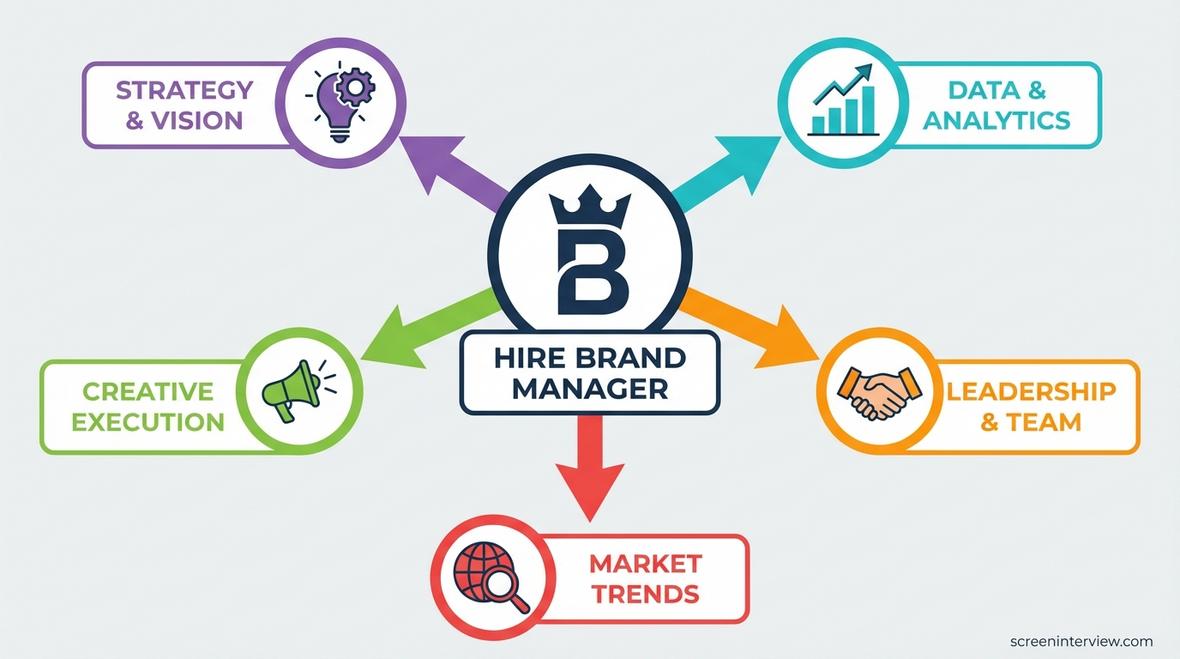
Strategy & Vision Development
Brand managers must demonstrate the ability to develop long-term brand strategies that align with organizational objectives. This requires understanding market positioning, competitive dynamics, and consumer behavior trends. Effective brand manager interview questions in this area should probe candidates' strategic thinking capabilities, their approach to market analysis, and their ability to translate insights into actionable brand roadmaps.
Data & Analytics Proficiency
Modern brand management is increasingly data-driven. Candidates must be comfortable working with consumer insights, market research, digital analytics, and performance metrics. The best brand managers can translate complex data sets into clear strategic recommendations and measure campaign effectiveness through quantitative and qualitative metrics.
Creative Execution Excellence
While strategy provides direction, creative execution brings brands to life. Brand managers must collaborate effectively with creative teams, develop compelling brand narratives, and ensure consistent brand expression across all customer touchpoints. Questions should assess candidates' understanding of creative processes, their ability to provide constructive feedback, and their track record of launching successful campaigns.
Leadership & Team Collaboration
Brand managers operate at the intersection of multiple functions marketing, sales, product development, and customer service. They must demonstrate strong leadership skills, effective stakeholder management, and the ability to build consensus across diverse teams. Your leadership assessment questions should evaluate interpersonal skills and team-building capabilities.
Market Trends & Consumer Insights
Exceptional brand managers maintain constant awareness of evolving market conditions, emerging consumer preferences, and competitive movements. They should demonstrate curiosity, adaptability, and the ability to pivot strategies based on changing market dynamics.
Strategic Thinking: Brand Manager Interview Questions
These brand manager interview questions assess candidates' ability to develop comprehensive brand strategies and think critically about market positioning.
Brand Positioning Questions
- How would you approach repositioning an established brand that's losing market share to emerging competitors? This question evaluates strategic thinking, competitive analysis skills, and change management capabilities. Strong candidates will outline a structured approach including market research, consumer insights, competitive benchmarking, and phased implementation strategies.
- Describe your process for developing a brand strategy for a new product launch in a crowded category. Look for candidates who demonstrate systematic thinking, starting with market analysis, identifying white space opportunities, defining unique value propositions, and creating differentiated positioning frameworks.
- How do you balance short-term sales objectives with long-term brand building? This question reveals candidates' understanding of the tension between immediate performance metrics and sustained brand equity development. Exceptional candidates will articulate frameworks for managing both priorities simultaneously.
Vision & Innovation Questions
- Tell me about a time when you identified an emerging consumer trend and successfully incorporated it into your brand strategy. This behavioral question assesses market awareness, innovation capabilities, and execution skills. Listen for specific examples demonstrating trend identification, strategic integration, and measurable business impact.
- How would you define and measure brand health for a consumer packaged goods company? Strong candidates will discuss multiple metrics including awareness, consideration, preference, loyalty, and advocacy, along with both quantitative and qualitative measurement methodologies.
Data-Driven Decision Making: Analytical Interview Questions
As brand management becomes increasingly analytical, your brand manager interview questions must assess candidates' comfort with data and metrics-driven decision making.
Performance Metrics Questions
- What key performance indicators do you track to measure brand campaign effectiveness? Look for candidates who mention a balanced mix of awareness metrics (reach, impressions, brand recall), engagement metrics (click-through rates, social interactions, content consumption), and conversion metrics (trial rates, purchase intent, actual sales).
- Describe a situation where data insights led you to pivot a brand campaign mid-flight. This question evaluates analytical agility and the ability to make data-informed decisions under pressure. Strong responses will detail the data signals observed, the decision-making process, stakeholder management, and ultimate outcomes.
- How do you approach attribution modeling for multi-channel brand campaigns? This technical question separates sophisticated analytical thinkers from those with surface-level metrics knowledge. Exceptional candidates will discuss various attribution models, their respective strengths and limitations, and how they've applied them in practice.
Consumer Research Questions
- Walk me through your approach to conducting brand research for a major strategic initiative. Candidates should demonstrate familiarity with various research methodologies including quantitative surveys, qualitative focus groups, ethnographic studies, and digital behavioral analysis.
- How do you incorporate consumer feedback into ongoing brand development? This question assesses candidates' customer-centric mindset and their processes for gathering, analyzing, and acting on consumer insights systematically.
Creative & Execution: Brand Manager Interview Questions
Brand managers must bridge the gap between strategic planning and creative execution. These questions evaluate that critical capability.
Campaign Development Questions
- Describe your most successful brand campaign. What made it effective? This open-ended question allows candidates to showcase their best work while revealing what they value in brand communications. Listen for discussion of strategic objectives, creative approach, execution excellence, and measurable results.
- How do you brief creative teams to ensure they deliver on-brand, on-strategy work? Strong candidates will outline structured briefing processes including clear objective setting, audience definition, key message articulation, and inspiring creative teams while providing appropriate guardrails.
- Tell me about a time when you had to reject creative work and provide constructive feedback. This question assesses judgment, communication skills, and the ability to maintain productive relationships with creative partners even during difficult conversations.
Brand Consistency Questions
- How do you ensure brand consistency across multiple channels and customer touchpoints? Look for candidates who discuss brand guidelines, governance frameworks, cross-functional alignment processes, and systematic review mechanisms.
- Describe your approach to adapting global brand campaigns for local markets. This question evaluates cultural sensitivity, flexibility within frameworks, and the ability to balance global brand consistency with local market relevance.
Leadership & Stakeholder Management Questions
Brand managers must influence without direct authority and build alignment across diverse stakeholder groups. These brand manager interview questions assess interpersonal and leadership capabilities.
Cross-Functional Influence Questions
- Describe a situation where you had to gain buy-in from skeptical stakeholders for a brand initiative. This behavioral question evaluates persuasion skills, stakeholder management, and resilience. Strong candidates will describe their approach to understanding objections, building compelling business cases, and creating coalition support.
- How do you manage competing priorities from different internal stakeholders? Look for candidates who demonstrate diplomatic skills, clear prioritization frameworks, and the ability to align diverse interests around shared brand objectives.
- Tell me about a time when you led a cross-functional team through a challenging brand project. This question assesses project management capabilities, team leadership, and the ability to navigate organizational complexity while maintaining team morale and productivity.
Team Development Questions
- How do you develop and mentor junior team members? Exceptional brand managers invest in talent development. Listen for specific examples of coaching, providing growth opportunities, and building team capabilities over time.
- How do you stay informed about competitive brand movements and market trends? Strong candidates will describe systematic approaches to competitive monitoring including formal research, social listening, retail monitoring, and industry network cultivation.
- Tell me about a time when a competitor's action required you to adjust your brand strategy. This question evaluates strategic agility, competitive awareness, and decision-making under pressure.
- How are you incorporating emerging technologies or platforms into brand strategies? In 2026, brand managers must demonstrate awareness of AI, augmented reality, voice interfaces, and other emerging channels. Listen for examples of experimental approaches balanced with measured risk-taking.
- Describe your approach to evaluating new marketing channels or tactics. Exceptional candidates will outline frameworks for pilot testing, establishing success metrics, scaling successful initiatives, and knowing when to discontinue unsuccessful experiments.
- Tell me about the most significant brand challenge you've faced and how you addressed it. This comprehensive question allows candidates to demonstrate problem-solving capabilities, strategic thinking, stakeholder management, and results orientation in a single response.
- Describe a brand campaign that didn't perform as expected. What did you learn? This question assesses self-awareness, accountability, analytical capabilities, and growth mindset. Strong candidates will take ownership, analyze what went wrong objectively, and articulate specific learnings applied to subsequent initiatives.
- Give me an example of an innovative brand initiative you championed that others were skeptical about. This question evaluates risk-taking, conviction, persuasion skills, and ultimately judgment about when to push boundaries.
- Describe a time when you successfully integrated customer feedback to improve a brand experience. Look for candidates who demonstrate customer-centricity, systematic feedback collection processes, cross-functional collaboration to implement changes, and measurement of impact.
- How do you approach social media strategy as part of overall brand management? Strong candidates will discuss social media as an integrated element of broader brand strategy rather than a standalone tactic, addressing content strategy, community management, paid amplification, and measurement frameworks.
- What's your approach to managing brand reputation in the digital age? This question assesses understanding of reputation monitoring, crisis management protocols, response strategies, and proactive reputation building.
- How does brand management differ in [your specific category] compared to other categories you've worked in? This question evaluates category expertise, adaptability, and the ability to recognize and navigate industry-specific dynamics.
- What brand strategies have you found most effective in driving trial/consideration/loyalty in [your category]? Look for candidates with relevant category experience who can provide specific, actionable insights applicable to your business context.
Describe your approach to working with external agencies and partners. This question evaluates vendor management skills, the ability to extract maximum value from partnerships, and collaborative working styles.
Market Awareness & Adaptability Questions
The best brand managers maintain constant market vigilance and demonstrate adaptive capabilities. These questions assess those critical attributes.
Competitive Intelligence Questions
Innovation & Trend Adoption Questions
Streamlining Brand Manager Screening with AI Technology
For recruiting professionals managing high-volume hiring processes, conducting thorough assessments across all these competency areas can be time-intensive. Modern AI interviewing technology enables recruiting teams to efficiently screen brand manager candidates while maintaining rigorous evaluation standards.Platforms like ScreenInterview allow you to create customized brand manager interview questions frameworks that assess all five core competency areas systematically. Through on-demand interviews, candidates can respond to comprehensive question sets at their convenience, while AI-powered analysis evaluates responses for strategic thinking, analytical depth, creative insight, and communication effectiveness.This approach offers several advantages for modern recruiting teams. First, it dramatically reduces time-to-hire by enabling parallel evaluation of multiple candidates. Second, it ensures standardized assessment across all applicants, reducing interviewer bias and improving calibration. Third, it provides rich data and insights that inform more effective live interview conversations with top candidates. Finally, it creates superior candidate experiences by respecting applicants' time and demonstrating your organization's commitment to innovative, efficient processes.For organizations committed to eliminating interviewing bias and implementing blind screening practices, AI-powered brand manager assessments ensure that evaluation focuses exclusively on competencies, experience, and demonstrated capabilities rather than extraneous factors.
Behavioral & Situational Brand Manager Interview Questions
Behavioral questions based on past experiences often provide the most reliable predictors of future performance. These brand manager interview questions use the STAR framework (Situation, Task, Action, Result) to elicit detailed responses.
Overcoming Challenges
Innovation & Experimentation
Technical & Industry-Specific Questions
Depending on your industry context, you may want to include technical questions specific to your category, channel, or business model.
Digital Brand Management
Category-Specific Questions
Creating Your Comprehensive Assessment Framework
Rather than asking all these questions in a single interview, effective recruiting professionals design multi-stage assessment processes that efficiently evaluate candidates across all competency dimensions.A recommended framework includes an initial telephone screening to assess basic qualifications and cultural fit, followed by a comprehensive AI-powered interview covering strategic thinking, analytical capabilities, and past experiences. Top candidates then advance to live interviews with hiring managers and cross-functional stakeholders focusing on role-specific scenarios and cultural alignment. Finally, finalist candidates might complete case studies or presentations demonstrating their approach to actual brand challenges your organization faces.This staged approach maximizes efficiency by investing more time only with candidates who demonstrate strong potential at each successive stage. It also provides candidates with multiple opportunities to showcase their capabilities through different assessment methods, creating a more comprehensive evaluation than any single interview could provide.Leveraging workflow automation and intelligent scheduling tools further streamlines this process, reducing administrative burden on recruiting teams while creating seamless experiences for candidates.
Scoring & Evaluation Best Practices
To ensure consistent, objective evaluation of brand manager candidates, develop clear scoring rubrics for each competency area. Define what constitutes exceptional, strong, adequate, and inadequate responses for key questions. Train interviewers on these rubrics to improve calibration and reduce subjective bias.Document detailed interview notes and scores immediately after each conversation while observations are fresh. Use structured interview insights tools to aggregate feedback from multiple interviewers and identify consensus views as well as areas of divergence requiring further exploration.Consider implementing record and review capabilities that allow multiple stakeholders to evaluate candidate responses asynchronously, particularly valuable when coordinating feedback from geographically distributed hiring teams or senior executives with limited availability for live interviews.
Red Flags to Watch For
While focusing on positive indicators of brand management excellence, also remain alert for potential warning signs during the interview process. Candidates who cannot articulate specific metrics or results from past brand initiatives may lack analytical rigor or accountability. Those who take full credit for team successes without acknowledging collaborators may struggle with the cross-functional nature of brand management roles.Vague, theoretical responses without concrete examples suggest limited practical experience. Inability to discuss failures or challenges candidly may indicate lack of self-awareness or accountability. Dismissive attitudes toward data, research, or creative partners signal potential collaboration issues. Finally, candidates who cannot demonstrate genuine curiosity about your brand, category, or business suggest insufficient preparation or authentic interest.
Creating Excellent Candidate Experiences
Throughout your brand manager assessment process, remember that candidates are simultaneously evaluating your organization. The interview experience itself becomes a brand touchpoint that shapes perceptions of your company culture, values, and professionalism.Provide clear communication about process timelines, next steps, and decision criteria. Respect candidates' time by starting interviews promptly and adhering to scheduled durations. Ask thoughtful, relevant questions that demonstrate you've reviewed their background thoroughly. Provide opportunities for candidates to ask questions and learn about the role, team, and organization.Offer timely feedback regardless of outcome, and for candidates not selected, consider providing constructive insights that help them grow professionally. These practices not only create positive candidate experiences but also enhance your employer brand and ability to attract top talent in competitive markets. Learn more about candidate experience and employer branding success strategies.
Frequently Asked Questions
How many interview questions should I ask brand manager candidates?
Rather than focusing on quantity, prioritize depth and coverage across the five core competency areas. A well-structured interview process might include 8-10 comprehensive questions in initial screenings, followed by 5-7 deeper questions in subsequent rounds. Quality of responses matters more than quantity of questions asked.
Should brand manager interviews be different for B2B versus B2C roles?
While core competencies remain consistent, emphasis may shift based on business model. B2B brand manager roles often require stronger emphasis on thought leadership, sales enablement, and longer consideration cycles, while B2C roles may prioritize consumer insights, retail execution, and mass media strategies. Adapt your brand manager interview questions accordingly while maintaining assessment of fundamental capabilities.
How can I assess creative judgment in brand manager candidates?
Request portfolio examples of past brand work and ask candidates to walk you through strategic objectives, creative development process, their specific contributions, and results achieved. Present hypothetical creative scenarios or actual examples from competitors and ask candidates to critique and suggest improvements. These exercises reveal creative judgment, communication skills, and strategic alignment.
What's the role of AI in brand manager interviews?
AI interviewing platforms enhance efficiency, consistency, and objectivity in initial screening stages, allowing recruiting teams to evaluate more candidates thoroughly while reducing time-to-hire. However, human judgment remains essential for final selection decisions, cultural fit assessment, and nuanced evaluation of strategic thinking and leadership capabilities.
How do I evaluate brand manager candidates from different industries?
Focus on transferable competencies strategic thinking, analytical capabilities, creative judgment, leadership skills, and adaptability. Ask candidates to articulate how their experience translates to your category and what they would need to learn. Strong brand managers can successfully transition across categories by applying fundamental principles while developing category-specific expertise quickly.
Conclusion
Identifying exceptional brand manager talent requires comprehensive assessment across strategic thinking, analytical capabilities, creative execution, leadership skills, and market awareness. The brand manager interview questions outlined in this guide provide recruiting professionals with a robust framework for evaluating candidates efficiently and effectively. By implementing structured, multi-stage assessment processes leveraging both human expertise and AI-powered screening technology, you can dramatically reduce time-to-hire while maintaining rigorous quality standards. Remember that the interview process itself represents a critical brand touchpoint create experiences that reflect your organizational values while systematically identifying the strategic, analytical, creative leaders who will drive your brand forward in 2026 and beyond.
Ready to Transform Your Interview Process?
See how ScreenInterview can help you automate phone screens, reduce bias, and hire better candidates faster.