
Bias In Hiring: How AI Transforms Fair Recruitment In 2026

Understanding Bias in Hiring: The Challenge Modern Recruiters Face
Bias in hiring remains one of the most persistent challenges confronting talent acquisition professionals in 2026. Despite increased awareness and training initiatives, unconscious preferences continue to influence hiring decisions at every stage of the recruitment funnel. From resume screening to final interviews, cognitive shortcuts and implicit associations can undermine efforts to build diverse, high-performing teams.
For modern recruiting professionals Heads of Talent, Recruiting Leads, and People Operations Managers addressing bias in hiring isn't just an ethical imperative. It's a business necessity. NBER economic impact of bias research quantifies hiring bias costs at 2-4% of GDP annually, with diverse practices yielding 10% higher firm performance. These numbers demonstrate that elimination of bias directly correlates with organizational success and competitive advantage.
The challenge intensifies in high-volume recruiting environments where speed often conflicts with fairness. Traditional screening methods that rely heavily on human judgment create opportunities for bias to enter the process, whether through resume keyword preferences, educational pedigree favoritism, or interview inconsistency. Understanding the mechanisms through which bias operates is the first step toward implementing effective solutions.
Common Types of Bias in Hiring Processes
Recruiting professionals encounter multiple forms of bias that can distort candidate evaluation. Affinity bias leads interviewers to favor candidates who share similar backgrounds, interests, or characteristics. This creates homogeneous teams that lack the cognitive diversity necessary for innovation and problem-solving.
Confirmation bias occurs when recruiters form early impressions and then selectively gather information that supports their initial assessment. A single detail on a resume or the first 30 seconds of an interview can trigger this cognitive shortcut, causing evaluators to overlook contradictory evidence.
The halo effect extends positive impressions from one area to unrelated domains. A candidate from a prestigious university might receive inflated assessments of their technical skills, while the opposite horn effect penalizes candidates based on irrelevant negative attributes.
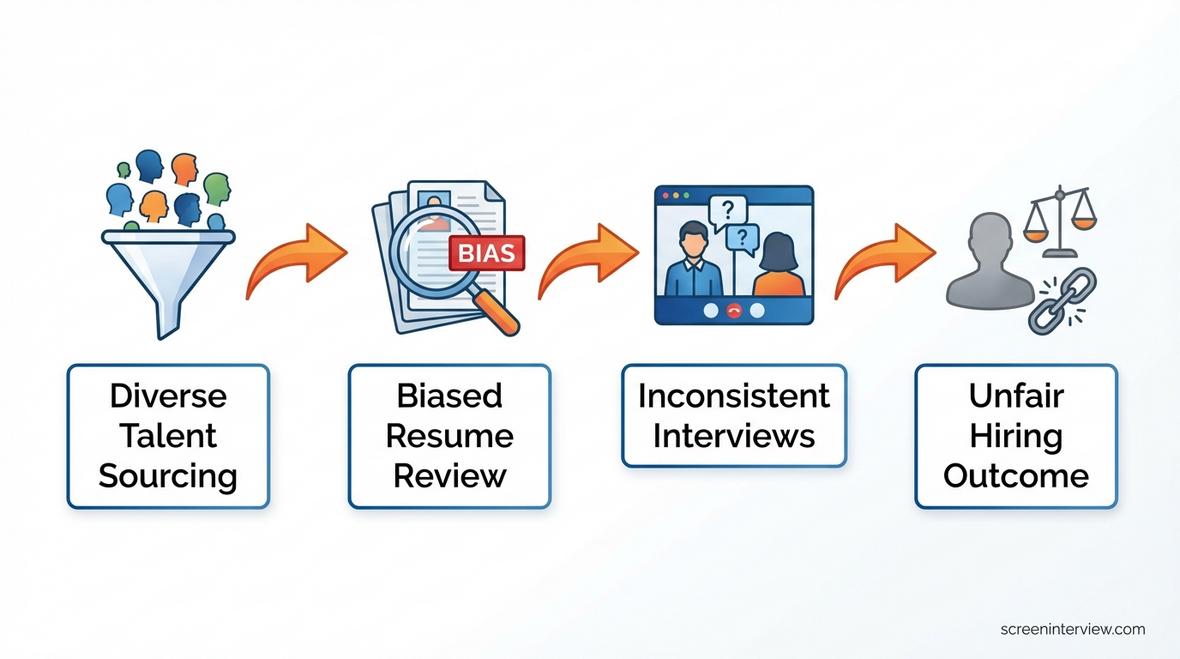
Recency bias gives disproportionate weight to recent interviews, disadvantaging earlier candidates. Contrast effects cause recruiters to evaluate candidates relative to those interviewed immediately before, rather than against objective criteria. The contrast principle in hiring demonstrates how sequential evaluation creates unfair comparisons.
Additional bias types include attribution bias, where successes are attributed to external factors for out-group candidates but internal qualities for in-group members, and conformity bias, which emerges during panel interviews when individuals align their assessments with perceived group consensus rather than independent judgment.
The Business Case Against Bias in Hiring
Beyond ethical considerations, bias in hiring creates measurable economic damage. Organizations that fail to implement fair screening processes experience higher turnover rates, reduced innovation capacity, and diminished employer brand strength. Research consistently demonstrates that diverse teams outperform homogeneous ones across multiple performance metrics.
The cost of a bad hire extends far beyond salary expenditures. Recruitment costs, onboarding investments, lost productivity, and team disruption compound when bias leads to poor candidate selection. When qualified candidates are eliminated due to irrelevant factors, organizations miss opportunities to secure talent that could drive competitive advantage.
Customer-facing businesses particularly suffer when their workforce fails to reflect their customer base. Product development, marketing strategies, and service delivery all benefit from teams that bring varied perspectives and lived experiences. Bias in hiring that creates demographic homogeneity limits an organization's ability to understand and serve diverse markets.
Legal and reputational risks also factor into the business case. Discriminatory hiring practices expose organizations to litigation, regulatory scrutiny, and public relations crises. In an era of transparent employer reviews and social media amplification, unfair recruitment practices can quickly damage years of brand building.
How AI Technology Addresses Bias in Hiring
Artificial intelligence offers powerful tools for reducing bias in hiring when properly designed and implemented. AI interview platforms standardize evaluation by asking every candidate identical questions in the same sequence, eliminating the conversational drift that introduces inconsistency in traditional interviews.
Structured evaluation frameworks powered by AI assess responses against predefined competency criteria rather than subjective impressions. This approach focuses assessment on job-relevant skills and behaviors while minimizing the influence of irrelevant candidate characteristics. Forrester candidate experience scores research shows that unbiased AI screening boosts Net Promoter Scores by 22 points, correlating with 18% faster time-to-fill.
Modern AI interviewer systems analyze candidate responses based on content and competency demonstration rather than demographic signals. By removing names, photos, educational institutions, and other bias-triggering information during initial screening, these platforms enable blind screening practices that focus purely on qualifications.
Advanced natural language processing evaluates substantive answer quality without being influenced by accent, speech patterns, or communication styles that might trigger unconscious bias in human evaluators. The technology assesses whether candidates demonstrate required knowledge and problem-solving capabilities, not whether they 'sound like' current employees.
Transparency and Algorithmic Accountability
Effective AI solutions for bias reduction must incorporate transparency mechanisms that allow recruiters to understand how candidates are evaluated. Black-box algorithms that provide scores without explanation can perpetuate bias in new forms. Leading platforms now offer detailed breakdowns of scoring rationale, enabling human oversight of automated decisions.
Regular algorithmic audits represent best practice in AI-powered hiring. These assessments examine whether automated systems produce disparate impact across protected groups. When statistical analysis reveals bias patterns, responsible platforms adjust their models to ensure fair outcomes while maintaining predictive validity.
The most sophisticated systems combine AI efficiency with human judgment at strategic points. While automation handles high-volume initial screening with consistent standards, recruiters retain decision authority for final selections. This hybrid approach leverages technological strengths while preserving human accountability and contextual understanding.
Implementing Bias-Free Candidate Screening
Transitioning to unbiased screening requires both technological adoption and process redesign. Organizations should begin by auditing their current recruitment funnel to identify where bias most commonly enters. Resume screening, phone interviews, and on-site evaluations each present distinct challenges requiring tailored interventions.
For resume screening, implementing candidate screening without bias means focusing on demonstrable skills and accomplishments rather than credentials that correlate with socioeconomic privilege. AI-powered applicant tracking systems can be configured to prioritize relevant experience and competencies while suppressing demographic information.
On-demand interview platforms allow candidates to complete initial assessments on their own schedule, removing bias associated with availability and time zone constraints. This approach particularly benefits candidates with caregiving responsibilities or those currently employed who cannot easily attend synchronous screening calls during business hours.
Standardized evaluation rubrics ensure all candidates are assessed against identical criteria. Rather than allowing interviewers to develop personal rating scales, organizations should define explicit behavioral indicators for each competency level. This structure transforms subjective impressions into objective evidence-based assessment.
Structured Interview Question Design
Question design significantly influences the fairness of interview processes. Behavioral and situational questions that ask candidates to describe past experiences or approach hypothetical challenges produce more valid assessments than abstract queries about strengths or weaknesses. These structured formats reduce opportunities for bias by grounding evaluation in concrete examples.
Organizations should develop question banks aligned with specific role requirements, ensuring every candidate for a position encounters the same core questions. While follow-up probes may vary based on initial responses, the foundational structure remains consistent. This approach enables meaningful comparison across candidates while maintaining conversation flow.
Technical roles benefit from AI-generated interview questions that assess actual job skills through practical scenarios. Rather than relying on credential screening, these assessments evaluate whether candidates can solve problems they'll encounter in the role, regardless of their educational background or previous employers.
Measuring Progress: Metrics for Fair Hiring
Organizations committed to reducing bias in hiring must establish metrics that track both process fairness and outcome equity. Simple demographic representation at each funnel stage reveals where particular groups experience disproportionate elimination. Significant drop-offs signal potential bias that requires investigation.
Pass-through rates by demographic group provide actionable insights. If resume screening advances candidates from one background at substantially higher rates than equally qualified candidates from different backgrounds, the screening criteria likely contain bias. Regular analysis of these patterns enables continuous improvement.
Time-to-fill metrics should be analyzed alongside quality-of-hire data to ensure efficiency gains don't come at the expense of fairness. The fastest hiring process means little if it systematically excludes qualified candidates or produces poor retention outcomes.
Candidate experience surveys that specifically ask about fairness perceptions offer valuable feedback. Questions about whether evaluation felt objective, relevant to the role, and free from inappropriate inquiries reveal how screening processes are experienced by those navigating them. This qualitative data complements quantitative funnel analysis.
Beyond Technology: Building Bias-Aware Recruiting Culture
While AI tools provide powerful capabilities for bias reduction, technology alone cannot eliminate hiring discrimination. Organizational culture, interviewer training, and leadership commitment all contribute to fair recruitment outcomes. The most effective approaches combine technological infrastructure with human development.
Bias training for workplace hiring equips recruiting teams with awareness of cognitive shortcuts and their impacts. Rather than one-time diversity workshops, ongoing education should be integrated into regular team development. Case studies, data analysis of past hiring decisions, and facilitated discussions help recruiters recognize bias in action.
Accountability mechanisms reinforce training by creating consequences for biased behavior. When hiring managers know their decisions will be analyzed for fairness and they'll need to justify assessments with reference to job-relevant criteria, they exercise greater care in evaluation. Regular calibration sessions where teams discuss candidate assessments also surface inconsistencies that might indicate bias.
Leadership modeling sets organizational tone. When executives publicly commit to fair hiring, allocate resources to bias reduction initiatives, and hold themselves accountable to diversity outcomes, these priorities cascade through recruiting teams. Conversely, when leaders emphasize speed over fairness or make biased statements about candidate attributes, they undermine bias reduction efforts.
Advanced AI Capabilities for Fair Assessment
Cutting-edge AI recruitment platforms now incorporate sophisticated capabilities that extend beyond basic structured interviews. Interview insights powered by AI analyze thousands of data points from candidate interactions to identify patterns invisible to human observers, while carefully avoiding protected characteristics.
Natural language understanding has advanced to the point where AI can assess the substance of candidate answers without being influenced by surface-level communication variations. A candidate who takes longer to formulate responses isn't penalized if their answers demonstrate deep understanding. Similarly, different communication styles receive fair evaluation when the technology focuses on content rather than presentation.
Workflow automation removes bias introduced by administrative burden. When recruiters are overwhelmed by applicant volume, they may rely on mental shortcuts that perpetuate bias. Automated scheduling, candidate communication, and documentation free recruiting professionals to focus on thoughtful evaluation rather than logistics.
Proctoring capabilities ensure assessment integrity without introducing bias. AI proctoring systems verify candidate identity and prevent cheating through behavioral analysis rather than invasive monitoring that might disadvantage candidates with disabilities or those in non-traditional testing environments.
Industry-Specific Applications of Bias Reduction
Different sectors face unique bias challenges that require tailored solutions. Technical recruiting often struggles with credential bias that favors candidates from elite computer science programs while overlooking self-taught programmers or bootcamp graduates who may possess superior practical skills. AI interviews for software engineers assess actual coding ability and problem-solving rather than academic pedigree.
Healthcare recruitment must balance standardization with recognition of diverse training pathways. AI-powered nurse screening evaluates clinical judgment and patient care competencies regardless of where candidates completed their nursing education, reducing bias against international medical graduates or those from non-traditional programs.
Sales and marketing roles traditionally relied heavily on 'cultural fit' assessments that often served as proxies for demographic similarity. AI interviews for sales and marketing positions focus on demonstrated persuasion skills, customer empathy, and strategic thinking rather than subjective personality judgments.
Leadership assessment presents particular bias challenges, as stereotypes about effective leadership often disadvantage women and minorities. AI-powered leadership interviews evaluate decision-making frameworks, team development capabilities, and strategic vision using evidence-based competency models rather than prototype matching.
Legal and Ethical Frameworks for AI in Hiring
As organizations adopt AI-powered hiring tools, they must navigate evolving legal requirements around algorithmic transparency and discrimination prevention. Regulatory frameworks increasingly require that automated decision systems undergo disparate impact analysis to ensure they don't perpetuate historical discrimination patterns.
The Equal Employment Opportunity Commission and similar bodies globally now scrutinize AI hiring tools with the same rigor applied to traditional selection methods. Organizations bear responsibility for ensuring their technology vendors provide systems that comply with anti-discrimination law, even when the algorithmic details remain proprietary.
Ethical implementation requires ongoing monitoring rather than one-time validation. As candidate pools, job requirements, and labor markets evolve, AI systems must be regularly retrained and audited to ensure continued fairness. Static algorithms optimized for past hiring decisions may not maintain equity under changed conditions.
Candidate rights to explanation represent an emerging area of both legal and ethical concern. When AI systems influence hiring decisions, candidates should receive meaningful information about how they were evaluated and which factors contributed to outcomes. This transparency enables candidates to contest unfair assessments and helps organizations identify potential system flaws.
The Future of Bias-Free Recruitment
As we progress through 2026, the convergence of regulatory pressure, competitive talent dynamics, and technological capability is accelerating the shift toward bias-free hiring. Organizations that fail to adopt fair screening practices face mounting risks while those that lead in this area gain advantages in talent attraction, retention, and performance.
Emerging technologies promise even more sophisticated bias detection and mitigation. Advanced AI systems now identify subtle bias patterns that would escape human notice, such as question sequences that inadvertently advantage certain demographic groups or evaluation criteria that correlate with protected characteristics rather than job performance.
Integration across the entire talent lifecycle from sourcing through onboarding and development will enable more comprehensive fairness assurance. Rather than addressing bias only at the screening stage, forward-thinking organizations are implementing end-to-end systems that promote equity at every employee touchpoint.
The most successful recruiting teams in 2026 recognize that bias reduction isn't a project with an endpoint but an ongoing commitment requiring continuous learning, adaptation, and improvement. By combining thoughtful AI implementation with human accountability and organizational culture change, they're building recruitment processes that identify the best talent regardless of background while creating candidate experiences that strengthen employer brand and competitive position.
Frequently Asked Questions About Bias in Hiring
What exactly is bias in hiring?
Bias in hiring refers to systematic preferences or prejudices that influence candidate evaluation based on characteristics irrelevant to job performance. These can be conscious or unconscious and affect decisions at every recruitment stage, from resume screening through final selection.
How does AI actually reduce bias compared to human interviewers?
AI reduces bias by applying consistent evaluation criteria to every candidate, removing demographic information that triggers unconscious preferences, and assessing responses based on content rather than surface characteristics like accent or communication style. Unlike human interviewers, AI doesn't experience fatigue, mood variations, or cognitive shortcuts that introduce inconsistency.
Can AI hiring tools themselves be biased?
Yes, AI systems can perpetuate or even amplify bias if trained on historical data that reflects discriminatory patterns or if designed with flawed assumptions. This is why regular algorithmic audits, diverse development teams, and ongoing monitoring are essential for responsible AI implementation in hiring.
How can organizations measure bias in their hiring process?
Organizations should track pass-through rates by demographic group at each funnel stage, analyze time-to-hire and quality-of-hire metrics across populations, conduct candidate experience surveys focused on fairness perceptions, and perform statistical analyses to identify disparate impact patterns.
What are the first steps to reducing bias in hiring?
Begin with a comprehensive audit of your current recruitment process to identify where bias most commonly enters. Implement blind resume screening, adopt structured interview questions, train recruiting teams on cognitive bias, and consider AI-powered tools that standardize evaluation. Most importantly, establish metrics to track progress and hold teams accountable for fair outcomes.
Conclusion
Bias in hiring represents both a significant challenge and a substantial opportunity for modern recruiting professionals. Organizations that successfully implement fair screening processes gain competitive advantages through access to broader talent pools, improved team performance, and stronger employer brands. The combination of AI-powered tools like those offered by ScreenInterview, structured evaluation frameworks, ongoing bias training, and robust accountability mechanisms creates recruitment systems that identify the best candidates regardless of background. As regulatory scrutiny intensifies and talent competition accelerates in 2026, bias reduction has evolved from an ethical aspiration to a business imperative that directly impacts organizational success and sustainability.
Ready to Transform Your Interview Process?
See how ScreenInterview can help you automate phone screens, reduce bias, and hire better candidates faster.