
Best AI Interview Platform: Complete 2026 Guide To Automated Recruitment Technology

Understanding AI Interview Platforms in Modern Recruitment
The recruitment landscape has undergone a dramatic transformation as organizations seek efficient, scalable solutions to manage increasingly competitive talent markets. The best AI interview platform represents more than just technological innovation it's a strategic investment that fundamentally reshapes how organizations identify, evaluate, and secure top-tier candidates.
Modern recruiting professionals face unprecedented challenges: screening hundreds of applications for single positions, maintaining consistency across evaluation criteria, eliminating unconscious bias, and dramatically reducing time-to-hire without compromising quality. Traditional interview processes simply cannot scale to meet these demands while maintaining the rigor and fairness that contemporary hiring requires.
AI interview platforms address these challenges through intelligent automation, natural language processing, and data-driven evaluation frameworks. According to Bureau of Labor Statistics: Recruitment Industry Benchmarks, organizations implementing AI-powered screening technologies report significant improvements in recruiter productivity metrics and substantial reductions in hiring timelines across various industry verticals.
These platforms leverage machine learning algorithms to conduct preliminary interviews, assess candidate responses against predefined competency frameworks, and generate detailed evaluation reports that enable human recruiters to focus their expertise where it matters most building relationships with qualified candidates and making final hiring decisions.
Core Features That Define the Best AI Interview Platform
Identifying the best AI interview platform requires understanding which features deliver measurable impact on recruitment outcomes. Not all AI interview solutions offer equivalent capabilities, and distinguishing between superficial automation and genuinely transformative technology is essential for recruiting leaders.
Intelligent Screening and Filtering
The foundation of any effective AI interview platform lies in its screening intelligence. Advanced platforms like ScreenInterview employ sophisticated algorithms that evaluate candidates across multiple dimensions simultaneously technical competencies, communication skills, cultural alignment, and role-specific qualifications.
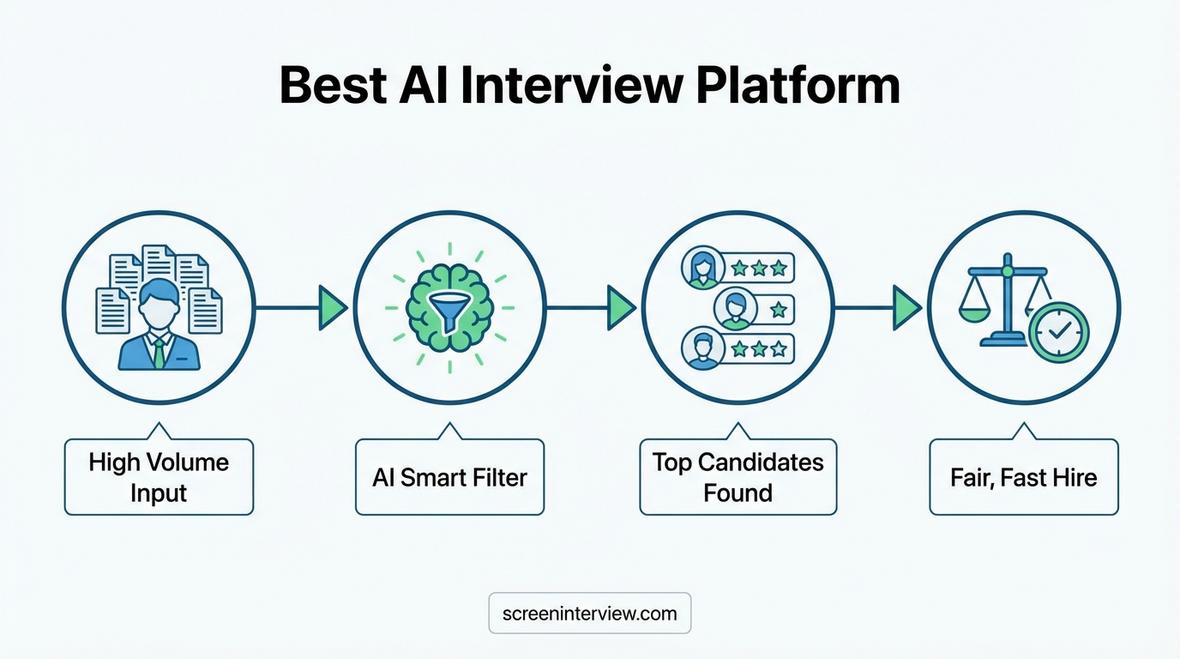
These systems process high-volume application flows through intelligent filters that identify top candidates based on objective criteria rather than subjective impressions. This capability proves particularly valuable when organizations receive hundreds or thousands of applications for competitive positions.
Adaptive Interview Technology
Leading platforms incorporate AI interviewer technology that adapts questioning based on candidate responses. This dynamic approach mirrors how experienced human interviewers adjust their line of inquiry to probe deeper into relevant areas while efficiently moving past topics where candidates demonstrate clear competency.
Adaptive interviewing ensures that technical candidates receive appropriately challenging questions while business-focused roles emphasize scenarios that reveal strategic thinking and interpersonal capabilities. This customization delivers more accurate assessments than rigid, one-size-fits-all interview scripts.
Comprehensive Evaluation Frameworks
The best AI interview platform provides robust evaluation frameworks that go beyond simple pass/fail scoring. These systems generate detailed candidate profiles highlighting strengths, development areas, and comparative rankings against peer applicants and role benchmarks.
Advanced platforms offer interview insights that help recruiting teams understand not just whether candidates qualify, but specifically how they align with organizational needs and where they might excel or require additional support.
Bias Elimination and Fair Hiring Practices
One of the most compelling advantages of AI interview platforms is their potential to significantly reduce bias in hiring decisions. Unconscious bias whether based on appearance, demographic characteristics, educational background, or communication style consistently undermines hiring quality and organizational diversity.
Traditional interview processes inadvertently perpetuate these biases because human evaluators, despite best intentions, inevitably bring subjective preferences and unconscious associations to their assessments. Research consistently demonstrates that factors completely irrelevant to job performance influence hiring decisions when humans conduct unstructured interviews.
The best AI interview platforms implement blind screening methodologies that evaluate candidates solely on demonstrated competencies and role-relevant responses. By removing identifying information and focusing exclusively on substantive answers, these systems create fundamentally fairer evaluation processes.
However, it's critical to recognize that AI systems are only as unbiased as their training data and implementation. Organizations must select platforms that undergo rigorous fairness auditing, provide transparency about their algorithms, and enable continuous monitoring for potential bias patterns. The commitment to eliminating interviewing bias must extend beyond initial platform selection to ongoing governance and refinement.
Implementation and Integration Considerations
Successfully deploying an AI interview platform requires thoughtful planning around technical integration, process redesign, and stakeholder alignment. The most sophisticated technology delivers limited value if recruiting teams struggle to incorporate it into existing workflows or candidates encounter frustrating user experiences.
ATS Integration and Workflow Automation
Leading platforms offer seamless integration with existing Applicant Tracking Systems, ensuring that candidate data flows efficiently between systems without manual data entry or reconciliation. This integration enables workflow automation that triggers AI interviews at appropriate pipeline stages and automatically updates candidate status based on evaluation outcomes.
Organizations should prioritize platforms that support their existing technology stack and provide flexible API access for custom integration scenarios. The goal is creating a unified recruitment technology ecosystem rather than introducing isolated point solutions that create data silos.
Candidate Experience Design
Even the most technically sophisticated platform fails if it creates poor candidate experiences. The best AI interview platform balances efficiency with engagement, ensuring that candidates feel respected and fairly evaluated throughout the process.
This means intuitive interfaces, clear instructions, reasonable time commitments, mobile-friendly access, and transparent communication about how AI evaluation works and what candidates should expect. Platforms should also provide candidates with meaningful feedback when possible, transforming the interview from a one-way evaluation into a development opportunity.
Specialized Capabilities for Diverse Roles
Different positions require different evaluation approaches, and the best AI interview platforms recognize this reality through role-specific assessment capabilities. A software engineer requires technical problem-solving evaluation fundamentally different from what a sales professional needs to demonstrate.
Advanced platforms offer specialized interview modules for technical roles including software engineer AI interviews, data scientist assessments, and DevOps engineer evaluations. These modules incorporate role-appropriate technical challenges, coding assessments, and scenario-based questions that accurately gauge candidate capabilities.
Similarly, business-focused positions benefit from specialized modules addressing product management, sales and marketing, and leadership competencies. This specialization ensures that evaluation criteria align with the actual requirements of each position rather than applying generic assessment frameworks that miss role-critical capabilities.
Security, Compliance, and Ethical Considerations
As AI interview platforms handle sensitive candidate data and influence consequential hiring decisions, security and compliance considerations become paramount. Organizations must ensure that their chosen platform meets rigorous data protection standards and complies with relevant employment regulations.
The best platforms implement enterprise-grade security measures including data encryption, secure authentication, access controls, and comprehensive audit trails. They should also provide clear data handling policies that specify how candidate information is stored, processed, and eventually deleted in accordance with privacy regulations.
Compliance extends beyond data security to encompass fair hiring regulations and anti-discrimination laws. Organizations should select platforms that document their fairness testing, provide explainability for AI decisions, and enable human oversight of automated recommendations. The technology should augment rather than replace human judgment in final hiring decisions.
Measuring ROI and Platform Effectiveness
Implementing an AI interview platform represents a significant investment, and recruiting leaders must demonstrate measurable returns to justify ongoing expenditure. Fortunately, these platforms generate extensive data that enables rigorous ROI analysis across multiple dimensions.
Key metrics include time-to-hire reduction, cost-per-hire decrease, improvement in candidate quality scores, increase in offer acceptance rates, reduction in early employee turnover, and enhancement in recruiter productivity. Organizations typically observe 40-60% reductions in time spent on initial screening activities, enabling recruiters to focus on relationship building and candidate experience enhancement.
Quality improvements prove equally valuable though sometimes harder to quantify. Organizations report better hiring outcomes measured through performance reviews, retention rates, and manager satisfaction scores when they implement structured, AI-assisted evaluation processes compared to traditional unstructured interviews.
Future Trends in AI Recruitment Technology
The AI interview platform landscape continues evolving rapidly as machine learning capabilities advance and organizations gain experience implementing these systems. Several emerging trends will shape the next generation of recruitment technology.
Conversational AI is becoming increasingly sophisticated, enabling more natural, dialogue-based interviews that feel less robotic and more engaging for candidates. These systems understand context, handle ambiguity, and adapt their communication style to match candidate preferences.
Multimodal assessment capabilities that evaluate not just what candidates say but how they communicate analyzing speech patterns, problem-solving approaches, and reasoning processes provide richer evaluation data. However, these capabilities must be implemented thoughtfully to avoid introducing new bias vectors.
Integration with broader talent management ecosystems enables platforms to not just evaluate external candidates but also facilitate internal mobility, identify skill gaps, and recommend development pathways. This evolution transforms AI interview platforms from hiring tools into comprehensive talent intelligence systems.
Selecting the Right Platform for Your Organization
With numerous AI interview platforms available, selecting the optimal solution for your organization requires systematic evaluation across multiple criteria. Begin by clearly defining your specific requirements: what roles you're hiring for most frequently, your current pain points in the recruitment process, your existing technology ecosystem, and your budget constraints.
Request demonstrations that simulate your actual use cases rather than generic product tours. Evaluate candidate experience directly by completing sample interviews yourself. Review the platform's approach to bias mitigation, data security, and compliance. Examine customer references from organizations similar to yours in size, industry, and hiring volume.
Consider the vendor's commitment to ongoing innovation and their product roadmap. The best AI interview platform for your needs today should continue evolving to meet your requirements tomorrow as your organization grows and recruitment challenges shift.
Conclusion
The best AI interview platform transforms recruitment from a resource-intensive, subjective process into a scalable, data-driven operation that consistently identifies top talent while eliminating bias and enhancing candidate experience. For modern recruiting professionals managing high-volume hiring across diverse roles, these platforms deliver measurable improvements in efficiency, quality, and fairness. Success requires selecting a platform with robust technical capabilities, seamless integration, role-specific assessment modules, and unwavering commitment to ethical AI implementation. As organizations increasingly compete on their ability to attract and deploy talent effectively, AI interview platforms have evolved from nice-to-have innovations into essential recruitment infrastructure for forward-thinking organizations.
Ready to Transform Your Interview Process?
See how ScreenInterview can help you automate phone screens, reduce bias, and hire better candidates faster.