
Automated Video Interview: Complete 2026 Guide To Streamlining Your Hiring Process

Understanding Automated Video Interviews
An automated video interview has fundamentally transformed how modern recruiting professionals approach candidate screening. This technology enables recruiters to evaluate candidates at scale, eliminating the scheduling bottlenecks that traditionally slow down hiring pipelines. For recruiting leaders managing high-volume talent acquisition, automated video interviews represent a strategic shift from reactive to proactive hiring.
Unlike traditional interviews that require real-time coordination between multiple stakeholders, automated video interviews allow candidates to record responses to pre-set questions at their convenience. This asynchronous approach addresses a critical challenge that many talent acquisition teams face the time-intensive nature of initial screening rounds that can delay identifying qualified candidates by weeks.
The technology has matured significantly, with advanced AI interview capabilities now providing objective scoring, sentiment analysis, and competency mapping. For organizations processing thousands of applications monthly, this shift from manual to automated screening can reduce time-to-hire by 40-60% while maintaining assessment quality.
How Automated Video Interviews Work
The automated video interview process follows a structured workflow that balances candidate experience with recruiter efficiency. Understanding this process helps talent acquisition professionals implement the technology effectively within their existing recruitment stack.
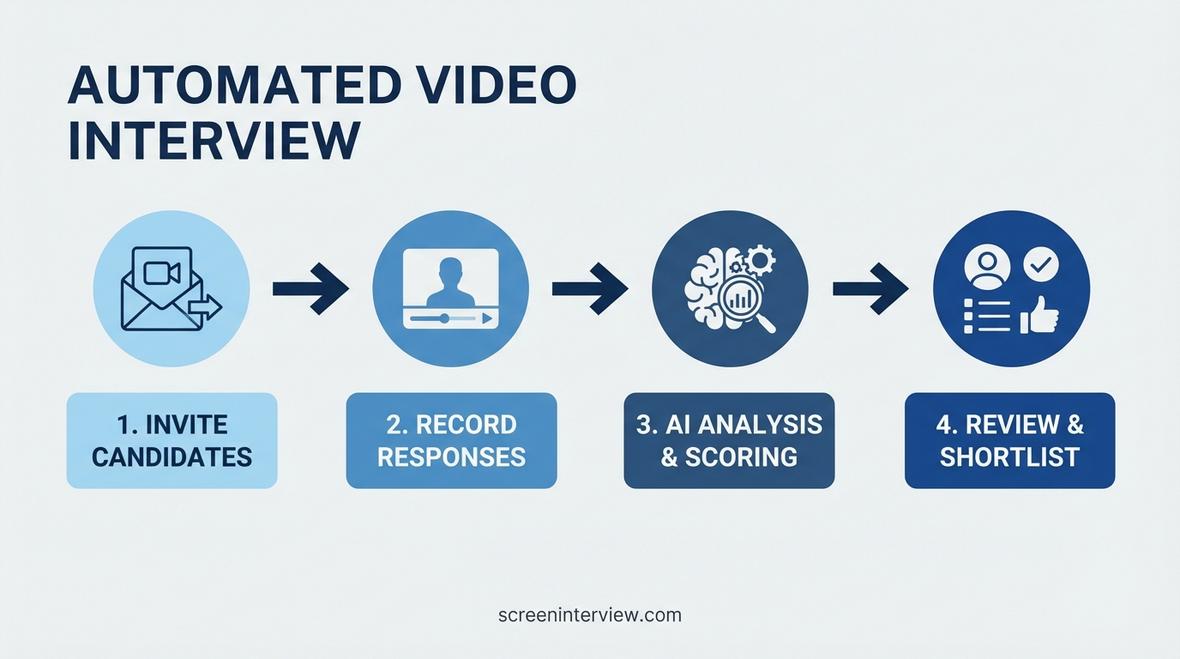
Candidate Invitation and Setup
The process begins when recruiters send personalized interview invitations through their workflow automation system. These invitations include clear instructions, technical requirements, and a deadline for completion. Modern platforms integrate directly with Applicant Tracking Systems, ensuring seamless candidate data flow and reducing administrative overhead.
Candidates receive access to a secure interview portal where they can review questions, test their equipment, and familiarize themselves with the interface before recording. This preparation phase reduces technical anxiety and ensures candidates present their best selves, which directly impacts the quality of responses recruiters receive.
Recording Candidate Responses
During the recording phase, candidates answer predetermined questions while the platform captures video, audio, and in some cases, behavioral metadata. The on-demand interview format typically allows candidates one or two attempts per question, with preparation time built in before recording begins.
Advanced platforms incorporate interview proctoring technology to ensure assessment integrity without creating an intimidating environment. This includes monitoring for unusual activity patterns while respecting candidate privacy a balance that modern recruiting professionals must carefully maintain.
AI Analysis and Scoring
Once candidates submit their responses, artificial intelligence engines analyze multiple dimensions of performance. Natural language processing evaluates content quality, relevance, and depth of answers. Computer vision algorithms assess non-verbal communication patterns, energy levels, and engagement indicators.
The AI generates objective scores across customizable competency frameworks, reducing the unconscious bias that often influences human-only evaluation. For organizations committed to candidate screening without bias, this data-driven approach provides measurable improvements in hiring fairness.
Human Review and Shortlisting
The final stage involves human recruiters reviewing AI-scored candidates, watching recordings, and making final advancement decisions. This hybrid approach leverages AI efficiency while preserving the human judgment necessary for cultural fit assessment and nuanced evaluation.
Recruiting teams can collaborate on candidate evaluations, leave timestamped comments, and build consensus through the platform. This structured review process creates audit trails that support compliance requirements while accelerating decision-making cycles.
Strategic Benefits for Recruiting Professionals
Implementing automated video interviews delivers measurable returns across multiple dimensions of talent acquisition operations. For heads of talent and recruiting leads facing pressure to reduce costs while improving quality of hire, these benefits directly address core business objectives.
Efficiency and Time Savings
The most immediate benefit is dramatic time savings in early-stage screening. According to 4 million monthly job openings benchmark data from the U.S. Bureau of Labor Statistics, the volume of hiring activity continues to strain traditional recruitment processes. Automated video interviews allow a single recruiter to effectively screen 50-100 candidates in the time previously required for 10-15 phone screens.
This efficiency extends beyond individual recruiter productivity. The asynchronous nature eliminates scheduling coordination, which often consumes 30-40% of recruiter time during initial screening phases. For organizations with distributed hiring teams across multiple time zones, this scheduling relief compounds significantly.
Enhanced Candidate Experience
Despite initial concerns about depersonalization, well-implemented automated video interviews actually improve candidate experience by offering flexibility and transparency. Candidates appreciate the ability to complete interviews on their schedule, from their chosen environment, without the stress of real-time performance pressure.
The structured format also ensures assessment consistency every candidate receives the same questions, time allocations, and evaluation criteria. This fairness resonates with candidates who have experienced inconsistent interview processes at other organizations, strengthening your employer brand in competitive talent markets.
Scalability for High-Volume Hiring
For organizations facing seasonal hiring surges or rapid growth phases, automated video interviews provide the infrastructure to scale screening capacity without proportional increases in recruiting headcount. A high-volume recruiting scenario that might require temporarily doubling your recruiting team can instead be managed with existing resources supported by automation.
This scalability extends to geographic expansion as well. Organizations opening new markets or hiring distributed teams can maintain consistent screening standards across locations without flying recruiters or coordinating complex logistics.
Data-Driven Hiring Insights
Automated video interview platforms generate rich datasets that enable continuous improvement of your hiring process. By analyzing which questions best predict successful hires, which competencies correlate with retention, and where candidates struggle, recruiting leaders can refine their screening criteria based on evidence rather than intuition.
These interview insights support strategic workforce planning by revealing talent pool characteristics, skill availability trends, and competitive positioning. For data-savvy recruiting professionals, this analytical capability transforms hiring from an operational function to a strategic business driver.
Implementation Best Practices
Successfully deploying automated video interviews requires thoughtful planning and change management. Organizations that rush implementation without addressing stakeholder concerns often face adoption resistance that undermines potential benefits.
Defining Clear Evaluation Criteria
Before launching automated video interviews, establish explicit competency frameworks aligned to role requirements. Generic questions produce generic insights the value emerges from carefully designed questions that elicit responses revealing critical skills and attributes.
Work with hiring managers to identify the 3-5 competencies that most strongly predict success in each role family. Then craft questions specifically designed to draw out evidence of those competencies. The interview question generator tools available in modern platforms can accelerate this process while ensuring question quality.
Balancing Automation with Human Judgment
The most effective implementations use AI to augment rather than replace human decision-making. Configure your platform to flag top-tier candidates for priority review while allowing recruiters to override AI scores when context warrants. This hybrid approach captures efficiency gains while preserving the relationship-building essential to successful recruiting.
Establish clear protocols for when human recruiters should watch full video responses versus relying on AI summaries. Typically, any candidate advancing beyond initial screening deserves full video review to assess cultural fit dimensions that AI cannot fully evaluate.
Candidate Communication and Transparency
Transparent communication about the automated video interview process reduces candidate anxiety and improves completion rates. Your invitation should clearly explain the format, time expectations, technical requirements, and evaluation process.
Consider providing sample questions or practice opportunities so candidates can familiarize themselves with the format before their actual interview. This preparation support levels the playing field for candidates less familiar with video technology, supporting your diversity and inclusion objectives.
Continuous Optimization and Validation
Treat your automated video interview implementation as an ongoing optimization project rather than a one-time deployment. Regularly analyze completion rates, candidate feedback, quality of hire data, and recruiter satisfaction to identify improvement opportunities.
Conduct periodic validation studies to ensure your questions and scoring criteria actually predict job performance. As roles evolve and labor markets shift, your screening criteria should adapt accordingly. This disciplined approach to talent assessment tools separates organizations that extract lasting value from those that see temporary efficiency gains.
Integration with Your Recruitment Technology Stack
Automated video interviews deliver maximum value when seamlessly integrated with your existing recruitment technology ecosystem. Isolated tools create data silos and workflow friction that diminish efficiency gains.
Applicant Tracking System Integration
Your automated video interview platform should integrate bidirectionally with your ATS, automatically pulling candidate data and pushing interview results back into candidate profiles. This integration eliminates manual data entry while ensuring all stakeholder have access to complete candidate information in their familiar workflow environment.
Leading platforms offer pre-built integrations with major ATS vendors, reducing implementation timelines and technical complexity. For organizations using niche or custom-built ATS solutions, API documentation and integration support become critical vendor selection criteria.
Calendar and Scheduling Tools
While automated video interviews reduce scheduling burden for initial screenings, candidates who advance still require live interviews. Integration with intelligent scheduling platforms creates a seamless candidate journey from automated screening through final-stage interviews.
This integration prevents candidates from falling through cracks during handoffs between screening stages a common failure point that costs organizations qualified candidates and damages employer brand.
Analytics and Reporting Platforms
For recruiting leaders accountable to executive stakeholders, integration with business intelligence platforms enables comprehensive reporting on hiring metrics. Track time-to-hire improvements, cost-per-hire reductions, quality of hire indicators, and diversity metrics in the dashboards your leadership team already monitors.
This visibility builds organizational support for continued investment in recruitment technology while providing the data foundation for strategic workforce planning initiatives.
Addressing Common Concerns and Objections
Despite proven benefits, automated video interviews face predictable concerns from various stakeholders. Proactively addressing these objections accelerates adoption and builds confidence in the technology.
Bias and Fairness Concerns
The most frequent concern involves potential algorithmic bias perpetuating or amplifying existing hiring inequities. This concern deserves serious attention poorly designed AI systems can indeed encode historical biases present in training data.
However, research consistently shows that well-designed automated video interview systems reduce bias compared to unstructured human screening. The key lies in proper configuration, regular auditing, and transparent evaluation criteria. Organizations committed to eliminating predictive bias should view AI as an ally rather than a threat, provided they implement appropriate governance frameworks.
Candidate Experience Concerns
Some recruiting professionals worry that automated interviews feel impersonal and may alienate candidates, particularly for senior roles. While this concern has some validity for executive-level positions, the majority of candidates especially younger professionals appreciate the flexibility and efficiency of automated screening.
The solution involves thoughtful deployment: use automated video interviews for early-stage screening where they provide maximum efficiency gains, then transition to live interviews for relationship-building and cultural assessment in later stages. This tiered approach optimizes both efficiency and candidate experience.
Technical Accessibility Concerns
Questions about technical accessibility for candidates without reliable internet or modern devices are legitimate, particularly for organizations committed to socioeconomic diversity. Address this by offering alternative accommodation pathways phone screening options, on-site interview opportunities, or partnerships with community centers providing technology access.
Most candidates in 2026 have sufficient technology access for video interviews, but maintaining alternative pathways demonstrates organizational values and ensures you do not inadvertently exclude qualified candidates facing temporary technology constraints.
Measuring ROI and Success Metrics
Demonstrating return on investment justifies continued investment and builds organizational support for recruitment technology initiatives. Establish baseline metrics before implementation and track improvements across multiple dimensions.
Efficiency Metrics
Track time-to-hire from application to offer, recruiter hours spent on screening activities, and candidate volume processed per recruiter. Most organizations see 40-60% reductions in screening time within the first quarter of implementation, with continued improvements as teams optimize their processes.
Also measure scheduling time saved the hours previously spent coordinating phone screens that now flow automatically through your automated video interview platform. This hidden time cost often represents 20-30% of total recruiting capacity.
Quality Metrics
Track quality of hire indicators such as new hire performance ratings, retention rates at 90 days and one year, and hiring manager satisfaction scores. The most successful implementations show quality improvements alongside efficiency gains, as structured assessment reduces the variability inherent in unstructured screening.
Monitor diversity metrics across the hiring funnel to ensure your automated video interview process advances rather than hinders inclusion objectives. Well-configured systems should show improved diversity in candidate advancement rates as unconscious bias decreases.
Cost Metrics
Calculate cost-per-hire reductions by factoring in recruiter time savings, reduced time-to-fill costs, and improved retention rates. While platform subscription costs are explicit, the savings often hide in distributed time allocations across your recruiting team.
For organizations using external recruiting agencies, the ability to handle higher volumes internally often generates six-figure annual savings that dramatically outweigh platform costs.
Future Trends in Automated Video Interviews
The automated video interview technology landscape continues evolving rapidly, with several emerging trends poised to further transform talent acquisition in coming years.
Conversational AI Advancement
The next generation of platforms incorporates AI interviewer technology that conducts dynamic, conversational interviews rather than static question sequences. These systems ask follow-up questions based on candidate responses, creating more natural interactions while maintaining the scalability benefits of automation.
This conversational approach addresses the primary candidate experience limitation of current automated video interviews the inability to clarify questions or explore interesting response threads. As natural language processing continues improving, expect increasingly sophisticated conversational capabilities.
Skills Assessment Integration
Future platforms will seamlessly blend behavioral interviews with technical skills assessment, allowing candidates to demonstrate competencies through practical exercises within the same session. This integration reduces assessment fragmentation while providing recruiters with comprehensive candidate profiles.
Predictive Analytics Enhancement
Machine learning models will increasingly predict not just candidate quality but optimal role fit, likely retention duration, and development trajectory. These predictive capabilities transform recruiting from a matching function to a strategic talent planning capability, helping organizations build workforces aligned to future business needs.
Frequently Asked Questions
How long should an automated video interview take?
Most automated video interviews range from 15-30 minutes, depending on role complexity and the number of questions included. This duration balances comprehensive assessment with respect for candidate time. For entry-level positions, 15-20 minutes typically suffices, while senior roles may warrant 25-30 minutes.
Can candidates retake their automated video interview?
This depends on your organizational policy and platform configuration. Some organizations allow one retake to account for technical issues, while others maintain single-attempt policies to preserve assessment integrity. The best practice involves allowing practice questions before the actual interview but limiting retakes of scored questions.
How do automated video interviews handle candidates with disabilities?
Reputable platforms provide accommodation options including extended time, alternative question formats, and accessibility features for visual or hearing impairments. Organizations should establish clear accommodation request processes and be prepared to offer alternative assessment methods when automated video interviews present insurmountable barriers.
What happens if a candidate experiences technical difficulties?
Quality platforms include technical support resources, system checks before interviews begin, and the ability for recruiters to reset interviews when legitimate technical issues occur. Establish clear policies for handling technical failures to ensure fairness while preventing abuse of reset capabilities.
How do I prevent candidates from cheating on automated video interviews?
Modern platforms incorporate multiple integrity measures including randomized question presentation, browser lockdown technology, eye-tracking analysis, and detection of unusual patterns. However, the most effective approach involves designing questions that require authentic demonstration of knowledge rather than simple factual recall that could be easily researched.
Conclusion
Automated video interviews represent a fundamental evolution in how modern recruiting professionals approach candidate screening. By combining the efficiency of asynchronous assessment with the depth of video evaluation and the objectivity of AI analysis, these platforms address the core challenges facing talent acquisition teams in 2026: scaling screening capacity, reducing time-to-hire, improving assessment quality, and advancing diversity objectives. For recruiting leaders committed to operational excellence, implementing automated video interview technology is no longer optional it is a competitive necessity that separates organizations winning the talent war from those falling behind.
Ready to Transform Your Interview Process?
See how ScreenInterview can help you automate phone screens, reduce bias, and hire better candidates faster.