
Automated Phone Screening: Complete Guide To AI-Powered Recruitment In 2026

Introduction to Automated Phone Screening
Automated phone screening has emerged as a transformative force in modern recruitment, fundamentally changing how organizations identify and evaluate talent. As hiring teams face unprecedented pressure to process high volumes of applications while maintaining quality and fairness, AI-powered phone screening technology offers a compelling solution. According to research from Talent Board and Phenom, AI-powered screening tools reduce résumé reviewing time by up to 75%, enabling recruiters to focus on high-value interactions rather than administrative tasks.
For recruiting professionals managing multiple open roles simultaneously, the promise of automated phone screening extends beyond simple efficiency gains. This technology represents a strategic shift toward data-driven hiring decisions, consistent candidate evaluation, and the ability to engage talent at scale without compromising the personal touch that distinguishes exceptional recruitment experiences.
What Is Automated Phone Screening?
Automated phone screening leverages artificial intelligence and natural language processing to conduct initial candidate interviews via telephone. Unlike traditional phone screens that require a recruiter's direct involvement, these systems can independently initiate calls, ask pre-determined questions, evaluate responses, and generate candidate assessments without human intervention.
The technology works through several integrated components: conversational AI that understands natural speech patterns, voice recognition systems that transcribe responses accurately, and machine learning algorithms that analyze answers against role-specific criteria. When a candidate submits an application, the automated phone screening system can immediately reach out to schedule and conduct an interview at the candidate's convenience, even outside traditional business hours.
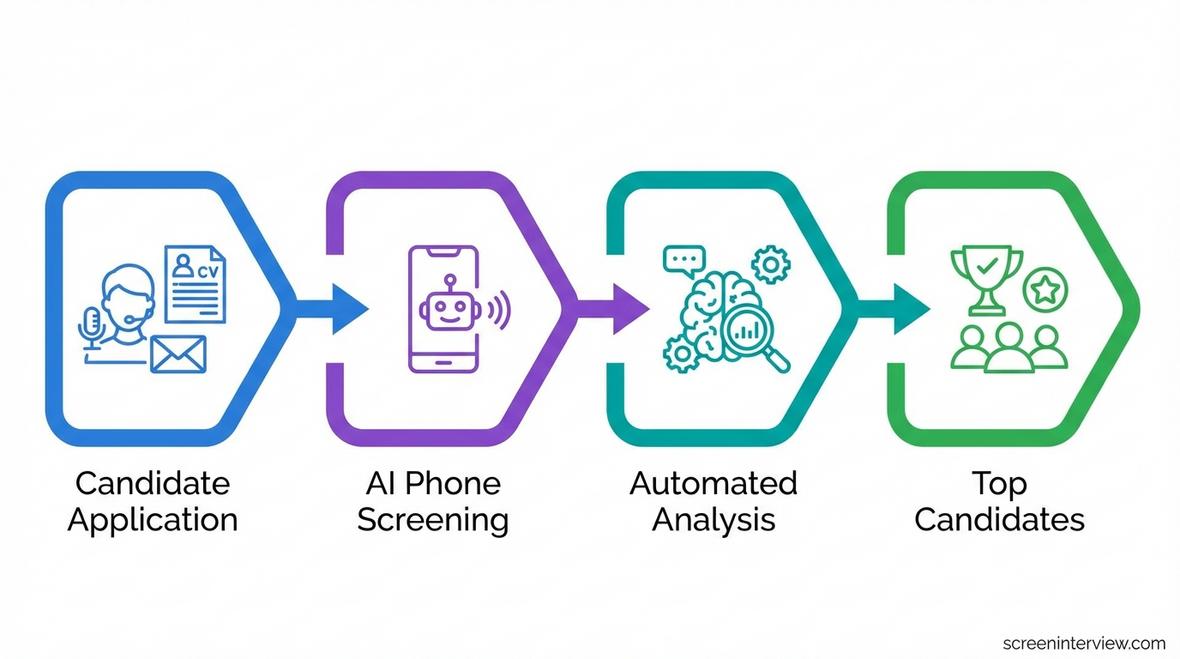
Modern automated phone screening platforms have evolved significantly from early rigid systems. Today's solutions employ sophisticated dialogue management that adapts to candidate responses, asks relevant follow-up questions, and creates conversational experiences that candidates find engaging rather than robotic. This advancement has made the technology suitable for screening across diverse role types, from technical positions to customer-facing roles where communication skills are paramount.
Key Benefits of Automated Phone Screening for Recruitment Teams
Dramatic Time Savings and Efficiency Gains
The most immediate benefit recruiting teams experience with automated phone screening is the substantial reduction in time spent on preliminary candidate evaluations. Studies demonstrate that AI-powered recruitment tools can cut hiring time by 50% by automating key tasks like resume screening and interview scheduling.
For a recruiting team managing 100 applications per role, manual phone screening could require 50+ hours of recruiter time. Automated phone screening compresses this timeline dramatically, conducting dozens of interviews simultaneously while recruiters focus on evaluating results and engaging with top candidates. This efficiency becomes particularly valuable during high-volume hiring periods or when filling multiple similar positions across an organization.
Enhanced Candidate Experience Through Accessibility
Contrary to concerns about impersonal automation, well-implemented automated phone screening often improves the candidate experience. The technology enables immediate engagement candidates don't wait days for a recruiter to reach them. Systems can conduct interviews at times convenient for candidates, including evenings and weekends, accommodating working professionals who cannot easily take calls during business hours.
The consistency of automated interviews also eliminates the variability candidates experience with different recruiters. Every applicant receives the same professional interaction, the same questions, and the same opportunity to demonstrate their qualifications. This standardization creates a fairer process that candidates appreciate, particularly those from underrepresented backgrounds who may have historically faced inconsistent treatment.
Improved Quality of Hire Through Data-Driven Decisions
Automated phone screening platforms generate rich data sets that support more informed hiring decisions. Rather than relying on a recruiter's subjective notes from a phone conversation, these systems produce structured assessments with scored responses, keyword analysis, and sentiment evaluation. This data enables recruiting teams to identify patterns that correlate with successful hires and continuously refine their screening criteria.
The interview insights capabilities of modern platforms allow teams to compare candidates objectively across multiple dimensions, from technical knowledge to communication style. This multi-dimensional assessment reduces the risk of advancing candidates who interview well but lack essential qualifications, while ensuring strong candidates who might not shine in traditional phone screens receive fair consideration.
Reduction of Unconscious Bias in Initial Screening
Human recruiters, despite best intentions, carry unconscious biases that influence hiring decisions. Research consistently shows that factors like accent, gender-associated voice characteristics, and even the time of day a call occurs can subtly affect how recruiters evaluate candidates. Automated phone screening, when properly designed and monitored, can significantly mitigate these bias sources.
By evaluating responses against predetermined criteria rather than subjective impressions, automated systems create a more level playing field. The technology doesn't form positive or negative associations based on a candidate's voice characteristics or speaking style unrelated to job requirements. Organizations committed to reducing bias in hiring find automated phone screening to be a valuable tool in their diversity and inclusion strategy.
How to Implement Automated Phone Screening Successfully
Defining Clear Screening Criteria and Questions
Successful automated phone screening begins with thoughtful preparation. Recruiting teams must identify the essential qualifications, skills, and experiences that distinguish viable candidates from those unlikely to succeed in the role. This clarity translates into well-constructed screening questions that elicit meaningful, evaluable responses.
Effective questions for automated phone screening typically combine closed-ended queries that verify specific qualifications ('Do you have experience with Python programming?') with open-ended questions that allow candidates to demonstrate knowledge and communication skills ('Describe your approach to debugging complex code issues'). The interview builder functionality in advanced platforms helps recruiting teams construct question sets optimized for automated delivery.
Integration with Existing Recruitment Technology Stack
Automated phone screening delivers maximum value when seamlessly integrated with existing recruitment systems. The technology should connect with your applicant tracking system to automatically trigger screens when candidates reach specific pipeline stages, pull candidate information to personalize interactions, and push results back to candidate profiles for recruiter review.
Modern platforms offer robust integration capabilities with leading ATS platforms. When evaluating automated phone screening solutions, recruiting teams should prioritize systems that support their existing technology ecosystem through APIs and pre-built connectors. This integration prevents the creation of data silos and ensures recruiters access all candidate information in a single location.
Training Recruiters and Managing Change
Introducing automated phone screening represents a significant workflow change for many recruiting teams. Success requires thoughtful change management that addresses recruiter concerns, provides adequate training, and demonstrates the technology's value. Some recruiters may initially feel threatened by automation or skeptical about AI's ability to evaluate candidates effectively.
Organizations that successfully implement automated phone screening typically involve recruiters early in the process, soliciting their input on screening criteria and question design. They provide hands-on training that allows recruiters to experience the candidate perspective, review sample interviews, and understand how to interpret automated assessments. This inclusive approach builds buy-in and ensures recruiters become effective advocates for the new approach.
Best Practices for Automated Phone Screening
Maintaining the Human Touch in an Automated Process
While automation handles initial screening, successful recruitment strategies maintain meaningful human interaction at critical touchpoints. Candidates who advance beyond automated phone screening should receive personalized communication from recruiters that acknowledges their specific qualifications and explains next steps. This hybrid approach leverages automation's efficiency while preserving the relationship-building that defines excellent recruitment.
Consider implementing workflow automation that triggers personalized recruiter outreach immediately after candidates complete automated screens with strong results. This rapid human follow-up demonstrates organizational responsiveness and begins building the relationship that will carry through the remaining hiring process.
Continuous Monitoring and Optimization
Automated phone screening systems require ongoing refinement to maintain effectiveness. Recruiting teams should regularly review interview data to identify questions that don't effectively differentiate candidates, criteria that may inadvertently disadvantage certain groups, and opportunities to improve the candidate experience.
Establish a quarterly review process that examines key metrics: completion rates (what percentage of candidates finish the automated interview?), time-to-complete, correlation between automated screening scores and subsequent hiring decisions, and candidate feedback. Use these insights to refine questions, adjust scoring algorithms, and optimize the overall screening process.
Transparency and Candidate Communication
Candidates appreciate transparency about how organizations use AI in hiring. When implementing automated phone screening, clearly communicate what candidates should expect: that they'll receive a phone call from an automated system, approximately how long the interview will take, what types of questions will be asked, and how their responses will be evaluated.
This transparency serves multiple purposes: it reduces candidate anxiety, prevents confusion that might cause candidates to dismiss the call as spam, and demonstrates organizational respect for candidates' time and autonomy. Include information about automated screening in application confirmation emails and any pre-interview communications.
Measuring the Impact of Automated Phone Screening
Key Performance Indicators to Track
Organizations implementing automated phone screening should establish clear metrics to evaluate the technology's impact. Essential KPIs include time-to-fill (has the hiring timeline shortened?), recruiter hours per hire (are recruiters spending less time on screening and more on high-value activities?), and candidate quality metrics (are hired candidates performing well and showing strong retention?).
Additional metrics provide deeper insights: interview completion rates reveal whether candidates find the automated experience acceptable, diversity in candidate advancement tracks whether the technology reduces bias, and candidate satisfaction scores indicate experience quality. Current data suggests that initial candidate screening is approximately 95% automated in 2026, reflecting widespread adoption and proven effectiveness.
Calculating Return on Investment
The ROI of automated phone screening extends beyond obvious time savings. Calculate the full economic impact by considering recruiter capacity gains (how many additional roles can your team manage with freed capacity?), reduced time-to-fill costs (what is the business impact of filling roles faster?), and improved quality of hire (what is the value of reduced turnover and higher performer productivity?).
For a mid-sized organization hiring 100+ employees annually, automated phone screening typically delivers six-figure returns through recruiter efficiency alone. When factoring in faster fills and quality improvements, the business case becomes compelling even for smaller hiring volumes.
The Future of Automated Phone Screening Technology
Automated phone screening continues to evolve rapidly as AI capabilities advance. Emerging developments include increasingly sophisticated natural language understanding that enables truly conversational interactions, emotion detection that provides insights into candidate engagement and enthusiasm, and predictive analytics that identify candidates likely to accept offers and succeed long-term.
Integration with comprehensive AI interview platforms is expanding the scope of what automated systems can evaluate. Some platforms now combine phone screening with video assessment, skills testing, and work sample evaluation to create holistic candidate profiles from a single automated interaction.
The technology is also becoming more accessible to organizations of all sizes. While early automated screening solutions required significant investment and technical expertise, modern cloud-based platforms offer intuitive interfaces and flexible pricing that make the technology viable for companies hiring just a few dozen employees annually.
Addressing Common Concerns About Automated Phone Screening
Will Automated Screening Miss Great Candidates?
This concern is understandable but often reflects misconceptions about how modern automated phone screening works. Well-designed systems don't make final hiring decisions they identify candidates who merit further consideration while efficiently screening out those clearly unqualified. The technology augments rather than replaces human judgment.
Moreover, automated screening can actually reduce the risk of overlooking strong candidates. Human recruiters conducting dozens of phone screens may experience fatigue, leading to inconsistent evaluation. Automated systems maintain consistent standards across every candidate interaction, ensuring every applicant receives thorough, unbiased assessment regardless of when they apply or which recruiter would have handled their call.
Do Candidates Accept Automated Interviews?
Candidate acceptance of automated phone screening has grown substantially as the technology has become more prevalent and sophisticated. Research indicates that candidates' primary concerns focus on fairness and transparency rather than automation itself. When organizations clearly communicate how automated screening works and ensure the process genuinely assesses relevant qualifications, most candidates view it as a legitimate, often preferable alternative to waiting days for initial human contact.
Younger candidates, in particular, tend to appreciate the immediacy and convenience of automated screening. The ability to complete an initial interview at 9 PM on a Sunday when it fits their schedule often outweighs any preference for human interaction at this preliminary stage.
Choosing the Right Automated Phone Screening Platform
Selecting an automated phone screening solution requires careful evaluation of several factors. Assess the platform's conversational AI capabilities does it sound natural and respond appropriately to candidate questions? Examine integration options to ensure compatibility with your existing recruitment technology. Review the question library and customization options to determine whether the system can effectively screen for your specific roles.
Security and compliance features are critical considerations, particularly for organizations in regulated industries. Ensure the platform maintains appropriate data protection standards and supports compliance with relevant employment laws. The provider should offer transparency about their AI algorithms and support bias testing to ensure fair candidate treatment.
Consider platforms like ScreenInterview that offer comprehensive capabilities including intelligent scheduling, interview proctoring, and detailed analytics. A unified platform that handles multiple aspects of digital interviewing often provides better integration and user experience than cobbling together point solutions.
Implementation Roadmap: Getting Started with Automated Phone Screening
Organizations ready to implement automated phone screening should follow a structured approach. Begin with a pilot program focused on one or two high-volume roles where the efficiency benefits will be most apparent. This limited scope allows your team to learn the technology, refine processes, and build confidence before broader rollout.
Develop your screening questions collaboratively, involving both recruiters and hiring managers who understand role requirements. Test the automated interview experience yourself and with colleagues to identify any issues before launching to candidates. Establish clear evaluation criteria for interpreting automated screening results, ensuring consistency in how recruiters act on the data.
Monitor early results closely, gathering feedback from both recruiters and candidates. Use this input to refine your approach before expanding to additional roles. Most organizations find they can scale from pilot to full implementation within 2-3 months, achieving meaningful efficiency gains while maintaining hiring quality.
Industry-Specific Applications of Automated Phone Screening
Technology and Engineering Recruitment
Tech companies leverage automated phone screening to evaluate technical knowledge efficiently while handling high application volumes. The technology can assess programming language familiarity, system design thinking, and problem-solving approach through structured questions, with responses analyzed for technical accuracy and depth of understanding. Organizations hiring software engineers, data scientists, and other technical roles find automated screening particularly valuable for initial technical assessment.
Healthcare and Nursing
Healthcare organizations facing persistent staffing challenges use automated phone screening to rapidly identify qualified candidates for nursing, allied health, and support positions. The technology can verify certifications, assess clinical knowledge, and evaluate scenario-based responses that reveal decision-making capabilities. Given healthcare's 24/7 operational reality, automated screening's ability to engage candidates at any hour proves especially valuable.
Retail and Hospitality
High-volume hiring in retail and hospitality benefits enormously from automated phone screening. These industries often need to quickly evaluate hundreds of candidates for seasonal positions or new location launches. Automated screening can assess availability, customer service orientation, and relevant experience while dramatically compressing hiring timelines. The technology enables lean recruiting teams to manage hiring surges without compromising candidate quality.
Legal and Compliance Considerations
Organizations implementing automated phone screening must navigate evolving legal frameworks governing AI use in employment. Several jurisdictions have enacted or proposed regulations requiring transparency about automated hiring tools, bias testing, and candidate rights regarding automated decisions. Recruiting teams should work with legal counsel to ensure their automated screening implementation complies with applicable laws.
Best practices include maintaining human involvement in final hiring decisions (automated screening should inform but not solely determine outcomes), regularly auditing automated systems for disparate impact across protected groups, and providing candidates with clear information about how automation is used in your hiring process. Documentation of your screening criteria, validation studies, and decision-making processes supports compliance and demonstrates good-faith efforts to use technology responsibly.
Frequently Asked Questions About Automated Phone Screening
How long does an automated phone screening interview typically take?
Most automated phone screening interviews last between 10-20 minutes, depending on the number and complexity of questions. This duration provides sufficient time to assess key qualifications while respecting candidates' time. The automated nature means candidates can complete the interview at their convenience rather than scheduling around recruiter availability.
Can automated phone screening handle candidates with accents or speech differences?
Modern speech recognition technology has advanced significantly and can accurately transcribe diverse accents and speech patterns. Leading automated phone screening platforms continuously train their models on diverse voice samples to ensure fair treatment regardless of accent. However, organizations should monitor transcription accuracy and be prepared to offer alternative screening methods for candidates who experience technical difficulties.
What happens if a candidate doesn't answer the automated screening call?
Automated phone screening systems typically make multiple contact attempts at different times before marking a candidate as non-responsive. Many platforms also offer candidates the option to schedule their screening call for a specific time, reducing missed connections. Candidates who repeatedly don't answer receive the same treatment as those who fail to respond to human recruiter outreach.
How do automated systems handle unexpected candidate responses?
Sophisticated conversational AI can manage a wide range of candidate responses, including requests for clarification, tangential answers, and follow-up questions. The systems use natural language processing to extract relevant information even from unconventional responses. For truly unexpected situations the AI cannot handle, advanced platforms can flag the interview for human review or seamlessly escalate to a live recruiter.
Is automated phone screening suitable for senior-level positions?
While automated phone screening is most commonly deployed for high-volume roles, it can be valuable for senior positions when thoughtfully implemented. The technology efficiently handles initial credential verification and basic qualification assessment, freeing executive recruiters to focus their time on in-depth evaluation of finalists. However, the screening questions and evaluation criteria for senior roles require more sophisticated design to appropriately assess executive-level competencies.
Conclusion
Automated phone screening represents a significant advancement in recruitment technology, offering recruiting teams the ability to engage candidates quickly, evaluate qualifications consistently, and make data-driven hiring decisions at scale. As organizations face increasing pressure to hire efficiently while maintaining quality and fairness, this technology provides a practical solution that benefits both recruiters and candidates. The substantial time savings, bias reduction, and improved candidate experience make automated phone screening an essential tool for modern recruiting professionals. By thoughtfully implementing these systems with attention to question design, transparency, and continuous optimization, organizations can transform their screening processes and build stronger talent pipelines for 2026 and beyond.
Ready to Transform Your Interview Process?
See how ScreenInterview can help you automate phone screens, reduce bias, and hire better candidates faster.