
Attention To Detail Interview Questions: 2026 Guide For Recruiters To Identify Top Talent

Why Attention to Detail Matters in Modern Recruitment
In today's competitive hiring landscape, attention to detail has emerged as a critical competency across virtually every role from software engineers and data analysts to product managers and sales professionals. For modern recruiting professionals managing high-volume candidate pipelines, identifying candidates with exceptional attention to detail can significantly impact organizational performance, reduce costly errors, and improve overall team efficiency.
Attention to detail encompasses the ability to thoroughly review work, identify errors, maintain consistency, and demonstrate meticulousness in task execution. According to Gallup State of the Workplace, structured interviewing correlates with 21% higher candidate retention, addressing pain points in manual soft skills assessment. This statistic underscores the importance of incorporating well-designed attention to detail interview questions into your screening process.
This comprehensive guide provides recruiting leaders, talent acquisition specialists, and people operations managers with a robust framework for evaluating attention to detail during candidate interviews. We'll explore behavioral questions, situational scenarios, technical assessments, and best practices for integrating these evaluations into your existing AI interview workflows.
Understanding Attention to Detail as a Core Competency
Before diving into specific interview questions, it's essential to understand what attention to detail truly means in the context of different roles. This competency manifests differently across positions a software developer's attention to detail involves code quality and bug detection, while a marketing manager's version focuses on brand consistency and campaign accuracy.
Key Components of Attention to Detail
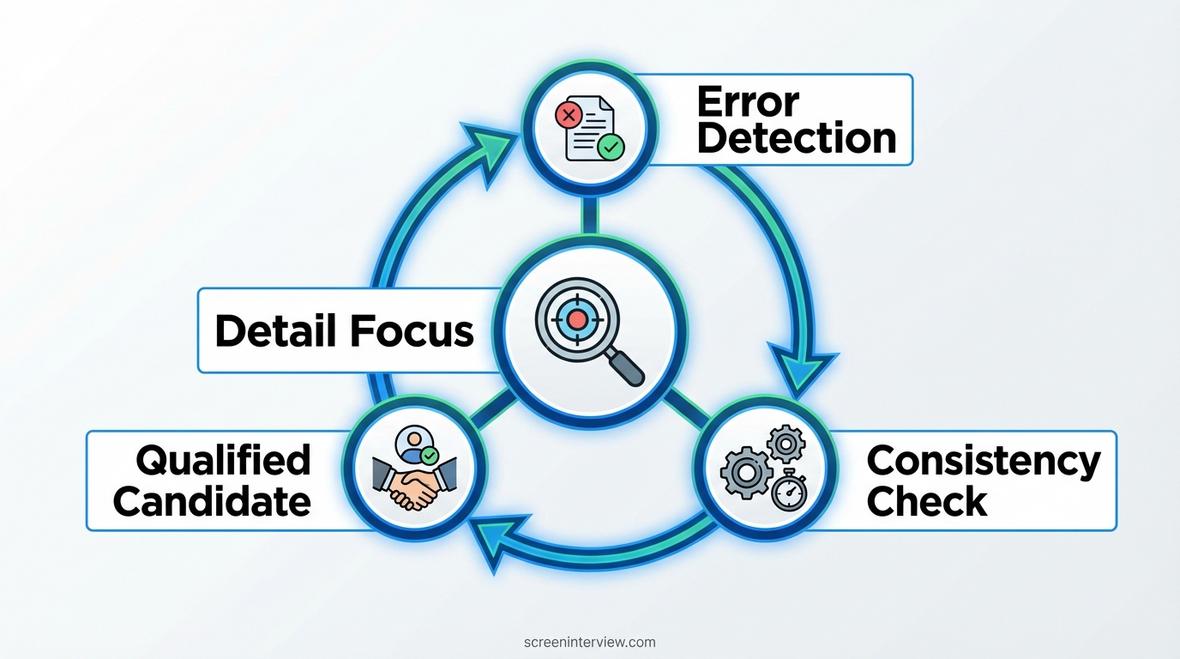
Effective attention to detail comprises several interconnected elements:
- Accuracy: The ability to produce error-free work consistently
- Thoroughness: Completing tasks with comprehensive coverage of all requirements
- Consistency: Maintaining standards across multiple tasks and time periods
- Organization: Structuring work systematically to minimize oversights
- Error detection: Identifying mistakes in one's own work or others' outputs
- Follow-through: Ensuring nothing falls through the cracks from initiation to completion
Modern recruiting professionals using AI interviewer technology can systematically assess these components through structured question frameworks combined with intelligent evaluation algorithms.
Role-Specific Variations in Attention to Detail
Different positions require different manifestations of this skill. Technical roles such as QA engineers need meticulous testing protocols, while product managers require attention to user requirements and feature specifications. Understanding these nuances helps you craft targeted attention to detail interview questions that align with role-specific expectations.
Behavioral Attention to Detail Interview Questions
Behavioral questions reveal how candidates have demonstrated attention to detail in previous roles. These questions follow the STAR method (Situation, Task, Action, Result) and provide concrete evidence of past performance as a predictor of future behavior.
Foundational Behavioral Questions
1. 'Describe a time when your attention to detail prevented a significant error or problem.'
This question assesses the candidate's awareness of detail-oriented situations and their proactive approach to quality control. Strong responses include specific examples with measurable outcomes, demonstrating both the detection process and the impact of their intervention.
What to listen for: Candidates should articulate the specific error they caught, the method they used to identify it, the steps they took to correct it, and the consequences avoided. Top performers will quantify the impact (e.g., 'prevented a $50,000 budget overrun' or 'avoided a production delay affecting 10,000 users').
2. 'Tell me about a project where you had to manage multiple detailed tasks simultaneously. How did you ensure nothing was overlooked?'
This question evaluates organizational systems, prioritization skills, and systematic approaches to complexity all critical for detail-oriented work in fast-paced environments.
What to listen for: Effective candidates will describe specific tools, systems, or methodologies (checklists, project management software, review protocols) rather than relying solely on memory. They should demonstrate awareness of their cognitive limitations and compensatory strategies.
3. 'Give me an example of when you identified an error in someone else's work. How did you handle it?'
This question assesses both technical attention to detail and interpersonal skills crucial for collaborative environments where feedback must be delivered constructively.
What to listen for: Look for diplomatic communication, respect for colleagues, and a focus on solutions rather than blame. The best responses demonstrate attention to team dynamics alongside technical accuracy.
Advanced Behavioral Questions
4. 'Describe a situation where you had to review complex information under tight deadlines. What was your approach?'
This question reveals how candidates maintain quality standards under pressure a common scenario in modern recruiting environments with compressed time-to-hire expectations.
5. 'Tell me about a time when your initial work contained an error. How did you discover it, and what did you learn?'
This question assesses self-awareness, accountability, and continuous improvement characteristics of professionals who actively refine their attention to detail over time. Candidates who can't recall any errors may lack self-reflection or honesty.
Situational Attention to Detail Interview Questions
Situational questions present hypothetical scenarios to assess how candidates would approach detail-oriented challenges. These questions are particularly valuable when screening candidates without extensive experience in your specific industry or role.
Scenario-Based Questions
6. 'You're preparing an important presentation for the executive team tomorrow morning and notice several inconsistencies in the data at 5 PM. What do you do?'
This scenario tests prioritization, problem-solving under pressure, and commitment to accuracy versus convenience.
What to listen for: Strong candidates will prioritize data accuracy over personal convenience, describe a systematic approach to verifying information, and potentially suggest appropriate escalation or timeline adjustments if corrections cannot be completed thoroughly.
7. 'You receive a 50-page document to review for errors within two hours. Walk me through your process.'
This question reveals systematic approaches to large-scale review tasks essential for roles involving quality assurance, editing, compliance, or data validation.
What to listen for: Effective responses include strategies like multiple-pass reviews (first for major issues, then for minor details), use of technology tools (spell-checkers, automated validation), section-by-section approaches, or appropriate delegation when feasible.
Technical Situational Questions
8. 'How would you ensure accuracy when transferring 10,000 customer records from one system to another?'
This technical scenario is relevant for data-centric roles and assesses understanding of validation protocols, testing methodologies, and risk mitigation strategies.
9. 'You're managing a team project with five contributors. How would you ensure consistency across all deliverables?'
This question evaluates leadership aspects of attention to detail, including standard-setting, quality control systems, and team coordination.
Skills Assessment and Technical Questions
Beyond behavioral and situational questions, direct skills assessments provide objective data about a candidate's actual attention to detail capabilities. These questions can be integrated into on-demand interviews for efficient screening at scale.
Written Assessment Questions
10. 'Review this [sample document/code snippet/design mockup] and identify all errors or inconsistencies.'
Provide candidates with a deliberately flawed sample relevant to the role a contract with typos and inconsistent terms, code with logical errors, or a spreadsheet with formula mistakes.
Evaluation criteria: Count the percentage of intentional errors identified, note the speed of identification, and assess whether candidates provide constructive feedback or simply point out problems.
Process Description Questions
11. 'Walk me through your quality control process when completing [specific role-related task].'
This question reveals whether candidates have established systematic approaches or rely on ad-hoc checking. For frontend developers, this might involve code review processes; for financial analysts, it might cover reconciliation procedures.
12. 'What tools or systems do you use to organize detailed information and track progress?'
This question assesses technical proficiency with organizational tools and reveals whether candidates leverage technology to augment their natural attention to detail.
Role-Specific Attention to Detail Interview Questions
Tailor your attention to detail interview questions to specific positions for maximum relevance and predictive validity.
Questions for Technical Roles
For software engineers and developers:
- 'Describe your code review process. What specific aspects do you focus on?'
- 'How do you ensure your code is maintainable and well-documented?'
- 'Tell me about a time when you caught a critical bug before production deployment.'
For data scientists and analysts:
- 'How do you validate data quality before analysis?'
- 'Describe your approach to ensuring reproducibility in your analytical work.'
- 'What strategies do you use to prevent errors in complex calculations or models?'
Questions for Business Roles
For project managers and coordinators:
- 'How do you track multiple project workstreams with interdependencies?'
- 'Describe a time when you identified a discrepancy in project requirements.'
- 'What systems do you use to ensure all stakeholders have consistent information?'
For customer-facing roles:
- 'How do you ensure accuracy when documenting customer interactions?'
- 'Tell me about a time when attention to detail improved customer satisfaction.'
- 'What's your process for following up on customer commitments?'
How to Evaluate Responses to Attention to Detail Interview Questions
Asking the right questions is only half the challenge evaluating responses effectively requires structured criteria and bias-aware assessment frameworks.
Structured Evaluation Framework
Create a scoring rubric that includes:
- Specificity: Does the candidate provide concrete examples with measurable details?
- Systematic approach: Do they describe organized methods rather than relying on intuition alone?
- Self-awareness: Do they acknowledge limitations and describe compensatory strategies?
- Impact orientation: Do they connect attention to detail with business outcomes?
- Continuous improvement: Do they demonstrate learning from past mistakes?
Modern interview insights platforms can help standardize evaluation by providing consistent rubrics across interviewers and generating comparative analytics.
Red Flags in Responses
Be alert for responses that indicate potential concerns:
- Vague answers without specific examples or outcomes
- Inability to recall any personal errors (suggesting lack of self-awareness)
- Over-reliance on memory without systematic backup systems
- Defensive responses when discussing mistakes
- Lack of structure or methodology in described processes
Integrating Attention to Detail Assessment with AI Technology
Forward-thinking recruiting professionals are leveraging AI-powered interview platforms to enhance the evaluation of attention to detail while reducing unconscious bias and increasing efficiency.
AI-Enhanced Screening Benefits
Platforms like ScreenInterview enable recruiters to:
- Standardize attention to detail interview questions across all candidates
- Analyze response patterns using natural language processing to identify detail-oriented language
- Incorporate practical assessments (document review, error identification) directly into the interview flow
- Reduce interview time while maintaining assessment depth through workflow automation
- Generate objective scoring based on predefined rubrics rather than interviewer impressions
Combining Human Judgment with AI Insights
The most effective approach combines AI-powered efficiency with human judgment. Use AI for initial screening and standardized assessment, then apply human evaluation for nuanced interpretation of responses, especially around cultural fit and soft skills.
The AI proctor functionality can also monitor candidate behavior during assessments to identify thoroughness, review patterns, and time allocation providing additional data points beyond verbal responses.
Best Practices for Implementing Attention to Detail Assessments
Maximize the effectiveness of your attention to detail interview questions by following these evidence-based best practices:
Standardization and Consistency
Use identical or equivalent questions for all candidates in the same role to enable fair comparisons. Document your evaluation criteria before interviews begin to reduce post-hoc rationalization and confirmation bias.
Multiple Assessment Methods
Combine different question types behavioral, situational, and skills-based to triangulate evidence from multiple angles. This multi-method approach increases predictive validity and reduces the impact of individual question weaknesses.
Role Relevance
Ensure your attention to detail interview questions directly relate to actual job responsibilities. Generic questions about 'being detail-oriented' provide less predictive value than role-specific scenarios candidates will actually encounter.
Interviewer Calibration
Conduct regular calibration sessions where multiple interviewers evaluate the same candidate responses and discuss scoring rationale. This practice improves inter-rater reliability and surfaces unconscious biases.
Continuous Refinement
Track which questions and evaluation criteria best predict on-the-job performance. Use this data to continuously refine your question bank and assessment methodology a capability enhanced by analytics from modern interview builder platforms.
Common Mistakes When Assessing Attention to Detail
Avoid these frequent pitfalls that undermine the effectiveness of attention to detail assessments:
Overemphasis on Perfection
Expecting candidates to identify 100% of errors in assessment exercises or to recall past work without any mistakes creates unrealistic standards. Focus instead on systematic approaches and appropriate error rates for the role's requirements.
Ignoring Context and Pressure
Interview environments create artificial pressure that may not reflect normal working conditions. Consider how anxiety might affect performance and look for underlying capabilities rather than flawless execution under stress.
Single-Dimension Evaluation
Attention to detail is multi-faceted. Don't reduce evaluation to a single score or impression assess different components (accuracy, thoroughness, error detection, organization) separately for a nuanced profile.
Bias Blind Spots
Be aware that attention to detail assessments can inadvertently disadvantage certain groups. For example, non-native speakers might make more grammatical errors despite having excellent analytical attention to detail. Design questions that focus on job-relevant detail orientation rather than language proficiency unless the role specifically requires it.
Sample Scoring Rubric for Attention to Detail
Use this framework to standardize evaluation across candidates:
| Dimension | Exceptional (5) | Strong (4) | Adequate (3) | Developing (2) | Weak (1) |
|---|---|---|---|---|---|
| Specificity | Provides detailed examples with quantified outcomes | Offers concrete examples with clear context | Gives general examples with some detail | Provides vague or incomplete examples | Cannot provide relevant examples |
| Systematic Approach | Describes comprehensive, documented processes with backup systems | Outlines organized methodology with some structure | Mentions basic organizational tactics | Relies primarily on memory or intuition | Shows no systematic approach |
| Error Detection | Identifies 90%+ of errors in assessment; describes proactive checking | Catches 70-89% of errors; mentions review habits | Finds 50-69% of errors; acknowledges importance | Detects 30-49% of errors; inconsistent checking | Misses most errors; no quality control habits |
| Self-Awareness | Acknowledges limitations; describes learned compensatory strategies | Recognizes past mistakes; shows some learning | Admits occasional errors when prompted | Defensive about mistakes; minimal reflection | Cannot recall any errors; lacks insight |
| Impact Orientation | Clearly connects detail orientation to business outcomes | Mentions some impact of detail work | Aware of importance but limited examples | Minimal connection to results | No understanding of detail's business value |
Frequently Asked Questions About Attention to Detail Interview Questions
How many attention to detail questions should I ask in an interview?
For a comprehensive assessment, include 3-5 attention to detail interview questions in a standard 45-60 minute interview. This provides sufficient data points without overwhelming the interview with a single competency. Balance these with questions about other critical skills relevant to the role.
Should attention to detail questions be different for senior versus junior candidates?
Yes. For junior candidates, focus on basic organizational skills, willingness to double-check work, and awareness of quality standards. For senior roles, emphasize strategic attention to detail (identifying systemic issues), teaching others quality practices, and balancing detail orientation with broader priorities. Senior candidates should demonstrate delegation of routine detail work while maintaining oversight.
How can I assess attention to detail in remote or asynchronous interviews?
Remote assessment actually offers advantages through technology. Use record and review functionality to capture candidate responses for thorough evaluation. Include written assessments or document review tasks in the interview workflow. Asynchronous formats allow candidates to demonstrate their natural checking processes without time pressure, often revealing more authentic detail orientation than live interviews.
Can attention to detail be developed, or is it a fixed trait?
Research indicates attention to detail is partly dispositional but significantly improvable through training, systems, and habit development. When evaluating candidates, look for self-awareness about natural tendencies and evidence of compensatory strategies (checklists, peer review, technology tools). A candidate with moderate natural detail orientation but excellent systems may outperform someone with high natural ability but no structured approach.
How do I avoid bias when evaluating attention to detail?
Implement structured evaluation rubrics applied consistently across all candidates. Use multiple assessors when possible and conduct calibration sessions. Focus on job-relevant detail requirements rather than general perfectionism. Be aware that cultural differences, neurodiversity, and communication styles can affect how detail orientation is expressed look for substance over style. AI-powered platforms can help by providing objective scoring based on content analysis rather than interviewer impressions.
Conclusion
Attention to detail interview questions are essential tools for modern recruiting professionals seeking to identify candidates who will deliver consistent, high-quality work across diverse roles. By implementing structured behavioral questions, situational scenarios, and practical assessments, you can effectively evaluate this critical competency while maintaining fairness and efficiency.
The most successful approach combines well-designed questions with standardized evaluation rubrics, multiple assessment methods, and AI-powered technology to reduce bias and increase predictive validity. As you refine your attention to detail assessment strategy, focus on role-specific requirements, systematic candidate evaluation, and continuous improvement based on performance data. By integrating these best practices into your recruitment workflow, you'll significantly enhance your ability to identify top-tier talent who will drive organizational success through meticulous, thorough, and consistently excellent work.
Ready to Transform Your Interview Process?
See how ScreenInterview can help you automate phone screens, reduce bias, and hire better candidates faster.