
Artificial Intelligence Screen: Complete Guide To AI-Powered Candidate Screening In 2026

How AI Screening Transforms Modern Recruitment
The artificial intelligence screen has fundamentally reshaped how recruiting professionals evaluate candidates, turning what was once a weeks-long manual process into an intelligent, data-driven workflow. For Heads of Talent, Recruiting Leads, and People Operations Managers managing high-volume hiring pipelines, AI screening technology offers a strategic advantage: the ability to identify top-tier talent faster while maintaining fairness and consistency across every evaluation.
Research demonstrates the tangible impact of these systems. A systematic review analyzing 61,327 applicants showed AI tools for applicant screening achieved an average AUROC of 0.84, with machine learning used in 66.7% of cases for ranking candidates and natural language processing in 33.3% for evaluating written responses. This level of accuracy directly translates to recruitment scenarios where volume meets urgency.
As the Stanford HAI 2025 AI Index Report reveals, nearly 90% of notable AI models in 2024 originated from industry, up from 60% in 2023, demonstrating the rapid maturation of commercial AI capabilities now available for talent acquisition teams. Modern recruiting professionals are no longer asking whether to adopt AI screening they're focused on how to implement it effectively within their existing workflows and workflow automation strategies.
What Is an Artificial Intelligence Screen?
An artificial intelligence screen is an automated evaluation system that uses machine learning algorithms, natural language processing, and predictive analytics to assess candidate qualifications, responses, and fit for specific roles. Unlike traditional resume parsing tools, modern AI screening platforms analyze multiple data points simultaneously including structured application data, unstructured interview responses, skill assessments, and behavioral indicators.
The technology operates across several screening modalities. AI interview platforms conduct conversational assessments that evaluate both technical competencies and communication skills. Video screening tools analyze candidate responses for content quality while maintaining fairness protocols. Phone screening automation systems handle initial candidate outreach and qualification at scale, and assessment-based screening evaluates role-specific competencies through adaptive testing.
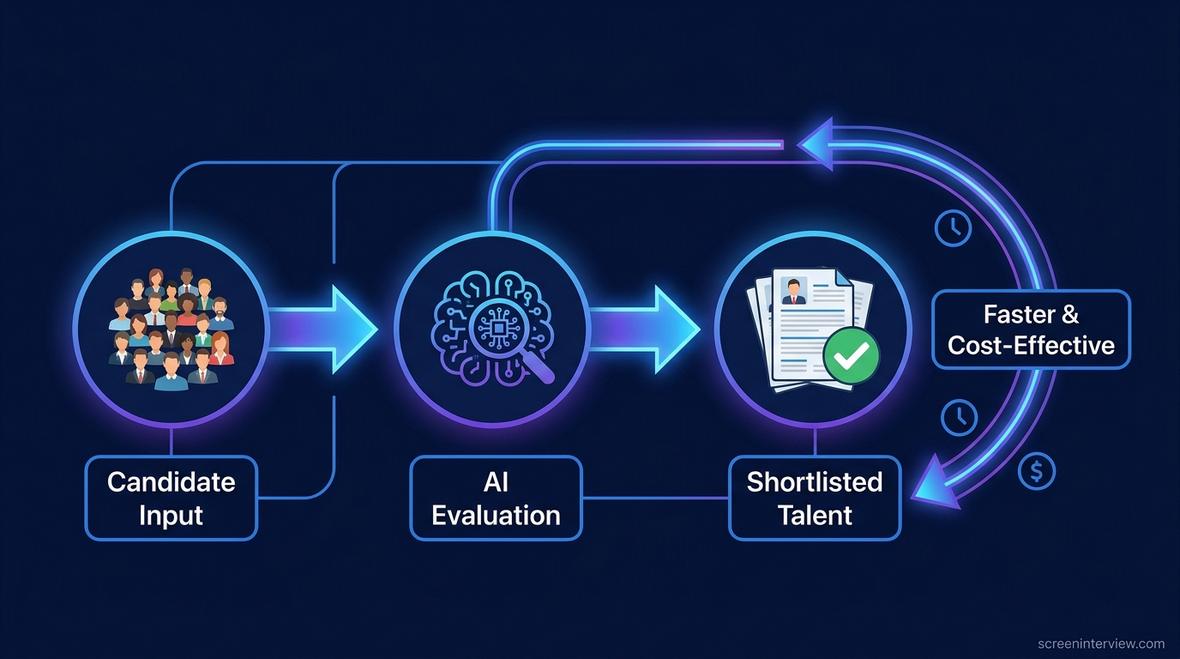
What distinguishes effective artificial intelligence screens from basic automation is their ability to learn from historical hiring data. These systems identify patterns that correlate with successful hires in your organization, then apply those insights to new candidate pools. For recruiting teams already using Applicant Tracking Systems, AI screening integrates as a middle layer between application receipt and human interview stages, dramatically reducing time-to-shortlist without sacrificing evaluation quality.
Core Technologies Powering AI Candidate Screening
Understanding the technological foundation of artificial intelligence screening helps recruiting professionals evaluate solutions and set realistic expectations for implementation outcomes.
Machine Learning Algorithms for Candidate Ranking
Machine learning forms the analytical backbone of AI screening systems. These algorithms process thousands of candidate data points education credentials, work experience, skill assessments, and response patterns to generate predictive scores indicating likelihood of success in specific roles. The systems improve continuously as they process more candidates and receive feedback on hiring outcomes.
Supervised learning models train on historical hiring data, learning which candidate characteristics correlate with positive performance reviews, retention, and promotion rates. Unsupervised learning identifies candidate clusters and patterns that human reviewers might miss, revealing non-obvious pathways to success within your organization.
Natural Language Processing for Response Evaluation
Natural language processing enables artificial intelligence screens to evaluate written and spoken candidate responses with contextual understanding. Rather than simple keyword matching, NLP analyzes semantic meaning, response structure, communication clarity, and domain knowledge demonstration.
When candidates complete on-demand interviews or respond to open-ended assessment questions, NLP engines parse their answers for technical accuracy, problem-solving approaches, and communication effectiveness. This technology proves particularly valuable for evaluating roles requiring strong written communication or complex technical explanation abilities.
Predictive Analytics for Quality-of-Hire Forecasting
Predictive analytics transforms screening from a pass/fail filter into a strategic forecasting tool. By analyzing correlations between screening data and long-term employee success metrics, these systems estimate not just whether candidates can perform the role, but how likely they are to excel, engage, and remain with your organization.
According to Brookings research, 65% of U.S. hospitals used predictive AI models by 2023 for operational decisions, though only 61% evaluated accuracy and 44% checked for bias highlighting the critical importance of validation protocols in recruitment applications. Effective talent acquisition teams implement continuous monitoring to ensure their predictive models maintain accuracy and fairness over time.
Strategic Benefits for Modern Recruiting Teams
The artificial intelligence screen delivers measurable operational improvements across the entire talent acquisition lifecycle, addressing the core challenges facing recruiting professionals in high-velocity hiring environments.
Dramatically Reduced Time-to-Hire
Time-to-hire directly impacts business outcomes unfilled positions cost organizations productivity, revenue, and competitive advantage. AI screening compresses the evaluation timeline by processing candidate assessments in minutes rather than days. What previously required coordinating multiple human reviewers across busy schedules now happens automatically, with qualified candidates advancing to human interview stages within hours of application.
For technical roles requiring specialized skill validation, AI-powered software engineer interviews and similar role-specific assessments provide immediate technical screening that would otherwise require senior engineer time your most constrained and expensive resource.
Enhanced Candidate Experience and Engagement
Modern candidates expect responsive, transparent hiring processes. Artificial intelligence screens provide immediate engagement candidates receive assessment invitations within minutes of applying, complete evaluations on their schedule, and receive timely communication about their status. This responsiveness significantly improves candidate perception of your employer brand.
Research from Ipsos indicates frequent usage of AI chatbot-like tools in the U.S. rose to 24%, with 'never users' dropping from 26% to 17%—signaling mainstream comfort with AI-mediated interactions that extends to recruitment contexts. Candidates increasingly view AI screening as a sign of organizational innovation rather than impersonal automation.
Unprecedented Scalability for High-Volume Hiring
Seasonal hiring surges, rapid growth phases, and ongoing high-volume recruitment create evaluation bottlenecks that artificial intelligence screens eliminate entirely. The same AI system that processes 50 candidates weekly scales effortlessly to 500 or 5,000 without additional headcount, infrastructure investment, or quality degradation.
This scalability proves particularly valuable for organizations with distributed hiring needs across multiple locations, departments, or role types. A centralized AI interviewer system maintains consistent evaluation standards regardless of volume fluctuations or geographic distribution.
Structured Bias Reduction and Fair Evaluation
Human screening inherently introduces bias unconscious preferences based on name recognition, educational pedigree, employment gaps, or demographic indicators. Properly designed artificial intelligence screens evaluate candidates against objective, role-relevant criteria, applying identical standards to every applicant.
The key qualifier is 'properly designed.' AI systems require careful implementation with bias auditing, diverse training data, and ongoing monitoring to ensure fairness. When executed correctly, AI screening demonstrably reduces bias compared to unstructured human review, creating more equitable access to opportunities for candidates from non-traditional backgrounds.
Implementation Best Practices for AI Screening Success
Successful artificial intelligence screen deployment requires strategic planning, cross-functional alignment, and ongoing optimization. These proven practices help recruiting teams maximize ROI while avoiding common implementation pitfalls.
Define Role-Specific Success Criteria Before Tool Selection
AI screening effectiveness depends entirely on the quality of success criteria you define. Before evaluating vendors, conduct thorough job analysis for your highest-volume roles. Identify the competencies, experiences, and attributes that distinguish top performers from average hires. Document measurable success indicators technical skills, behavioral competencies, cultural alignment factors that your AI screen should evaluate.
For technical positions, this might include specific programming language proficiency, system design capabilities, or problem-solving approaches. For customer-facing roles, communication clarity, empathy demonstration, and conflict resolution skills become evaluation priorities. Interview builder tools help translate these criteria into structured assessment frameworks.
Ensure Seamless ATS and Workflow Integration
Your artificial intelligence screen must integrate cleanly with existing recruitment technology. Candidate data should flow automatically from your ATS into the screening platform, with results returning to candidate profiles without manual data entry. Screening triggers should activate based on application status changes, and results should update candidate stages automatically based on performance thresholds.
Evaluate integration capabilities during vendor selection. Request demonstrations of the complete candidate flow from application through screening to result recording. Confirm that intelligent scheduling systems can coordinate subsequent human interviews automatically for candidates who pass AI screening thresholds.
Start with Pilot Programs and Controlled Rollouts
Rather than organization-wide immediate deployment, implement artificial intelligence screening through controlled pilots. Select one or two high-volume roles with clear success metrics and sufficient candidate flow to generate meaningful data within 30-60 days. Compare AI-screened candidate quality against your traditional screening process through parallel evaluation.
During pilots, maintain human review of all AI screening decisions to identify false negatives qualified candidates the system incorrectly filters out. This validation phase helps calibrate scoring thresholds and refine evaluation criteria before full-scale deployment. Document time savings, candidate experience feedback, and quality-of-hire metrics to build the business case for broader implementation.
Implement Continuous Bias Monitoring and Model Validation
AI screening systems require ongoing oversight to maintain fairness and accuracy. Establish regular auditing protocols that analyze screening outcomes across demographic groups, educational backgrounds, and employment history patterns. Monitor for disparate impact situations where screening disproportionately filters out candidates from protected classes despite similar qualifications.
Schedule quarterly model validation reviews that assess prediction accuracy against actual hiring outcomes. As your organization evolves and role requirements shift, your AI screening criteria must adapt correspondingly. Interview insights platforms provide analytics dashboards that surface potential bias indicators and model performance trends.
Role-Specific AI Screening Applications
Different role categories benefit from tailored artificial intelligence screen approaches that address their unique evaluation requirements.
Technical and Engineering Positions
Technical screening demands objective skill validation that AI systems excel at providing. Automated coding assessments evaluate programming proficiency, algorithm knowledge, and problem-solving approaches without requiring senior engineer time. AI screens for positions like data scientists, DevOps engineers, and machine learning engineers combine technical assessments with architectural thinking evaluation and communication skills analysis.
The most effective technical AI screens adapt difficulty based on candidate responses, providing appropriately challenging problems that differentiate senior from mid-level talent without creating unnecessarily frustrating experiences for qualified candidates at any level.
Business and Operational Functions
Business role screening focuses on analytical thinking, communication effectiveness, and problem-solving approaches rather than technical skill validation. AI screens for product managers, operations specialists, and business analysts evaluate case study responses, prioritization frameworks, and stakeholder management scenarios.
Natural language processing proves particularly valuable for these assessments, analyzing response structure, business acumen demonstration, and communication clarity. The screening identifies candidates who can articulate complex problems clearly and propose structured solutions competencies that correlate strongly with business role success.
Creative and Design Positions
Creative role screening presents unique challenges that modern AI systems increasingly address effectively. Portfolio analysis algorithms evaluate design work for technical proficiency, aesthetic alignment with brand standards, and creative problem-solving approaches. AI screens for UX designers and UI designers assess both portfolio quality and communication skills through hybrid evaluation approaches.
The most sophisticated creative screening systems combine automated portfolio analysis with conversational assessment that explores design thinking, critique incorporation, and stakeholder collaboration capabilities providing holistic evaluation that respects the complexity of creative roles.
Measuring AI Screening ROI and Success Metrics
Quantifying artificial intelligence screen impact requires tracking specific metrics that demonstrate business value and justify continued investment.
Time and Cost Efficiency Indicators
Calculate time-to-shortlist reduction by comparing average days from application to interview-ready candidate pool before and after AI screening implementation. Measure recruiter hours saved by multiplying candidate volume by average manual screening time per candidate, then comparing against AI screening processing time. Quantify cost-per-hire reduction through decreased recruiter hours, faster time-to-fill, and reduced reliance on external sourcing for high-volume roles.
Quality-of-Hire Improvements
Track hiring manager satisfaction scores for AI-screened candidates compared to traditionally screened pools. Monitor 90-day retention rates, performance review scores, and promotion rates for AI-screened hires versus control groups. Calculate offer acceptance rates to assess whether AI-screened candidates perceive the process as fair and engaging.
Fairness and Compliance Metrics
Analyze screening pass rates across demographic groups to ensure equitable outcomes. Monitor adverse impact ratios and conduct regular disparate impact analyses. Track candidate feedback regarding process fairness and transparency. Document all validation studies and bias audits for compliance purposes and continuous improvement initiatives.
Emerging Trends in AI Screening Technology
The artificial intelligence screen landscape continues evolving rapidly, with several emerging capabilities poised to further transform talent acquisition in the coming years.
Multimodal Assessment Integration
Next-generation screening platforms combine multiple data sources written responses, video interviews, technical assessments, and work samples into unified candidate profiles with holistic evaluation scores. Rather than treating each screening modality as a separate filter, integrated systems identify complementary strengths and provide nuanced candidate insights that better predict real-world performance.
Advanced Conversational AI Capabilities
Conversational AI screening evolves beyond structured question-and-answer formats toward natural dialogue that adapts based on candidate responses. These systems conduct exploratory conversations that feel more human while maintaining evaluation consistency and objectivity. Candidates engage more authentically when conversations flow naturally rather than following rigid scripts.
Skills Inference from Experience Narratives
Emerging AI systems infer skill proficiency from experience descriptions rather than requiring explicit skill listings. By analyzing project descriptions, achievement narratives, and problem-solving examples, these platforms identify transferable capabilities that traditional keyword matching misses particularly valuable for candidates from non-traditional backgrounds or career transitioners with relevant competencies despite unconventional paths.
Overcoming Common AI Screening Implementation Challenges
Despite clear benefits, organizations encounter predictable obstacles during artificial intelligence screen adoption. Anticipating these challenges enables proactive mitigation strategies.
Addressing Stakeholder Concerns and Change Resistance
Hiring managers and senior leaders often express skepticism about AI screening accuracy or concerns about losing human judgment in hiring. Address these concerns through transparent communication about how AI complements rather than replaces human decision-making. Share pilot program results demonstrating candidate quality improvements and time savings. Involve skeptical stakeholders in evaluation criteria definition to build ownership and trust.
Managing Candidate Perception and Communication
Some candidates react negatively to AI screening, perceiving it as impersonal or unfair. Proactively communicate your screening process, explaining how AI ensures consistent evaluation and eliminates common biases. Provide clear timelines, preparation resources, and appeals processes. Offer human contact options for candidates with questions or accessibility needs. Transparency and responsiveness transform potential resistance into appreciation for your structured, fair approach.
Navigating Technical Integration Complexity
Legacy ATS platforms and fragmented recruitment technology stacks create integration challenges. Work closely with your IT team and screening platform vendor to map data flows, identify integration points, and establish fallback processes for system failures. Prioritize vendors offering robust APIs, pre-built integrations with major ATS platforms, and responsive technical support during implementation phases.
Frequently Asked Questions
How accurate are artificial intelligence screens compared to human recruiters?
Research shows well-designed AI screening systems achieve AUROC scores of 0.84 when properly validated, comparable to or exceeding human screening consistency. However, accuracy depends entirely on implementation quality, training data representativeness, and ongoing validation. AI screens excel at consistent application of defined criteria but require human oversight for nuanced judgment and contextual evaluation that algorithms cannot replicate.
Do AI screening systems introduce bias into hiring processes?
AI systems can perpetuate biases present in training data or evaluation criteria, but properly designed implementations demonstrably reduce bias compared to unstructured human screening. The key is implementing continuous monitoring, diverse training data, bias auditing protocols, and regular validation studies. Organizations committed to fairness find AI screening helps standardize evaluation and eliminate inconsistent human judgment that often introduces unconscious bias.
What happens to candidates who perform poorly in AI screening but might succeed in the role?
Effective implementations include human review processes for borderline candidates and appeals mechanisms for those who believe screening didn't capture their qualifications accurately. Many organizations implement tiered screening where AI handles clear passes and fails while flagging middle-range candidates for human evaluation. This hybrid approach balances efficiency with the flexibility to recognize non-traditional excellence.
How long does AI screening implementation typically take?
Pilot implementations for single roles typically require 4-6 weeks including criteria definition, system configuration, and integration testing. Organization-wide deployment across multiple roles generally spans 3-6 months depending on technical complexity, stakeholder alignment requirements, and validation thoroughness. The timeline extends when integrating with legacy systems or implementing extensive customization.
Can small organizations benefit from AI screening or is it only for large enterprises?
AI screening delivers value at any scale, though ROI calculations differ. Small organizations with occasional hiring may benefit more from on-demand AI screening services rather than enterprise platform investments. Mid-size companies experiencing growth find AI screening prevents recruiter team expansion while maintaining evaluation quality. Large enterprises achieve the clearest ROI through reduced time-to-hire and improved screening consistency across distributed teams.
Conclusion
The artificial intelligence screen has evolved from experimental technology to essential infrastructure for modern talent acquisition teams. By combining machine learning, natural language processing, and predictive analytics, these systems deliver measurable improvements in efficiency, candidate experience, and hiring quality while reducing bias and scaling effortlessly with organizational needs. Successful implementation requires strategic planning, continuous monitoring, and commitment to fairness, but the operational advantages prove transformative for recruiting professionals managing high-volume pipelines. As AI capabilities continue advancing and adoption becomes universal, organizations that implement thoughtful, validated screening systems today position themselves for sustained competitive advantage in the ongoing war for talent.
Ready to Transform Your Interview Process?
See how ScreenInterview can help you automate phone screens, reduce bias, and hire better candidates faster.