
Appearance Bias In Hiring: The Complete Guide To Fair Recruitment In 2026

Understanding Appearance Bias in Modern Recruitment
Appearance bias represents one of the most pervasive yet overlooked challenges in modern recruitment. This form of unconscious bias occurs when hiring decisions are influenced by a candidate's physical appearance, clothing, grooming, or other visual characteristics rather than their actual qualifications and competencies. For recruiting professionals managing high-volume hiring pipelines, appearance bias can significantly undermine efforts to build diverse, high-performing teams.
The stakes are particularly high in 2026, as organizations face increasing pressure to demonstrate fair hiring practices while simultaneously screening more candidates than ever before. Research indicates that appearance bias can manifest within the first seven seconds of an interaction, creating immediate barriers for qualified candidates who may not conform to traditional corporate aesthetics. This challenge has intensified with the proliferation of video interviews and digital screening tools that inadvertently amplify visual information during candidate evaluation.
Modern recruiting professionals recognize that appearance bias doesn't just affect candidates it damages organizational outcomes. When hiring decisions prioritize appearance over capability, companies miss out on exceptional talent, limit diversity, and expose themselves to legal and reputational risks. Understanding the mechanisms, impact, and mitigation strategies for appearance bias has become essential for any Head of Talent or People Operations Manager committed to building competitive advantage through superior hiring practices.
The Psychology Behind Appearance Bias
Appearance bias stems from deeply ingrained cognitive shortcuts that humans use to process information quickly. These mental heuristics evolved to help our ancestors make rapid safety assessments, but in modern professional contexts, they create unfair disadvantages for qualified candidates. The 'halo effect' represents one manifestation, where positive physical attributes lead evaluators to assume superior professional capabilities without evidence.
Research in cognitive psychology demonstrates that evaluators form impressions based on attractiveness, height, weight, clothing choices, facial features, hairstyles, and even subtle factors like facial symmetry. These impressions occur automatically and unconsciously, making appearance bias particularly difficult to recognize and address. Even well-intentioned recruiters who believe they evaluate candidates objectively can fall victim to these cognitive patterns.
The challenge intensifies when appearance bias intersects with other forms of discrimination. Physical appearance often correlates with protected characteristics like race, age, gender, and disability status, creating compounding disadvantages for certain candidate populations. For instance, judgments about 'professional appearance' frequently reflect culturally specific standards that disadvantage candidates from diverse backgrounds. Understanding these psychological mechanisms helps recruiting professionals implement more effective countermeasures throughout their hiring workflows.
The Business Impact of Appearance Bias
The consequences of appearance bias extend far beyond individual candidate experiences they directly impact organizational performance and competitive positioning. When hiring decisions are influenced by appearance rather than capability, companies systematically exclude talented professionals who could drive innovation and business results. This talent drain becomes particularly acute in competitive labor markets where every hiring misstep represents lost opportunity.
Financial implications are substantial. Poor hiring decisions resulting from appearance bias lead to increased turnover, reduced team performance, and higher recruitment costs. When organizations repeatedly hire based on superficial characteristics rather than job-relevant qualifications, they build homogeneous teams that lack the cognitive diversity necessary for solving complex business challenges. Studies consistently demonstrate that diverse teams outperform homogeneous ones across metrics including innovation, problem-solving, and financial performance.
Legal and compliance risks represent another critical consideration. Appearance bias that correlates with protected characteristics can expose organizations to discrimination lawsuits and regulatory scrutiny. Even when not legally actionable, reputation damage from perceived bias can harm employer branding, making it harder to attract top talent. According to 48% of companies use data-driven assessments up from 30% in 2023, reflecting growing recognition that objective evaluation methods are essential for mitigating these risks while improving hiring outcomes.
How Appearance Bias Manifests in Hiring Processes
Appearance bias infiltrates recruitment at multiple touchpoints, from initial resume screening to final interview stages. During resume review, even seeing a candidate's photograph or making assumptions based on names can trigger biased evaluations. Studies show that identical resumes receive different ratings when paired with photos of candidates perceived as more or less conventionally attractive.
Phone and video interviews present distinct challenges. While traditional phone screenings eliminate visual bias, video interviews which have become standard practice reintroduce appearance-based judgments. Recruiters may unconsciously evaluate candidates based on their home environment, lighting, camera quality, clothing choices, and physical appearance rather than focusing exclusively on responses and qualifications. This creates particular disadvantages for candidates who lack resources for professional video setups or who don't conform to traditional appearance standards.
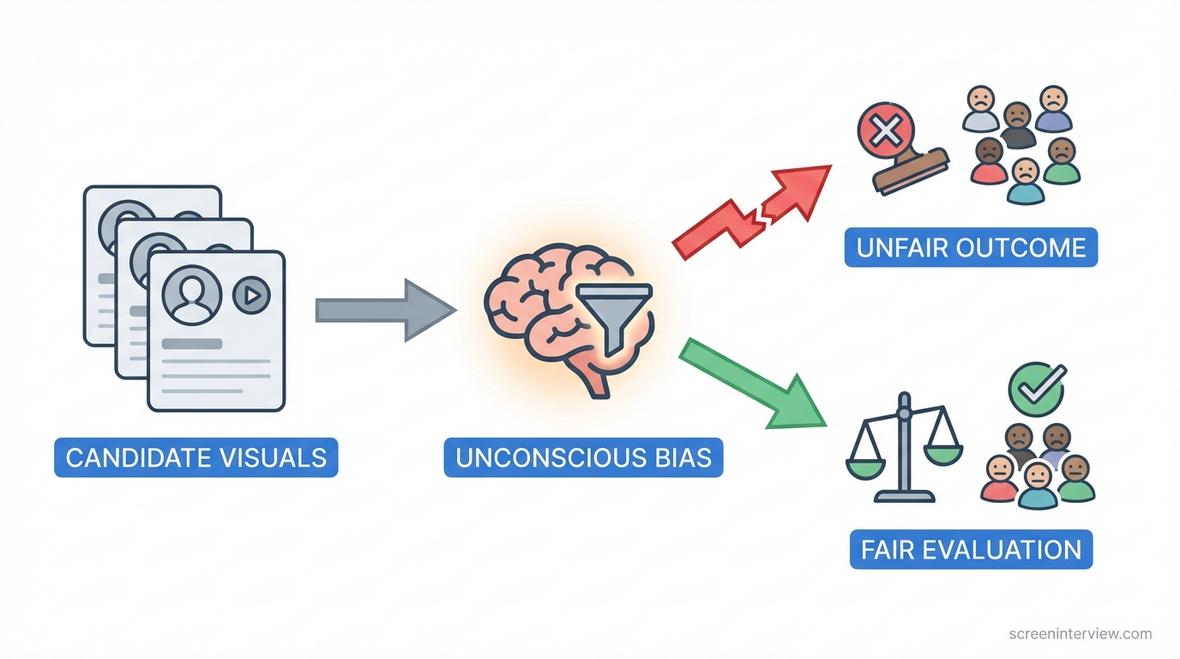
In-person interviews represent the highest-risk scenario for appearance bias. Face-to-face interactions provide maximum visual information, activating all the cognitive shortcuts that drive biased decision-making. Candidates may be judged on factors ranging from height and weight to clothing brands, hairstyles, visible tattoos or piercings, and even subtle factors like posture and facial expressions. These judgments often occur before substantive conversation begins, creating confirmation bias where interviewers seek information that validates their initial impressions.
The scoring and evaluation phase presents additional vulnerability. When interviewers rely on subjective 'gut feelings' rather than structured evaluation criteria, appearance bias heavily influences final decisions. Recruiters may rationalize these biased judgments with post-hoc justifications about 'cultural fit' or 'executive presence' that mask underlying appearance-based preferences. Implementing structured interview insights helps organizations identify and correct these patterns.
Industries and Roles Most Affected by Appearance Bias
While appearance bias affects hiring across all sectors, certain industries and roles experience disproportionate impact. Customer-facing positions including sales, hospitality, retail, and client services often involve explicit or implicit appearance expectations that may not correlate with job performance. Employers may justify appearance-based selection by claiming customer preferences, but this perpetuates discriminatory patterns without improving business outcomes.
Executive and leadership roles face particularly acute appearance bias challenges. Research demonstrates that leaders who fit traditional appearance stereotypes particularly regarding height, attractiveness, and masculine features receive preferential treatment in hiring and promotion decisions. This 'executive presence' bias limits leadership diversity and excludes qualified candidates whose appearance doesn't match conventional expectations, ultimately weakening organizational leadership capacity.
Technology and engineering roles, despite emphasizing technical skills, are not immune to appearance bias. Studies reveal that candidates in technical fields face judgments about whether they 'look like' engineers or developers, with these stereotypes disadvantaging women, older workers, and candidates from underrepresented backgrounds. Even when organizations use AI-powered technical interviews, bias can occur during subsequent human review stages if appearance information is included.
Data-Driven Approaches to Reducing Appearance Bias
Addressing appearance bias requires systematic, evidence-based interventions rather than relying on individual awareness or good intentions. The most effective approach involves removing or minimizing appearance information during critical evaluation stages. Blind screening where identifying information including photos, names, and universities is removed from applications demonstrates consistent success in improving candidate diversity without compromising quality.
Structured interviews represent another powerful tool for bias mitigation. By standardizing questions, evaluation criteria, and scoring processes, organizations reduce the influence of subjective impressions including those based on appearance. Research shows that structured interviews with predetermined competency-based questions and behavioral rating scales significantly improve hiring accuracy while reducing various forms of bias. Modern platforms offering customizable interview builders make it easier to implement these structured approaches at scale.
Technology solutions provide additional leverage for reducing appearance bias. AI-powered screening tools can evaluate candidates based exclusively on job-relevant qualifications, skills assessments, and work samples without incorporating appearance information. According to research from Korn Ferry, 84% of talent leaders to use AI in 2026 for recruitment, reflecting widespread recognition that technology can help mitigate human biases when properly implemented. However, organizations must carefully audit their AI interviewer systems to ensure they don't inadvertently encode or amplify existing biases.
Skills-based assessments offer another evidence-based approach. By evaluating candidates through work samples, technical tests, and practical exercises rather than interviews alone, organizations can assess capability directly rather than inferring it from appearance or other proxies. This approach aligns with broader talent acquisition trends emphasizing demonstrable skills over credentials or impressions. Platforms specializing in comprehensive skills assessment enable recruiters to prioritize objective capability evaluation throughout their screening processes.
Implementing Effective Bias Training Programs
While process changes and technology provide essential infrastructure for reducing appearance bias, human judgment remains central to most hiring decisions. This makes bias training an important complementary strategy, though research shows that training alone produces limited lasting impact without supporting systemic changes. The most effective bias training programs focus on specific, actionable behavioral changes rather than general awareness.
Effective training should educate recruiters about the psychological mechanisms underlying appearance bias, including the halo effect, confirmation bias, and stereotype activation. However, knowledge alone doesn't change behavior training must also provide concrete strategies that recruiters can implement immediately. These include techniques like deliberately slowing down evaluation processes, using structured scoring rubrics, seeking disconfirming evidence for initial impressions, and focusing attention on job-relevant information rather than extraneous characteristics.
Organizations should complement initial training with ongoing reinforcement through regular refreshers, feedback on hiring decisions, and accountability mechanisms. Data analytics can identify patterns suggesting bias in individual recruiter decisions or across hiring panels, enabling targeted interventions. Some leading organizations conduct regular audits examining whether candidates who advance through screening stages differ systematically in appearance-related characteristics from those who don't, using these insights to refine both training and processes. Resources on eliminating interviewing bias provide additional guidance for implementation.
Technology Solutions for Appearance Bias in 2026
The rapid advancement of recruitment technology has created powerful new tools for addressing appearance bias. Modern applicant tracking systems and interview platforms now incorporate features specifically designed to minimize bias throughout the hiring process. These technological solutions work by controlling information flow ensuring evaluators only access job-relevant candidate data during critical decision points.
Asynchronous video interview platforms with bias-reduction features represent significant progress. Advanced systems can present interview responses as text transcripts or audio-only formats, removing visual information while preserving candidates' answers for evaluation. Some platforms incorporate AI analysis that evaluates response content based on predefined competency frameworks, providing objective scoring that supplements human judgment. Organizations using on-demand interview technology can configure these settings to match their specific bias mitigation priorities.
AI-powered screening and assessment tools continue evolving with increasingly sophisticated bias detection and mitigation capabilities. These systems can evaluate candidates based on skills, experience, and work sample performance without incorporating appearance data. However, talent leaders must recognize that AI systems are not automatically bias-free they require careful design, training data curation, and ongoing monitoring to ensure they don't replicate or amplify human biases. The fact that 99.8% of TA teams adopting AI agents in 2026 underscores both the opportunity and the responsibility to implement these tools thoughtfully.
Integrated platforms that combine multiple bias mitigation strategies offer the most comprehensive solutions. These systems orchestrate blind resume screening, structured interview delivery, standardized evaluation rubrics, and analytics dashboards that surface potential bias patterns all within unified workflows. For recruiting professionals managing high-volume pipelines, such integrated approaches deliver both efficiency gains and fairness improvements without requiring candidates to navigate fragmented tool sets.
Measuring Success: Metrics for Bias Reduction
Implementing appearance bias mitigation strategies requires measuring their effectiveness through relevant metrics and KPIs. Organizations cannot manage what they don't measure, making data collection and analysis essential for continuous improvement. The most meaningful metrics examine both process indicators and outcome measures across the candidate journey.
Process metrics should track the extent to which bias mitigation protocols are actually followed. This includes measuring what percentage of applications undergo blind screening, how consistently structured interview protocols are implemented, and whether evaluation forms are completed according to established rubrics. Compliance with bias mitigation processes indicates whether interventions have been embedded into daily practice or remain theoretical commitments.
Outcome metrics examine the results of hiring processes, particularly regarding candidate diversity and quality. Organizations should analyze demographic composition at each hiring funnel stage application, screening, interview, offer, and acceptance identifying where certain groups experience disproportionate attrition. Significant dropoffs at particular stages may indicate bias. However, demographic parity alone doesn't guarantee fairness; organizations must also examine whether hired candidates perform well and remain with the company, ensuring that bias mitigation doesn't come at the expense of quality.
Candidate experience metrics provide additional insights. Survey data capturing candidates' perceptions of fairness, respect, and evaluation relevance can reveal whether process changes translate into improved experiences. Organizations serious about addressing appearance bias should also track time-to-hire and quality-of-hire metrics, demonstrating that fair processes can simultaneously improve efficiency and candidate quality. Comprehensive guidance on candidate experience metrics helps recruiting teams select the most meaningful indicators for their contexts.
Legal and Compliance Considerations
Appearance bias intersects significantly with employment law and regulatory compliance, making legal considerations essential for any comprehensive mitigation strategy. While appearance itself typically isn't a protected characteristic under discrimination law, appearance-based decisions frequently correlate with protected categories including race, national origin, gender, age, disability, and religion. This correlation means that appearance bias can constitute illegal discrimination even when not explicitly targeting protected characteristics.
Title VII of the Civil Rights Act, the Age Discrimination in Employment Act, the Americans with Disabilities Act, and similar statutes prohibit employment decisions based on protected characteristics. When appearance preferences disadvantage candidates from protected groups even unintentionally organizations face legal exposure. For example, grooming policies that prohibit certain hairstyles may disproportionately affect candidates of specific racial backgrounds, creating disparate impact discrimination.
Some jurisdictions have enacted explicit protections against appearance-based discrimination. Several states and localities prohibit discrimination based on height, weight, or personal appearance, particularly when these characteristics don't affect job performance. Organizations operating across multiple jurisdictions must understand varying legal requirements and implement hiring practices that meet the highest applicable standards.
Documentation becomes crucial for both compliance and defense. Organizations should maintain detailed records of job requirements, evaluation criteria, interviewer training, candidate assessments, and hiring rationales. When decisions can be defended based on objective, job-related qualifications rather than subjective impressions, organizations significantly reduce legal risk. Implementing systematic recording and review processes supports both fairness objectives and legal compliance requirements.
Creating Organizational Culture Change
Sustainable progress against appearance bias requires culture change that extends beyond policy implementation to transform how organizations think about talent and evaluation. This cultural transformation must engage leadership, managers, and employees across the organization, not just recruiting teams. When reducing bias becomes a shared organizational value rather than a compliance exercise, interventions gain the support and resources necessary for lasting impact.
Leadership commitment provides essential foundation for culture change. When executives publicly prioritize fair hiring, allocate resources to bias mitigation initiatives, and hold leaders accountable for diversity outcomes, they signal that these efforts represent core business priorities rather than peripheral HR initiatives. This top-down commitment enables recruiting professionals to implement meaningful changes without facing resistance from hiring managers who may prefer traditional approaches.
Transparency and communication sustain culture change momentum. Organizations should share data about hiring outcomes, bias mitigation efforts, and progress toward diversity goals with internal stakeholders. This transparency builds accountability while demonstrating that bias mitigation produces tangible results. Some leading organizations publish diversity reports externally, using public commitments to reinforce internal accountability. Insights from workplace bias training programs can inform broader cultural initiatives beyond recruitment.
Continuous improvement processes ensure that bias mitigation evolves with emerging challenges and opportunities. Organizations should regularly review hiring data, solicit feedback from candidates and recruiters, monitor developments in bias research and technology, and refine their approaches accordingly. This iterative approach recognizes that addressing appearance bias represents an ongoing journey rather than a one-time fix, requiring sustained attention and adaptation as recruitment contexts change.
Future Trends: The Evolution of Bias-Free Hiring
The landscape of appearance bias mitigation continues evolving rapidly, driven by technological innovation, regulatory developments, and shifting social expectations. Understanding emerging trends helps recruiting professionals anticipate future challenges and opportunities, positioning their organizations at the forefront of fair hiring practices. Several key trends will shape bias mitigation strategies in coming years.
Artificial intelligence will play an increasingly central role in reducing appearance bias, but with growing scrutiny regarding AI fairness. Regulatory frameworks like the EU AI Act and similar initiatives in other jurisdictions will require organizations to demonstrate that AI hiring tools don't produce discriminatory outcomes. This regulatory pressure will drive development of more sophisticated bias detection and mitigation capabilities, while also requiring greater transparency about how AI systems make decisions. Organizations must balance AI's bias reduction potential against compliance requirements and ethical considerations.
Skills-based hiring will continue displacing credential-based approaches, reducing reliance on subjective evaluations where appearance bias thrives. As emphasized in recent 2026 hiring trends emphasize skills over appearance biases, forward-thinking organizations increasingly evaluate candidates based on demonstrated capabilities rather than proxies like educational pedigree or interview impressions. This shift aligns naturally with appearance bias mitigation, as skills assessments focus attention on job-relevant factors rather than extraneous characteristics.
Virtual and hybrid work arrangements will transform interview dynamics in ways that both challenge and support bias mitigation efforts. While video interviews present appearance bias risks, they also enable new mitigation strategies like standardized virtual environments that minimize distracting visual information. Organizations may increasingly adopt audio-only or text-based screening stages before any visual interaction, creating more opportunities to evaluate candidates based on qualifications before appearance information enters the process.
Frequently Asked Questions About Appearance Bias
What is the difference between appearance bias and other forms of hiring bias?
Appearance bias specifically refers to judgments based on physical appearance and visual presentation, while other biases may stem from factors like educational background, work history, or communication style. However, appearance bias frequently intersects with other bias forms, particularly those involving protected characteristics like race, gender, and age, making it especially important to address through comprehensive bias mitigation strategies.
Can blind hiring completely eliminate appearance bias?
Blind hiring significantly reduces appearance bias during initial screening stages by removing visual information from evaluation. However, most hiring processes eventually include some form of direct interaction where appearance information becomes available. Blind hiring should therefore be combined with structured interviews, standardized evaluation criteria, and bias training to maintain fairness throughout the entire candidate journey.
How do I convince hiring managers to adopt bias mitigation processes?
Focus on business outcomes rather than compliance language. Present data showing how bias mitigation improves hiring quality, reduces time-to-fill, expands talent pools, and enhances organizational performance. Pilot programs demonstrating results in specific departments can build credibility, while executive sponsorship provides necessary authority to implement changes across the organization.
Are there situations where appearance legitimately matters for job performance?
Very few roles have genuine appearance-related requirements that affect job performance. When appearance considerations exist such as specific uniforms for safety or brand representation these should be clearly defined as job requirements and applied consistently to all candidates. Personal grooming preferences or subjective attractiveness judgments are rarely job-relevant and typically mask bias rather than legitimate requirements.
How can technology help without introducing new biases?
Technology reduces appearance bias by standardizing evaluation processes, removing visual information during critical decision points, and providing objective capability assessments. However, AI systems require careful design, diverse training data, ongoing monitoring, and regular audits to ensure they don't replicate human biases. Organizations should work with vendors who demonstrate commitment to fairness and provide transparency about how their systems function.
Conclusion
Appearance bias represents a critical challenge for modern recruiting professionals committed to building high-performing, diverse teams through fair evaluation processes. As organizations screen increasing candidate volumes while facing heightened expectations for equitable hiring, addressing appearance bias has become both a moral imperative and a competitive necessity. The strategies outlined in this guide from blind screening and structured interviews to AI-powered assessment tools and comprehensive bias training provide practical pathways for reducing appearance bias at every stage of the recruitment funnel. Success requires combining technological solutions with process discipline, cultural change, and ongoing measurement to ensure that hiring decisions reflect candidate capabilities rather than superficial characteristics. By implementing these approaches systematically, recruiting leaders can simultaneously improve hiring quality, expand talent pools, enhance candidate experience, and demonstrate organizational commitment to fairness in an increasingly competitive and scrutinized talent landscape.
Ready to Transform Your Interview Process?
See how ScreenInterview can help you automate phone screens, reduce bias, and hire better candidates faster.