
Appearance Bias Definition: How Physical Judgments Undermine Fair Hiring In Modern Recruitment

What Is Appearance Bias? A Comprehensive Definition
Appearance bias, also known as beauty bias or lookism, refers to the unconscious or conscious tendency to form judgments about a person's competence, character, and suitability based on their physical appearance rather than their actual qualifications, skills, or experience. In recruitment contexts, appearance bias definition specifically describes the phenomenon where hiring decisions are influenced by a candidate's looks, grooming, weight, height, facial features, or style of dress instead of job-relevant criteria.
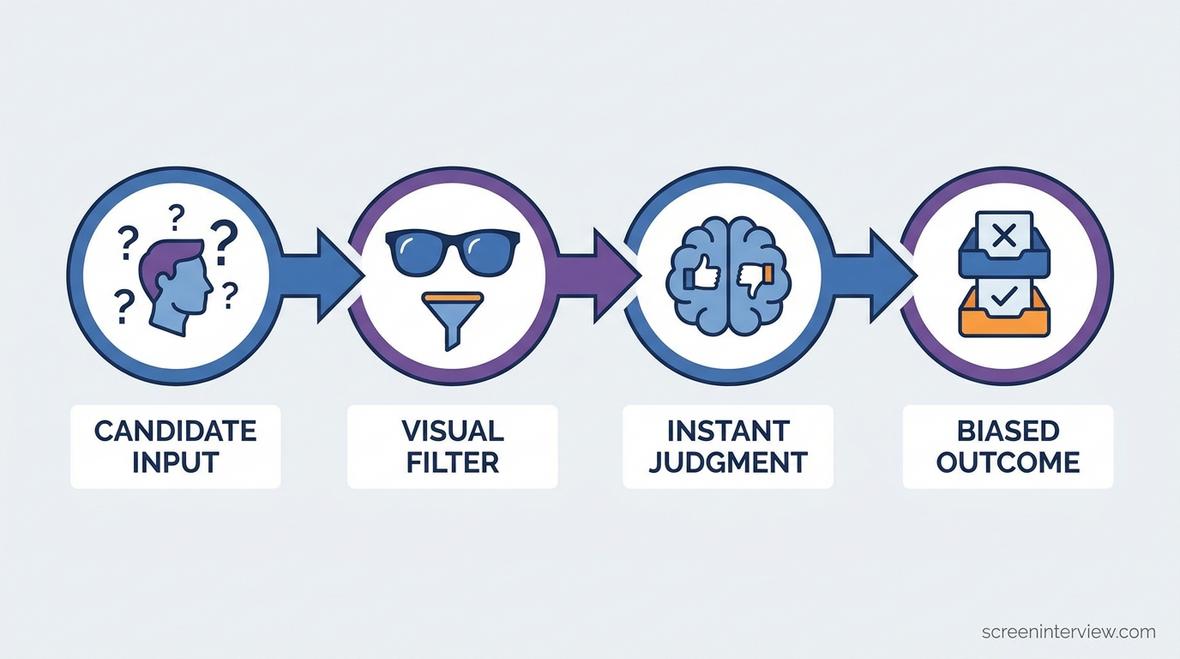
According to peer-reviewed research on appearance-based bias and source memory, physical appearance creates perceptual biases that lead to overgeneralized personality judgments from facial qualities alone. This cognitive shortcut causes recruiters and hiring managers to make snap decisions within the first few seconds of meeting a candidate often before any meaningful conversation has occurred.
The general psychology definition of bias frames it as a tendency or prejudice toward or against someone or something. When applied to physical characteristics, this bias manifests as systematic advantages for conventionally attractive candidates and disadvantages for those who don't fit narrow aesthetic standards. For modern recruiting professionals seeking to build diverse, high-performing teams, understanding and mitigating appearance bias has become a critical operational priority.
The Psychology Behind Appearance Bias in Hiring Decisions
Appearance bias doesn't emerge from deliberate discrimination in most cases it's rooted in deeply ingrained cognitive processes that evolved over millennia. Human brains are wired to make rapid assessments based on visual information, a survival mechanism that helped our ancestors quickly identify threats or allies. However, these same mental shortcuts create systematic errors in professional evaluation contexts.
Research from cognitive psychology demonstrates that people automatically associate physical attractiveness with positive personality traits a phenomenon called the 'halo effect.' When a recruiter perceives a candidate as physically attractive, they unconsciously assume that person is also more intelligent, competent, trustworthy, and socially skilled. Conversely, candidates who don't meet conventional beauty standards may be perceived as less capable, regardless of their actual qualifications.
The APA's research on bias in social cognition shows that these appearance-based judgments happen within milliseconds and operate below conscious awareness. Even recruiters who genuinely believe they evaluate candidates objectively are susceptible to these automatic associations. This makes appearance bias particularly insidious it operates invisibly, shaping hiring outcomes without leaving obvious evidence.
Common Manifestations of Appearance Bias in Recruitment
Appearance bias manifests in multiple ways throughout the hiring process:
- Resume screening based on photos: When candidate photos are included, recruiters spend less time reviewing qualifications and more time forming appearance-based impressions.
- First impression dominance: Initial visual assessments during video or in-person interviews disproportionately influence final hiring decisions, even when subsequent performance data contradicts those impressions.
- Dress code assumptions: Candidates who dress in ways that don't align with corporate norms face negative evaluations, even when their attire has no bearing on job performance.
- Weight and height discrimination: Taller candidates and those who fit conventional body standards receive higher ratings and salary offers across industries.
- Facial feature judgments: Specific facial characteristics trigger assumptions about personality traits, with symmetrical faces and certain expressions receiving preferential treatment.
These biases don't just affect individual hiring decisions they compound over time, creating systemic barriers that prevent talented professionals from advancing while perpetuating homogeneous organizational cultures.
The Business Impact of Appearance Bias on Recruiting Outcomes
For Heads of Talent and People Operations Managers, appearance bias represents both an ethical concern and a significant business risk. When hiring decisions are influenced by physical appearance rather than merit, organizations systematically exclude qualified candidates, reduce team diversity, and ultimately undermine competitive advantage.
Research consistently demonstrates that diverse teams outperform homogeneous ones across innovation, problem-solving, and financial metrics. However, appearance bias actively works against diversity initiatives by favoring candidates who conform to narrow aesthetic standards standards that often correlate with dominant demographic groups. This creates a feedback loop where existing organizational homogeneity is reinforced through biased selection processes.
The Quantifiable Costs of Appearance-Based Hiring
The financial implications of appearance bias are substantial:
- Lost talent acquisition: Top-tier candidates who don't fit appearance expectations are systematically filtered out, forcing organizations to settle for less qualified candidates who happen to 'look the part.'
- Increased time-to-hire: When recruiters prioritize appearance over qualifications, they often need multiple rounds to find candidates who can actually perform the role, extending hiring cycles unnecessarily.
- Higher turnover rates: Employees hired primarily for their appearance rather than fit and capability are more likely to underperform or leave, increasing replacement costs.
- Legal and reputational risks: Appearance-based discrimination can expose organizations to legal liability and damage employer brand, making it harder to attract future talent.
- Innovation deficits: Homogeneous teams produced by biased hiring lack the cognitive diversity necessary for breakthrough thinking and adaptive problem-solving.
For recruiting professionals managing high-volume screening processes, these inefficiencies multiply across every open position, creating substantial operational drag that undermines departmental performance metrics and organizational objectives.
How to Identify Appearance Bias in Your Recruitment Process
Before you can address appearance bias, you need to recognize where it's operating within your existing hiring workflows. Modern recruiting professionals can use several diagnostic approaches to detect appearance-based decision patterns:
Data Analysis Methods
Conduct demographic analysis of your hiring funnel at each stage. Compare the diversity profile of your applicant pool against interview invitations, second-round selections, and final offers. Significant drop-offs at in-person or video interview stages particularly for candidates from underrepresented groups may indicate appearance bias is influencing evaluations.
Track correlation patterns between interviewer ratings and candidate characteristics that should be irrelevant to job performance. If certain physical attributes consistently predict hiring recommendations across unrelated roles, you've likely identified systemic bias.
Process Audit Techniques
Review your current screening and interview procedures against workplace bias types including beauty bias frameworks:
- Do you require or accept candidate photos before the interview stage?
- Are video interviews scheduled before skills assessments or work sample reviews?
- Do interviewers have access to candidate social media profiles containing appearance information?
- Are interview evaluation criteria clearly defined and job-relevant, or do they include subjective 'culture fit' assessments?
- Do you conduct structured interviews with consistent questions, or do conversations vary significantly between candidates?
Each affirmative answer represents a potential entry point for appearance bias to influence hiring decisions. Organizations serious about fair evaluation must systematically close these gaps through process redesign.
Evidence-Based Strategies to Mitigate Appearance Bias
Eliminating appearance bias requires intentional intervention at multiple points throughout the recruitment lifecycle. Modern recruiting professionals have access to proven strategies and technology solutions that significantly reduce appearance-based judgment errors:
Implement Blind Screening Protocols
The most direct approach to preventing appearance bias is removing appearance information from initial evaluation stages entirely. Blind interview methodologies strip identifying information including photos, names, and demographic indicators from resumes and applications before reviewers assess qualifications.
Research consistently shows that blind screening increases diversity outcomes by forcing evaluators to focus exclusively on skills, experience, and demonstrated capabilities. For technical roles, blind coding assessments and work sample tests provide objective performance data that replaces subjective appearance-based impressions.
Deploy Structured Interview Frameworks
Structured interviews use predetermined questions asked in consistent order across all candidates, with standardized evaluation rubrics that define what constitutes strong versus weak responses. This approach dramatically reduces interviewer discretion the primary mechanism through which unconscious biases influence hiring decisions.
When implementing structured interviews, ensure your evaluation criteria focus exclusively on job-relevant competencies. Avoid vague assessments like 'executive presence' or 'culture fit' that often serve as proxies for appearance-based judgments.
Leverage AI-Powered Screening Technology
Advanced AI interview platforms can conduct initial candidate screening without introducing appearance bias. These systems evaluate candidates based on their responses to job-relevant questions, analyzing content, problem-solving approaches, and domain knowledge rather than physical presentation.
The AI interviewer technology available through modern recruiting platforms enables organizations to assess hundreds of candidates consistently and objectively, identifying top talent based on merit rather than appearance. This approach is particularly valuable for high-volume recruiting scenarios where manual screening becomes susceptible to cognitive fatigue and bias amplification.
Delay Visual Contact Until Later Stages
Structure your hiring process to conduct skills assessments, technical evaluations, and initial screening before any visual contact occurs. Telephone screening and audio-only interviews eliminate appearance information while still allowing recruiters to assess communication skills, enthusiasm, and cultural alignment.
By the time candidates advance to video or in-person interviews, you'll have substantial objective data about their qualifications, making it easier to recognize and counter any appearance-based impressions that arise.
Train Interview Teams on Bias Recognition
While awareness training alone is insufficient to eliminate unconscious bias, it remains a valuable component of comprehensive bias mitigation strategies. Help your interview teams understand how appearance bias operates, recognize when they're making appearance-based assumptions, and actively counter those impulses with evidence-based evaluation.
Incorporate bias interruption techniques where team members are empowered to gently challenge appearance-based comments during hiring discussions, redirecting conversations toward job-relevant criteria.
Technology Solutions for Bias-Free Candidate Evaluation
Modern recruiting technology offers powerful tools for reducing appearance bias while simultaneously improving efficiency and candidate experience. For tech-savvy recruiting professionals already using ATS platforms, integrating AI-powered screening solutions represents a natural evolution that addresses both operational and fairness objectives.
AI Proctoring for Assessment Integrity
When conducting skills assessments remotely, AI proctoring technology ensures evaluation integrity without requiring live human observation. This eliminates the need for video-based monitoring that could introduce appearance bias while still maintaining assessment validity.
Automated Interview Analysis
Advanced platforms can analyze candidate responses to standardized interview questions, evaluating content quality, problem-solving approaches, and domain expertise without consideration of physical appearance. Interview insights generated through automated analysis provide objective performance metrics that support evidence-based hiring decisions.
Workflow Automation for Consistency
Human judgment becomes increasingly inconsistent as cognitive fatigue sets in during high-volume screening. Workflow automation ensures every candidate receives identical evaluation procedures regardless of when they're processed, eliminating the variability that amplifies bias.
On-Demand Interview Platforms
On-demand interview solutions allow candidates to complete screening assessments asynchronously, with responses reviewed by multiple evaluators using standardized rubrics. This separation of performance from appearance reduces the impact of first impressions while improving scheduling efficiency.
Building a Culture of Fair Hiring Beyond Appearance
Technology and process improvements provide essential infrastructure for reducing appearance bias, but sustainable change requires cultural transformation. Modern recruiting leaders must champion fairness as a core organizational value, embedding bias mitigation into everyday practices rather than treating it as a compliance checkbox.
Establish Leadership Accountability
Ensure hiring managers and interview team members understand that diversity and inclusion outcomes factor into their performance evaluations. When decision-makers know their hiring patterns will be analyzed for bias indicators, they become more intentional about applying structured evaluation criteria.
Implement Transparent Metrics Tracking
Regularly publish internal data on hiring funnel diversity metrics, highlighting where candidates from underrepresented groups are dropping out of your process. This transparency creates organizational pressure to investigate and address the underlying causes, including appearance bias.
Create Candidate Feedback Mechanisms
Solicit feedback from candidates particularly those not selected about their experience with your hiring process. Patterns in responses about feeling judged on appearance rather than qualifications can reveal bias blind spots your internal team hasn't recognized.
Legal and Compliance Considerations for Appearance-Based Discrimination
While appearance itself isn't a protected class under federal employment discrimination law in most jurisdictions, appearance bias often correlates with and reinforces discrimination based on protected characteristics including race, gender, age, and disability. This creates significant legal exposure for organizations with appearance-biased hiring practices.
For example, grooming standards and dress code expectations that seem appearance-neutral may have disparate impact on specific demographic groups, constituting indirect discrimination. Hair texture policies, facial hair restrictions, and body modification prohibitions have all generated successful discrimination claims when they systematically exclude protected groups.
Modern recruiting professionals must ensure their hiring practices can withstand legal scrutiny by demonstrating that evaluation criteria are job-relevant and consistently applied. Documentation showing structured evaluation processes, blind screening protocols, and objective assessment data provides essential evidence that decisions were based on merit rather than appearance.
Frequently Asked Questions About Appearance Bias in Hiring
How quickly does appearance bias influence hiring decisions?
Research shows that appearance-based impressions form within the first 7-10 seconds of visual contact. These initial judgments disproportionately influence final hiring decisions, even when subsequent information contradicts them. This is why delaying visual contact until after objective assessments is so effective at reducing bias.
Can training eliminate appearance bias from recruiting?
Awareness training alone is insufficient to eliminate unconscious bias. While it helps recruiters recognize when bias may be operating, it doesn't prevent automatic cognitive processes from generating appearance-based impressions. Effective bias mitigation requires combining awareness with structural interventions like blind screening, standardized evaluations, and technology-enabled objectivity.
Is appearance bias worse in video interviews than in-person interviews?
Video interviews can actually amplify certain aspects of appearance bias because visual information is presented without the contextual richness of in-person interaction. Factors like lighting, camera angle, and background become additional appearance-based data points that influence judgments. However, video interviews also enable blind screening alternatives like AI-powered phone screening that eliminate visual bias entirely.
What role does AI play in reducing appearance bias?
AI systems can evaluate candidate qualifications and responses without processing appearance information, eliminating a major source of bias. However, AI tools must be carefully designed and validated to ensure they don't perpetuate historical bias patterns encoded in training data. When properly implemented, AI transforms fair recruitment practices by providing consistent, objective evaluation at scale.
How can I convince hiring managers to adopt appearance bias mitigation strategies?
Frame bias mitigation in business terms: better quality of hire, reduced time-to-fill, improved retention, and enhanced innovation through diversity. Provide data showing how current processes may be filtering out qualified candidates based on irrelevant criteria, costing the organization top talent. Pilot structured approaches with specific roles and demonstrate improved outcomes before scaling organization-wide.
Conclusion
Appearance bias represents one of the most pervasive yet overlooked obstacles to fair, effective recruiting. For modern talent acquisition professionals committed to building high-performing, diverse teams, understanding the appearance bias definition is only the first step. True progress requires implementing structural interventions blind screening protocols, standardized evaluation frameworks, and AI-powered assessment technologies that prevent appearance from influencing hiring decisions. By combining process discipline with advanced recruiting technology, organizations can ensure every candidate is evaluated on merit rather than physical presentation, ultimately identifying the top-tier talent that drives competitive advantage. The recruitment leaders who prioritize fairness today will build the innovative, resilient teams that define organizational success tomorrow.
Ready to Transform Your Interview Process?
See how ScreenInterview can help you automate phone screens, reduce bias, and hire better candidates faster.