
AI-Powered Interview: Complete Guide To Automated Hiring Technology In 2026

Introduction to AI-Powered Interview Technology
The recruitment landscape has undergone a dramatic transformation in recent years, with ai-powered interview platforms emerging as the cornerstone of modern talent acquisition. As organizations face mounting pressure to hire faster while maintaining quality, artificial intelligence has stepped in to revolutionize how companies identify, assess, and select candidates. These intelligent systems combine machine learning algorithms, natural language processing, and behavioral analytics to streamline hiring workflows that traditionally consumed weeks of recruiter time.
According to Statista: AI in Recruitment Market Size and Growth Projections, the adoption of AI recruiting technology has accelerated significantly, with year-over-year growth trends indicating substantial sector-specific penetration across talent acquisition functions. This shift represents more than just automation it's a fundamental reimagining of how organizations approach candidate evaluation.
Modern ai-powered interview solutions offer capabilities that extend far beyond simple resume screening. They conduct comprehensive assessments through video analysis, voice pattern recognition, skills testing, and behavioral evaluations, all while reducing unconscious bias and improving candidate experience. For organizations looking to stay competitive in 2026's talent market, understanding these technologies is no longer optional it's essential.
What is an AI-Powered Interview?
An ai-powered interview is an automated recruitment process that leverages artificial intelligence to conduct, evaluate, and score candidate interactions without requiring real-time human involvement. Unlike traditional interviews that demand significant recruiter time and scheduling coordination, these systems enable candidates to complete assessments on their own schedule while AI algorithms analyze responses across multiple dimensions.
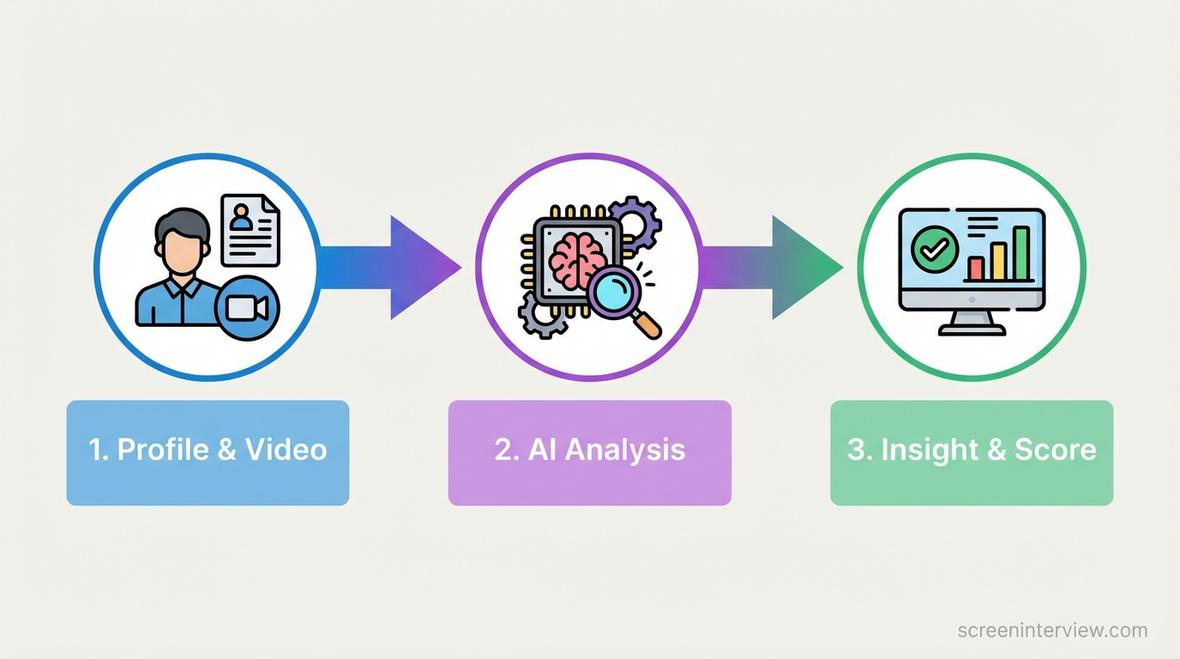
The process typically follows a structured workflow: candidates submit their profile information and complete video or audio responses to predetermined questions. The AI then processes this data through sophisticated algorithms that evaluate verbal communication, technical competency, emotional intelligence, and cultural fit indicators. Finally, the system generates comprehensive insights, data visualizations, and candidate scores that help hiring teams make informed decisions.
Core Components of AI Interview Systems
Effective ai-powered interview platforms integrate several technological components. Natural language processing enables the system to understand and evaluate spoken or written responses, while computer vision analyzes facial expressions and body language in video submissions. Machine learning models trained on thousands of successful hires identify patterns that correlate with job performance, and sentiment analysis gauges candidate enthusiasm and cultural alignment.
Platforms like ScreenInterview's AI Interview solution combine these elements into cohesive systems that handle everything from question delivery to final scoring, creating seamless experiences for both candidates and recruiters.
Key Benefits of AI-Powered Interviews
Organizations implementing ai-powered interview technology report transformative improvements across multiple hiring metrics. The advantages extend beyond simple time savings to encompass quality, consistency, and strategic impact.
Dramatic Efficiency Improvements
The most immediate benefit is the massive reduction in time-to-hire. Traditional screening processes that might require 20-30 minutes per candidate can be compressed into automated workflows that handle hundreds of applicants simultaneously. Recruiters who previously spent 60-70% of their time on initial screenings can redirect that energy toward relationship-building with top candidates and strategic talent planning.
Workflow automation capabilities enable recruiters to design complex interview sequences that adapt based on candidate responses, creating personalized assessment experiences without manual intervention.
Enhanced Fairness and Bias Reduction
Unconscious bias remains one of recruitment's most persistent challenges. AI-powered interview systems address this by standardizing evaluation criteria and removing demographic information from initial assessments. Every candidate receives identical questions presented in the same format, and scoring algorithms focus exclusively on job-relevant competencies rather than subjective impressions.
Organizations committed to building diverse teams can leverage unbiased candidate screening practices that AI platforms facilitate, ensuring that talent is evaluated solely on merit and potential.
Improved Candidate Experience
Contrary to concerns about impersonal automation, well-designed ai-powered interview platforms often enhance candidate experience. The flexibility to complete assessments on personal schedules eliminates the stress of coordinating multiple interview rounds, while immediate feedback mechanisms keep applicants engaged throughout the process. Candidates appreciate the transparency of standardized evaluation and the opportunity to showcase skills through diverse assessment formats beyond traditional conversation.
How to Implement AI-Powered Interviews
Successfully deploying ai-powered interview technology requires thoughtful planning and execution. Organizations that approach implementation strategically realize value faster and encounter fewer adoption challenges.
Step 1: Assess Your Hiring Needs
Begin by analyzing your current recruitment challenges. Are you struggling with high-volume hiring for entry-level positions? Do technical assessments consume excessive engineering time? Is unconscious bias affecting diversity metrics? Different ai-powered interview solutions excel in different scenarios, so clarity on your specific pain points ensures you select the right technology.
For technical roles, specialized platforms offering software engineer AI interviews or data scientist assessments provide role-specific evaluation frameworks that generic systems cannot match.
Step 2: Select the Right Platform
The market offers numerous ai-powered interview platforms with varying capabilities. Evaluate options based on integration capabilities with your existing applicant tracking system, the sophistication of AI algorithms, customization options, compliance features, and vendor support quality. Request demonstrations with your actual job descriptions and candidate profiles to see how different systems perform with your specific use cases.
Consider exploring comprehensive platform comparisons that analyze features, pricing, and suitability for different organizational contexts.
Step 3: Launch a Pilot Program
Rather than organization-wide deployment, start with a controlled pilot targeting one department or role type. This approach allows you to refine question libraries, calibrate scoring algorithms, and address technical issues before broader rollout. Collect feedback from both recruiters and candidates during the pilot to identify improvement opportunities.
Step 4: Train Your Team
Even the most sophisticated ai-powered interview platform delivers limited value if recruiters don't understand how to leverage its capabilities. Invest in comprehensive training that covers not just system mechanics but also how to interpret AI-generated insights, when to override algorithmic recommendations, and how to explain the process to candidates and hiring managers.
AI-Powered Interviews for Different Roles
The versatility of ai-powered interview technology enables customization for virtually any position type, with specialized assessment frameworks that evaluate role-specific competencies.
Technical and Engineering Positions
For software development and engineering roles, AI platforms can administer coding challenges, evaluate algorithm efficiency, and assess system design thinking. These systems analyze not just whether code functions correctly but also coding style, problem-solving approach, and explanation clarity. Frontend developer interviews, backend developer assessments, and DevOps engineer evaluations each employ frameworks tailored to their specific technical domains.
Leadership and Management Positions
Evaluating leadership potential requires different assessment dimensions. AI-powered interview platforms for managerial roles analyze situational judgment, conflict resolution approaches, strategic thinking, and team development philosophy. Video analysis can identify communication patterns associated with effective leadership, while scenario-based questions reveal decision-making frameworks. Specialized leadership and people management assessments provide these targeted evaluations.
Creative and Design Roles
For positions requiring creative thinking, AI systems evaluate portfolio work, design rationale, and problem-solving creativity. UX designer interviews might assess user empathy and design process thinking, while UI designer evaluations focus on visual hierarchy understanding and interface consistency.
Advanced Features of Modern AI Interview Platforms
Today's leading ai-powered interview solutions offer sophisticated capabilities that extend far beyond basic question-and-answer formats.
Intelligent Scheduling and Coordination
Advanced platforms incorporate intelligent scheduling systems that automatically coordinate multi-round interviews, sync with recruiter calendars, send reminders, and handle rescheduling requests without manual intervention. This automation eliminates the administrative burden that typically consumes 15-20% of recruiter time.
Interview Proctoring and Security
For high-stakes assessments, interview proctoring capabilities ensure candidate authenticity through identity verification, browser lockdown, and behavior monitoring. These features detect potential cheating attempts while respecting candidate privacy, creating secure assessment environments comparable to in-person testing.
Comprehensive Interview Insights
The most valuable output from ai-powered interview systems isn't just pass/fail scores it's the rich analytical insights they generate. Interview insights platforms provide comparative analytics showing how candidates stack up against peer groups, identify skill gaps that training could address, and predict performance trajectories based on historical data patterns.
Best Practices for AI-Powered Interview Success
Maximizing the value of ai-powered interview technology requires adherence to proven implementation and operational practices.
Design Thoughtful Question Libraries
The quality of AI-generated insights depends entirely on the questions you ask. Develop question libraries that directly correlate with job success factors, avoid questions with obvious 'correct' answers that encourage gaming, and include a mix of technical assessments, behavioral scenarios, and situational judgment tests. Regularly refresh questions to prevent candidate answer-sharing.
Maintain Human Oversight
AI should augment human decision-making, not replace it entirely. Establish clear guidelines for when recruiters should override algorithmic recommendations, require human review of all final hiring decisions, and create feedback loops where recruiter observations improve AI model accuracy over time.
Communicate Transparently with Candidates
Candidates appreciate understanding how they'll be evaluated. Clearly explain that AI technology will assess their responses, describe what factors the system evaluates, and emphasize that human recruiters make final decisions. This transparency builds trust and reduces anxiety about automated assessments.
Monitor and Optimize Continuously
Track key metrics like candidate completion rates, time-to-hire improvements, quality-of-hire scores, and diversity outcomes. Use this data to refine question sets, adjust scoring algorithms, and optimize the candidate experience. The most successful ai-powered interview implementations treat the technology as continuously evolving rather than 'set and forget.'
Overcoming Common Challenges
While ai-powered interview technology offers substantial benefits, implementation isn't without challenges. Understanding common obstacles helps organizations prepare effective mitigation strategies.
Managing Change Resistance
Recruiters accustomed to traditional methods may resist AI adoption, fearing job displacement or doubting algorithmic judgment. Address these concerns through transparent communication about how AI augments rather than replaces human expertise, involvement of recruiting teams in platform selection and configuration, and showcasing early wins that demonstrate value.
Addressing Candidate Skepticism
Some candidates view AI interviews as impersonal or unfair. Combat this perception by emphasizing the bias reduction benefits, offering practice interviews so candidates can familiarize themselves with the format, and providing clear channels for candidates to ask questions or raise concerns about the process.
Ensuring Seamless Technical Integration
Integration challenges with existing HR technology stacks can derail implementations. Prioritize platforms with robust API capabilities and pre-built integrations with major applicant tracking systems, allocate sufficient IT resources for integration work, and test thoroughly before full deployment.
The Future of AI-Powered Interviews
The ai-powered interview landscape continues evolving rapidly, with several emerging trends poised to reshape recruitment further in coming years.
Conversational AI Interviews
Next-generation platforms will feature truly conversational AI that engages in dynamic dialogue rather than scripted question delivery. These systems will ask follow-up questions based on candidate responses, probe deeper into interesting areas, and create experiences that feel more like natural conversations than structured assessments.
Enhanced Predictive Analytics
Future ai-powered interview systems will not only assess current capabilities but predict long-term potential, flight risk, and career trajectory. By analyzing patterns across thousands of career progressions, these platforms will help organizations identify candidates likely to become future leaders rather than just competent performers.
Multimodal Assessment Integration
Leading platforms will integrate diverse assessment modalities video interviews, skills tests, personality assessments, work samples, and reference checks into unified candidate profiles. AI will synthesize insights across these dimensions to generate holistic evaluations that capture candidate potential more completely than any single assessment method.
Frequently Asked Questions
How accurate are AI-powered interviews?
When properly configured, ai-powered interview systems demonstrate accuracy rates comparable to or exceeding traditional interviews. Research indicates that structured AI assessments reduce false positives and negatives compared to unstructured human interviews, where evaluator mood, fatigue, and unconscious bias significantly impact outcomes. However, accuracy depends heavily on question quality, algorithm training data, and ongoing calibration against actual hire performance.
Can AI interviews really eliminate bias?
While AI cannot completely eliminate bias, well-designed ai-powered interview platforms substantially reduce it. By standardizing questions, removing demographic information from initial evaluations, and focusing exclusively on job-relevant factors, these systems minimize many bias sources that affect human interviews. However, algorithms can perpetuate biases present in training data, making diverse training sets and regular bias audits essential.
What do AI interview platforms cost?
Pricing varies significantly based on features, interview volume, and customization requirements. Entry-level platforms may charge per-candidate fees, while enterprise solutions typically use subscription models. Organizations should evaluate total cost of ownership including implementation, training, and ongoing optimization rather than just licensing fees.
How should candidates prepare for AI-powered interviews?
Candidates can prepare by reviewing the job description carefully to understand required competencies, practicing responses to common interview questions, ensuring they have a quiet space with good lighting and stable internet, and approaching the experience professionally just as they would an in-person interview. Many platforms offer practice sessions that help candidates familiarize themselves with the format.
Conclusion
The rise of ai-powered interview technology represents one of the most significant advances in recruitment history. By automating time-consuming screening tasks, reducing unconscious bias, and providing data-driven candidate insights, these platforms enable organizations to hire faster, smarter, and more fairly. As AI capabilities continue advancing, the gap between early adopters and laggards will only widen. Organizations that embrace this technology thoughtfully maintaining human oversight while leveraging AI's analytical power will gain substantial competitive advantages in attracting and identifying top talent. The future of hiring is not human or AI, but the strategic combination of both, with platforms like ScreenInterview leading the way in making sophisticated recruitment technology accessible to organizations of all sizes.
Ready to Transform Your Interview Process?
See how ScreenInterview can help you automate phone screens, reduce bias, and hire better candidates faster.