
AI Sourcing Agent: Complete 2026 Guide To Intelligent Recruitment Automation

What Is an AI Sourcing Agent and Why It Matters in 2026
An AI sourcing agent represents the next evolution in recruitment technology an intelligent system that autonomously identifies, evaluates, and engages candidates without manual intervention. Unlike traditional applicant tracking systems that simply store and organize applications, AI sourcing agents actively search through millions of profiles across job boards, social networks, and professional platforms to proactively discover talent that matches your specific requirements.
For modern recruiting professionals managing high-volume hiring pipelines, the challenge isn't just processing applications it's finding qualified candidates before competitors do. According to a spring 2025 survey by MIT Sloan Management Review and Boston Consulting Group, 35% of respondents had adopted AI agents by 2023, with 44% planning short-term deployment. This rapid adoption reflects the transformative potential of agentic AI in talent acquisition, where autonomous systems handle complex sourcing workflows that previously required dozens of recruiter hours.
The fundamental difference between an AI sourcing agent and conventional recruitment tools lies in its autonomous decision-making capability. While standard ATS platforms require recruiters to manually search, filter, and evaluate candidates, an AI sourcing agent operates independently understanding job requirements, identifying matching profiles, assessing qualifications, and even initiating first-contact communications. This paradigm shift from passive to active recruitment enables talent teams to focus on relationship-building and strategic hiring decisions rather than repetitive sourcing tasks.
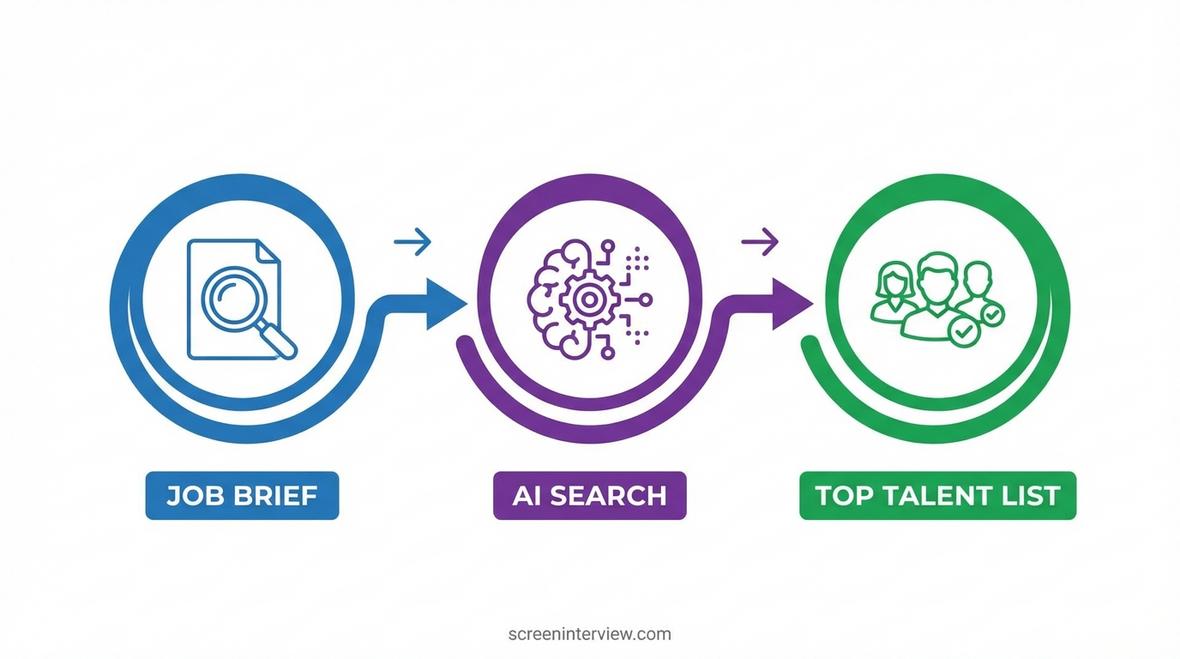
How AI Sourcing Agents Transform the Candidate Discovery Process
Understanding the technical architecture behind an AI sourcing agent reveals why this technology delivers superior results compared to traditional methods. These systems leverage multiple AI capabilities working in concert: natural language processing to understand job descriptions, machine learning algorithms to identify patterns in successful hires, and neural networks that continuously improve candidate matching accuracy.
Intelligent Profile Analysis and Pattern Recognition
The core functionality of an AI sourcing agent begins with semantic understanding of job requirements. Rather than relying on simple keyword matching which often misses qualified candidates who use different terminology these agents comprehend the underlying skills, experience levels, and competencies needed for success. When a hiring manager inputs a job brief for a 'Senior DevOps Engineer with Kubernetes expertise,' the AI sourcing agent translates this into a comprehensive candidate profile that includes related technologies, typical career progression patterns, and adjacent skill sets.
This intelligent analysis extends to candidate evaluation. AI sourcing agents scan resumes, LinkedIn profiles, GitHub repositories, and professional portfolios to build multidimensional candidate assessments. They identify not just explicit qualifications like certifications and job titles, but also implicit signals such as project complexity, leadership indicators, and continuous learning patterns. Research from arXiv introduces a framework auditing which tasks workers want AI agents to automate or augment, including recruitment sourcing tasks to reduce manual review time significantly.
Multi-Channel Candidate Discovery and Engagement
Leading AI sourcing agents don't limit themselves to a single talent pool. They simultaneously search across dozens of platforms from traditional job boards like Indeed and Monster to professional networks like LinkedIn, specialized communities like Stack Overflow for developers, and passive candidate databases. This omnichannel approach dramatically expands the available talent pool, especially for hard-to-fill technical roles where the best candidates aren't actively job-seeking.
The automation extends to initial engagement. Once promising candidates are identified, the AI sourcing agent can initiate personalized outreach messages tailored to each individual's background and interests. These communications go beyond generic templates they reference specific projects in the candidate's portfolio, highlight relevant aspects of the opportunity, and adapt messaging based on response patterns. For recruiting teams using platforms like ScreenInterview, this seamless integration between sourcing and screening creates an end-to-end automated workflow that reduces time-to-hire by 60-70%.
Strategic Advantages of Implementing an AI Sourcing Agent
The business case for adopting an AI sourcing agent extends far beyond simple efficiency gains. While reducing manual work is valuable, the strategic advantages fundamentally transform how organizations compete for talent in 2026's highly competitive market.
Accelerated Time-to-Hire Without Compromising Quality
Traditional sourcing processes create a frustrating tradeoff between speed and quality. Rushing to fill positions often means settling for 'good enough' candidates, while thorough evaluation extends hiring timelines to weeks or months. AI sourcing agents eliminate this tradeoff by processing thousands of profiles in hours not weeks while maintaining rigorous evaluation standards. For high-volume roles like customer service representatives or software developers, this acceleration is transformative.
Organizations implementing AI sourcing agents report reducing time-to-hire from 45 days to 12-15 days on average. This speed advantage compounds throughout the hiring funnel: faster sourcing means quicker screening with tools like AI interview platforms, shorter scheduling cycles using intelligent scheduling systems, and ultimately faster offers to top candidates before competitors can act.
Unprecedented Access to Passive Candidate Markets
The most qualified professionals those who would be immediate value-adds to your organization typically aren't browsing job boards. They're successfully employed, not actively seeking new opportunities, and largely invisible to traditional recruitment methods. AI sourcing agents excel at identifying and engaging this passive talent pool through continuous monitoring of professional activities, career progression signals, and engagement indicators.
By analyzing patterns like increased LinkedIn activity, GitHub project completions, or professional certification acquisitions, AI sourcing agents identify candidates who may be open to opportunities even before they actively job-seek. This proactive approach gives organizations first-mover advantage in competitive talent markets, particularly for specialized roles like machine learning engineers or blockchain developers where demand significantly outpaces supply.
Reducing Unconscious Bias and Improving Diversity Outcomes
Human recruiters, despite best intentions, carry unconscious biases that influence sourcing decisions favoring candidates from certain universities, with particular name patterns, or from familiar geographic regions. These biases perpetuate homogeneous workforces and exclude qualified diverse candidates. A properly configured AI sourcing agent evaluates candidates based purely on job-relevant criteria, stripping away demographic indicators that trigger bias.
Harvard Business Review discusses how AI agents are reshaping decision-making processes, paralleling recruiter reliance on AI sourcing agents for candidate identification and evaluation that prioritizes competency over demographic factors. Organizations using bias-audited AI sourcing agents report 30-40% improvements in candidate diversity at the initial screening stage, creating more inclusive hiring pipelines. For more on eliminating bias, explore strategies for removing interview bias with AI technology.
Implementing an AI Sourcing Agent: Strategic Framework for Success
Deploying an AI sourcing agent requires more than simply purchasing software it demands thoughtful integration with existing workflows, careful configuration, and ongoing optimization. Organizations that approach implementation strategically achieve ROI within 90 days, while those treating it as a 'plug-and-play' solution often struggle with adoption and suboptimal results.
Defining Clear Success Criteria and Evaluation Metrics
Before implementing any AI sourcing agent, establish specific, measurable objectives. Are you primarily focused on reducing time-to-hire? Improving candidate quality as measured by hiring manager satisfaction scores? Expanding diversity in your talent pipeline? Reducing cost-per-hire? Different objectives may require different configuration approaches and integration points.
Key performance indicators for AI sourcing agent success typically include: sourcing efficiency metrics (candidates identified per hour, qualified candidates as percentage of total sourced), quality indicators (interview-to-offer ratios, new hire performance ratings, 90-day retention rates), and diversity measurements (demographic representation in sourced candidates versus overall applicant pool). Establish baseline measurements before implementation to quantify improvement accurately.
Seamless Integration with ATS and Recruitment Tech Stack
The most effective AI sourcing agents don't operate in isolation they integrate seamlessly with your existing applicant tracking system, interview scheduling tools, and assessment platforms. This integration eliminates manual data transfer, reduces errors, and creates a continuous automated workflow from initial candidate identification through final offer.
When evaluating AI sourcing agents, prioritize platforms offering robust API connections to your current systems. For organizations using comprehensive solutions like ScreenInterview's workflow automation, the integration between sourcing, screening with AI interviewer technology, and evaluation creates a fully automated hiring pipeline requiring minimal manual intervention. This end-to-end automation is where the greatest efficiency gains materialize.
Continuous Learning and Model Refinement
AI sourcing agents improve over time through machine learning, but this improvement requires active participation from your recruitment team. Every hiring decision whether a sourced candidate receives an interview, advances through stages, or ultimately receives an offer provides valuable training data that refines the agent's understanding of your specific requirements and company culture fit.
Establish a regular review cadence (typically monthly) where recruiting leaders analyze AI sourcing agent performance, identify patterns in successful versus unsuccessful candidates, and provide feedback that tunes the system's algorithms. This human-in-the-loop approach combines AI efficiency with human judgment, continuously improving matching accuracy and reducing false positives. Organizations implementing this collaborative optimization see matching accuracy improvements of 15-25% within the first six months of deployment.
AI Sourcing Agents vs. Traditional Recruitment Methods: Comparative Analysis
Understanding the practical differences between AI sourcing agents and conventional approaches helps quantify the transformation this technology enables. The comparison isn't simply about speed it encompasses fundamental changes in capability, scalability, and strategic focus.
| Capability | Traditional Manual Sourcing | AI Sourcing Agent |
|---|---|---|
| Candidate Volume | 50-100 profiles reviewed daily per recruiter | 10,000+ profiles analyzed daily per agent |
| Search Scope | Limited to 2-3 platforms due to time constraints | Simultaneous search across 20+ platforms |
| Passive Candidate Identification | Requires extensive manual research and networking | Automated monitoring of activity signals and career patterns |
| Bias Risk | High subject to unconscious human biases | Low evaluates based on configured job-relevant criteria |
| Consistency | Varies by recruiter experience and workload | Uniform evaluation standards applied to all candidates |
| Scalability | Linear requires proportional hiring of recruiters | Exponential single agent handles multiple concurrent searches |
| Cost Structure | $50,000-$70,000 annual salary per recruiter | $15,000-$30,000 annual subscription for unlimited searches |
This comparative analysis reveals that AI sourcing agents don't simply do the same work faster they enable fundamentally different approaches to talent acquisition. The ability to simultaneously monitor passive candidate markets, maintain consistent evaluation standards, and scale without proportional cost increases creates strategic capabilities impossible with manual methods alone.
AI Sourcing Agents for Technical and Specialized Roles
The value of an AI sourcing agent becomes particularly evident when recruiting for technical positions requiring specific skill combinations, certifications, or project experience. These roles from data scientists to cybersecurity engineers demand nuanced evaluation that goes beyond resume keyword matching.
Evaluating Technical Competency Signals
Leading AI sourcing agents for technical roles integrate with platforms like GitHub, Stack Overflow, and specialized technical communities to assess actual coding ability, problem-solving approaches, and community contributions. Rather than relying solely on self-reported skills, these agents analyze commit histories, code review participation, and technical question responses to build evidence-based competency profiles.
For example, when sourcing a DevOps engineer, the AI sourcing agent doesn't just search for 'DevOps' keywords it identifies candidates with demonstrated experience in infrastructure-as-code tools, container orchestration contributions, and CI/CD pipeline implementations visible in their public repositories. This depth of analysis identifies truly qualified candidates while filtering out those with superficial keyword optimization but limited practical experience.
Adapting to Industry-Specific Certification and Compliance Requirements
Certain industries impose specific credential requirements that make sourcing particularly challenging healthcare roles requiring particular licensure, financial services positions demanding regulatory certifications, or government contracts requiring security clearances. AI sourcing agents can be configured with these mandatory criteria, automatically filtering candidates and even verifying credential validity through integration with licensing databases.
This compliance-aware sourcing reduces risk and accelerates the vetting process. Rather than discovering halfway through the interview process that a promising candidate lacks a non-negotiable certification, the AI sourcing agent excludes unqualified candidates at the initial stage, ensuring every profile advanced to human review meets all mandatory requirements.
The Future of AI Sourcing Agents: Emerging Trends and Capabilities
The AI sourcing agent landscape continues evolving rapidly, with emerging capabilities that will further transform recruitment in coming years. Understanding these trends helps organizations make strategic technology investments and prepare for the next generation of talent acquisition.
Predictive Success Modeling and Cultural Fit Assessment
Next-generation AI sourcing agents move beyond evaluating whether candidates can do the job to predicting whether they will thrive in your specific organizational environment. By analyzing patterns in your most successful employees their career trajectories, work styles, and even communication patterns these advanced systems build predictive models that assess cultural fit alongside technical qualifications.
This predictive capability addresses one of recruitment's most persistent challenges: candidates who look perfect on paper but struggle with company culture or team dynamics. By incorporating these 'soft' factors into sourcing algorithms, AI agents identify candidates with higher likelihood of long-term success and satisfaction, improving retention rates and reducing costly early-tenure turnover.
Conversational AI for Candidate Relationship Management
The boundary between sourcing and engagement continues blurring as AI sourcing agents incorporate conversational capabilities. Rather than simply identifying candidates and handing them off to human recruiters, these systems maintain ongoing relationships through intelligent chatbot interactions answering candidate questions about roles, providing application status updates, and even conducting preliminary screening conversations.
This conversational AI capability ensures no promising candidate falls through the cracks due to slow recruiter response times. The AI sourcing agent maintains engagement even when human team members are unavailable, providing 24/7 responsiveness that matches modern candidate expectations. Organizations implementing these hybrid systems report 40-50% improvements in candidate response rates and progression through hiring funnels. Learn more about conversational AI in recruiting.
Frequently Asked Questions About AI Sourcing Agents
How much does an AI sourcing agent cost?
AI sourcing agent pricing varies significantly based on features, candidate volume, and integration requirements. Entry-level platforms start around $500-$1,000 monthly for small teams with basic sourcing needs, while enterprise solutions with advanced capabilities, unlimited searches, and comprehensive ATS integration range from $2,000-$5,000+ monthly. Most providers offer tiered pricing based on number of active job requisitions or monthly sourced candidates. When evaluating cost, compare against the fully-loaded expense of manual sourcing (recruiter salaries, job board subscriptions, sourcing tool licenses), which typically totals $50,000-$70,000 annually per full-time recruiter.
Will AI sourcing agents replace human recruiters?
AI sourcing agents augment rather than replace human recruiters. They automate repetitive, time-consuming sourcing tasks searching profiles, initial screening, candidate matching freeing recruiters to focus on high-value activities that require human judgment: building candidate relationships, assessing cultural fit, negotiating offers, and providing consultative guidance to hiring managers. Organizations implementing AI sourcing agents typically redeploy recruiter time toward these strategic functions rather than reducing headcount. The most effective recruitment teams in 2026 combine AI efficiency with human empathy and relationship-building capabilities.
How do AI sourcing agents handle candidate data privacy?
Reputable AI sourcing agents comply with data protection regulations including GDPR, CCPA, and industry-specific requirements. They source candidates from publicly available information (LinkedIn profiles, professional portfolios, job board submissions) or platforms where candidates have explicitly opted into recruiter visibility. Leading platforms implement encryption, access controls, and data retention policies that protect candidate information. When evaluating AI sourcing agents, verify their compliance certifications, review their privacy policies, and ensure they offer candidate data deletion capabilities to meet 'right to be forgotten' requirements under various privacy laws.
How long does it take to implement an AI sourcing agent?
Implementation timelines vary based on complexity and integration requirements. For standalone AI sourcing agents with minimal ATS integration, basic deployment can occur within 1-2 weeks primarily configuration time to define job requirements and evaluation criteria. More comprehensive implementations involving deep ATS integration, custom workflow automation, and team training typically require 4-6 weeks. The learning period for the AI to optimize to your specific requirements generally spans 2-3 months, during which matching accuracy continuously improves as the system learns from your hiring decisions. Organizations should expect 90-120 days from initial deployment to full operational maturity and maximum ROI realization.
Conclusion
The AI sourcing agent represents a fundamental shift in how organizations discover and engage talent. By automating the most time-consuming aspects of recruitment candidate identification, profile analysis, and initial engagement these intelligent systems enable recruiting teams to focus on strategic relationship-building and cultural assessment that truly differentiates top performers. With adoption rates accelerating and capabilities continuously expanding, AI sourcing agents have moved from emerging technology to essential infrastructure for competitive talent acquisition in 2026. Organizations that strategically implement these systems gain measurable advantages in time-to-hire, candidate quality, diversity outcomes, and cost efficiency advantages that compound as the technology learns and improves. Whether you're a small startup competing for scarce technical talent or an enterprise managing thousands of hires annually, incorporating an AI sourcing agent into your recruitment technology stack isn't just an optimization it's a competitive necessity.
Ready to Transform Your Interview Process?
See how ScreenInterview can help you automate phone screens, reduce bias, and hire better candidates faster.