
AI Recruiting Agent: The Complete 2026 Guide To Intelligent Talent Acquisition

What is an AI Recruiting Agent?
An AI recruiting agent represents the next evolution in talent acquisition technology, combining artificial intelligence, machine learning, and natural language processing to automate and enhance the entire recruitment lifecycle. Unlike traditional applicant tracking systems that simply organize candidate data, an AI recruiting agent actively participates in sourcing, screening, interviewing, and evaluating candidates with minimal human intervention.
For modern recruiting professionals Heads of Talent, Recruiting Leads, and People Operations Managers the AI recruiting agent has become an indispensable tool in managing high-volume hiring while maintaining quality and fairness. According to IBM Institute for Business Value research, AI boosts recruiter productivity by 50%, allowing talent teams to focus on strategic relationship-building rather than administrative screening tasks.
These intelligent systems can conduct thousands of candidate conversations simultaneously, ask relevant follow-up questions, assess responses against job requirements, and provide comprehensive evaluation reports all while delivering a consistent, bias-free candidate experience. The modern AI recruiting agent integrates seamlessly with existing workflow automation systems and applicant tracking platforms to create a unified hiring ecosystem.
How AI Recruiting Agents Work: The Technology Behind Intelligent Hiring
Understanding the technical foundation of an AI recruiting agent helps recruiting professionals leverage these tools more effectively. At their core, these systems utilize multiple AI technologies working in concert to replicate and enhance human recruiting judgment.
Natural Language Processing and Conversation Intelligence
The conversational capabilities of an AI recruiting agent rely on advanced natural language processing (NLP) models that can understand context, intent, and nuance in candidate responses. Modern systems use transformer-based language models that have been trained on millions of professional conversations, enabling them to conduct interviews that feel natural and engaging rather than robotic.
These NLP engines power features like AI interviewer capabilities that can ask relevant follow-up questions based on candidate answers, probe deeper into specific experiences, and adapt the conversation flow based on the role requirements. The technology has advanced to the point where candidates often report positive experiences with AI-driven interviews that rival human interactions.
Machine Learning for Candidate Evaluation
Beyond conversation, an AI recruiting agent employs sophisticated machine learning algorithms to evaluate candidate suitability. These systems analyze multiple data points verbal responses, communication patterns, technical knowledge demonstrations, and behavioral indicators to generate comprehensive candidate assessments.
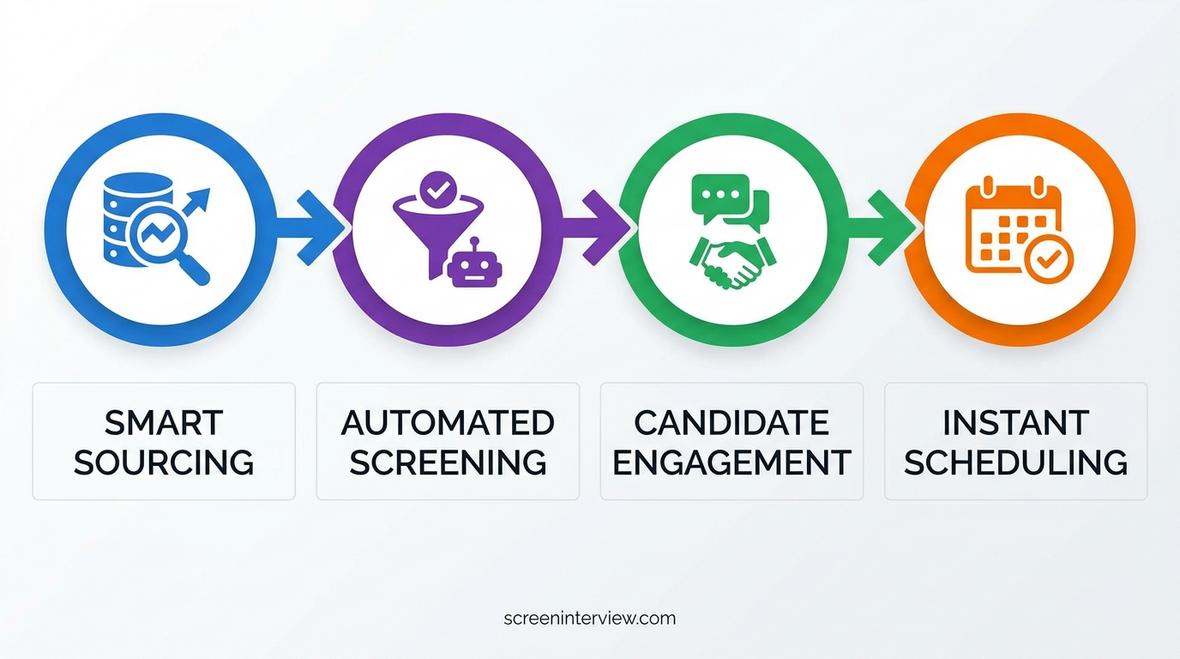
The evaluation process typically encompasses four key stages: smart sourcing to identify qualified candidates from large talent pools, automated screening to filter based on essential qualifications, candidate engagement through conversational interactions, and instant scheduling to coordinate next steps. Research from Gallup indicates a 25% improvement in quality of hire metrics when organizations implement AI recruiting agents, including measurably higher post-hire retention rates for AI-sourced technical talent.
Bias Detection and Prevention Mechanisms
One of the most significant advantages of an AI recruiting agent is its ability to reduce unconscious bias in hiring decisions. These systems are designed with fairness constraints that prevent discrimination based on protected characteristics. Modern platforms incorporate bias detection algorithms that continuously monitor for disparate impact across demographic groups.
The AI interview process can be configured to focus exclusively on job-relevant competencies, removing factors like appearance, accent, age indicators, or other characteristics that might trigger unconscious bias in human reviewers. This creates a more equitable screening process that evaluates all candidates against the same objective criteria.
Key Capabilities of Modern AI Recruiting Agents
Today's AI recruiting agent platforms offer a comprehensive suite of capabilities that address every stage of the talent acquisition funnel. Understanding these features helps recruiting teams select the right solution for their specific hiring challenges.
Automated Screening at Scale
The foundation of any AI recruiting agent is its ability to screen large volumes of candidates efficiently. These systems can process hundreds or thousands of applications simultaneously, conducting initial qualification assessments that would take human recruiters weeks to complete. The telephone screening functionality enables voice-based interactions that feel personal while operating at machine scale.
Automated screening goes beyond simple resume parsing. Advanced AI recruiting agents conduct structured interviews that assess both technical competencies and soft skills, asking role-specific questions and evaluating responses against benchmarks derived from successful hires in similar positions. This comprehensive approach identifies truly qualified candidates rather than just those who know how to optimize their resumes for keyword matching.
Role-Specific Interview Customization
Generic screening questions rarely uncover the specific competencies required for specialized roles. Modern AI recruiting agents offer extensive customization capabilities, with pre-built interview templates for dozens of positions. Whether you're hiring a data scientist, frontend developer, or product manager, specialized question banks ensure candidates are evaluated on relevant skills.
The interview builder functionality allows recruiting teams to create custom assessment frameworks tailored to their organization's specific requirements and cultural values. This flexibility ensures the AI recruiting agent aligns with your unique hiring standards rather than forcing you to adapt to a one-size-fits-all approach.
Enhanced Candidate Engagement
Contrary to concerns that automation depersonalizes hiring, a well-implemented AI recruiting agent actually improves the candidate experience. These systems provide immediate responses, eliminate scheduling delays, and offer candidates the flexibility to complete interviews at their convenience including outside traditional business hours.
The on-demand interview capability exemplifies this candidate-centric approach. Rather than coordinating calendars for initial screening calls, candidates receive interview invitations they can complete whenever convenient, receiving immediate confirmation and next steps. This responsiveness creates positive impressions of employer brands, particularly among in-demand technical talent who value efficiency.
Advanced Analytics and Interview Insights
Data-driven decision making separates high-performing recruiting teams from those relying on intuition. An AI recruiting agent generates comprehensive analytics throughout the hiring funnel, providing visibility into conversion rates, time-to-screen metrics, candidate quality indicators, and assessment score distributions.
The interview insights dashboard aggregates this data into actionable intelligence, highlighting which sourcing channels produce the best candidates, which interview questions have the highest predictive validity, and where bottlenecks occur in your hiring process. These insights enable continuous optimization of recruitment strategies based on empirical evidence rather than assumptions.
Strategic Benefits of Implementing an AI Recruiting Agent
Beyond operational efficiencies, implementing an AI recruiting agent delivers strategic advantages that transform talent acquisition from a cost center into a competitive differentiator.
Dramatically Reduced Time-to-Hire
Speed matters in competitive talent markets. The best candidates are off the market within 10 days, making recruiting velocity a critical success factor. An AI recruiting agent compresses screening timelines from weeks to days or even hours, ensuring your organization can move quickly on top talent before competitors extend offers.
This acceleration occurs across multiple touchpoints: instant application acknowledgment, same-day screening interviews, immediate evaluation and scoring, and automated advancement of qualified candidates to the next stage. The cumulative effect can reduce overall time-to-hire by 40-60% compared to traditional manual screening approaches.
Improved Quality of Hire
Speed without quality is counterproductive. The true power of an AI recruiting agent lies in its ability to improve both velocity and candidate quality simultaneously. By evaluating every candidate against consistent, validated criteria, these systems identify high-potential individuals who might be overlooked in resume-based screening.
The structured assessment approach ensures all relevant competencies are evaluated, not just those that happen to come up in unstructured phone screens. This comprehensiveness results in better hiring decisions, with measurable improvements in new hire performance, cultural fit, and retention rates.
Enhanced Candidate Experience and Employer Brand
Every candidate interaction shapes your employer brand, whether they ultimately receive an offer or not. An AI recruiting agent delivers consistently professional, respectful experiences to all applicants a standard difficult to maintain when human recruiters are overwhelmed by application volume.
Candidates appreciate the transparency, efficiency, and flexibility of AI-driven processes. They receive clear communication about next steps, aren't left waiting for weeks without updates, and can complete assessments on their schedule. These positive experiences translate into stronger employer brand reputation, higher offer acceptance rates, and expanded talent pools as word spreads about your streamlined process.
Scalability for High-Volume Hiring
Organizations experiencing rapid growth or seasonal hiring surges face unique challenges. An AI recruiting agent provides infinite scalability the system handles 10 candidates or 10,000 with equal efficiency. This elasticity eliminates the need to rapidly expand recruiting teams during growth periods or rely on expensive external agencies.
For companies managing high-volume recruiting, this scalability is transformative. Whether you're a retailer staffing for holiday season, a tech company scaling engineering teams, or a healthcare system filling nursing positions, the AI recruiting agent maintains quality and speed regardless of application volume.
Choosing the Right AI Recruiting Agent for Your Organization
Not all AI recruiting agents are created equal. Selecting the right platform requires careful evaluation of capabilities, integration options, and alignment with your specific hiring needs.
Essential Evaluation Criteria
When assessing AI recruiting agent solutions, consider these critical factors: Interview quality and customization—does the platform offer role-specific questions and allow custom interview creation? Integration capabilities—how seamlessly does it connect with your existing ATS and HRIS systems? Bias mitigation features—what specific mechanisms prevent discriminatory outcomes? Candidate experience—how do candidates rate their interaction with the platform? Analytics and reporting—what insights does the system provide about your hiring funnel?
Additionally, examine the platform's proctoring capabilities if assessment integrity is important for your use case, and review their approach to data security and candidate privacy, particularly if you operate in regulated industries or jurisdictions with strict data protection requirements.
Platform Comparison Considerations
The AI recruiting agent market includes numerous vendors with varying strengths. Conducting thorough platform comparisons helps identify the solution best suited to your requirements. Look beyond feature checklists to understand how the technology actually performs in real-world hiring scenarios.
Request demonstrations with your actual job descriptions and candidate personas. Ask about training data sources and model validation methodologies. Understand the vendor's approach to continuous improvement and how frequently the underlying AI models are updated to reflect evolving best practices in talent assessment.
Best Practices for AI Recruiting Agent Implementation
Technology alone doesn't guarantee success. Effective implementation of an AI recruiting agent requires thoughtful change management, clear governance, and ongoing optimization.
Stakeholder Alignment and Change Management
Begin by building consensus among key stakeholders recruiting team members, hiring managers, and executive leadership. Address concerns about job displacement by framing the AI recruiting agent as an augmentation tool that eliminates tedious work and allows recruiters to focus on high-value activities like candidate relationship building and hiring manager consultation.
Involve your recruiting team in the implementation process. Solicit their input on interview questions, evaluation criteria, and process workflows. This inclusive approach increases buy-in and ensures the system reflects your organization's actual hiring needs rather than generic best practices.
Starting with Pilot Programs
Rather than organization-wide deployment, begin with a focused pilot program for one or two high-volume roles. This controlled approach allows you to refine configurations, test candidate experience, and demonstrate value before broader rollout.
Measure specific metrics during the pilot: time-to-screen, candidate satisfaction scores, hiring manager feedback on candidate quality, and diversity metrics. Use these baseline measurements to optimize the system and build the business case for expanded implementation.
Continuous Monitoring and Optimization
AI systems improve with use, but only when properly monitored and refined. Establish regular review cycles to examine system performance, identify areas for improvement, and update interview questions or evaluation criteria based on hiring outcomes.
Monitor for potential bias by analyzing hiring funnel conversion rates across demographic groups. Even well-designed AI recruiting agents require ongoing validation to ensure they're delivering fair, equitable outcomes. Use the platform's workflow automation analytics to identify bottlenecks and continuously streamline your process.
The Future of AI Recruiting Agents
The AI recruiting agent category continues to evolve rapidly, with emerging capabilities that will further transform talent acquisition in coming years.
Predictive Performance Analytics
Next-generation systems will move beyond assessing current capabilities to predicting future performance and cultural fit. By analyzing patterns in successful employee trajectories, AI recruiting agents will identify candidates with the highest probability of long-term success in specific roles and organizational contexts.
Multimodal Assessment Integration
Future AI recruiting agents will integrate multiple assessment modalities conversational interviews, technical skill demonstrations, work sample evaluations, and behavioral assessments into unified candidate profiles. This holistic approach will provide deeper insights into candidate potential than any single assessment method.
Hyper-Personalized Candidate Journeys
Advanced AI will enable individualized candidate experiences that adapt in real-time based on each person's background, preferences, and responses. Rather than one-size-fits-all processes, every candidate will experience a journey optimized for their specific circumstances, improving both assessment accuracy and candidate satisfaction.
Frequently Asked Questions About AI Recruiting Agents
How accurate are AI recruiting agents compared to human recruiters?
AI recruiting agents demonstrate comparable or superior accuracy to human recruiters when properly configured, particularly for initial screening stages. They excel at consistently applying objective criteria across all candidates, eliminating day-to-day variation in human judgment. However, they work best as part of a hybrid approach where AI handles volume screening and humans focus on final evaluation and relationship building.
Will AI recruiting agents replace human recruiters?
No, AI recruiting agents augment rather than replace human recruiters. These systems handle repetitive, high-volume tasks like initial screening, allowing human recruiters to focus on activities requiring emotional intelligence, negotiation skills, and strategic thinking. The most effective recruiting teams combine AI efficiency with human relationship-building capabilities.
How do AI recruiting agents prevent bias in hiring?
Quality AI recruiting agents incorporate multiple bias mitigation mechanisms: training data that's been audited for historical bias, evaluation criteria focused exclusively on job-relevant competencies, removal of demographic indicators from assessment processes, and continuous monitoring for disparate impact across protected groups. These technical safeguards create more equitable outcomes than traditional screening methods.
What types of roles are best suited for AI recruiting agents?
AI recruiting agents excel in high-volume hiring scenarios and roles with clearly defined competency requirements. Technical positions like software engineers, data scientists, and developers are particularly well-suited due to objective skill assessments. However, modern systems also effectively screen for business roles, customer service positions, and even leadership competencies when properly configured.
How long does it take to implement an AI recruiting agent?
Implementation timelines vary based on organization size and complexity, but most companies can deploy an AI recruiting agent within 2-4 weeks. This includes system configuration, ATS integration, interview template customization, recruiter training, and initial pilot program launch. Full organization-wide rollout typically occurs over 2-3 months as teams refine processes and expand to additional roles.
Conclusion
The AI recruiting agent represents a fundamental shift in how organizations identify and engage talent. By combining conversational AI, machine learning evaluation, and intelligent automation, these systems enable recruiting teams to screen more candidates, faster, while improving both quality of hire and candidate experience. For modern talent acquisition professionals facing pressure to do more with less, the AI recruiting agent isn't just a productivity tool it's a strategic imperative that determines competitive advantage in tight talent markets. Organizations that embrace this technology today position themselves to attract the best talent tomorrow, building teams that drive business success through more efficient, equitable, and effective hiring processes.
Ready to Transform Your Interview Process?
See how ScreenInterview can help you automate phone screens, reduce bias, and hire better candidates faster.