
AI Recruiter: How Artificial Intelligence Is Transforming Hiring In 2026

What is an AI Recruiter?
An AI recruiter is an advanced technological solution that leverages artificial intelligence, machine learning, and natural language processing to automate and optimize the recruitment process. In 2026, organizations worldwide are increasingly adopting AI-powered recruitment tools to handle everything from resume screening and candidate sourcing to interview scheduling and candidate engagement. The AI recruiter serves as a digital assistant that works alongside human HR professionals, dramatically reducing time-to-hire while improving the quality of candidate matches.
Modern AI recruiters utilize sophisticated algorithms to analyze thousands of applications in minutes, identify top talent based on specific criteria, and even conduct preliminary screening interviews. This technology has evolved from simple keyword-matching systems to intelligent platforms capable of understanding context, evaluating soft skills, and predicting candidate success rates with remarkable accuracy.
The adoption of AI interviewer technology has grown exponentially, with organizations reporting up to 75% reduction in screening time and significant improvements in hiring quality. These systems integrate seamlessly with existing applicant tracking systems and provide recruiters with actionable insights that enable data-driven hiring decisions.
How Does an AI Recruiter Work?
Understanding the workflow of an AI recruiter is essential for organizations looking to implement this technology effectively. The process typically involves three major phases that transform raw applications into qualified candidate matches.
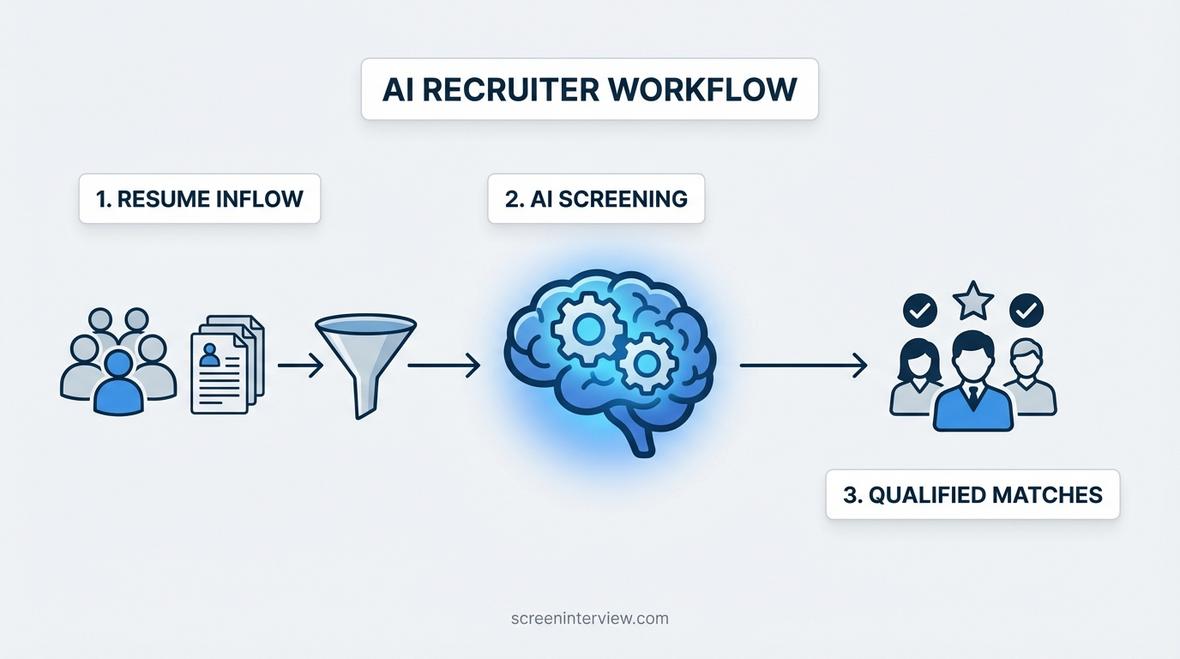
Resume Inflow and Data Collection
The first stage involves collecting and organizing applications from multiple sources. An AI recruiter automatically aggregates resumes from job boards, career pages, email submissions, and social media platforms. Advanced parsing technology extracts relevant information including work experience, education, skills, certifications, and contact details. This automated data extraction eliminates manual data entry and ensures consistency across all candidate profiles.
During this phase, the system normalizes data formats, corrects common errors, and structures information in a standardized format that enables efficient analysis. The AI recruiter can process hundreds or even thousands of applications simultaneously, creating a comprehensive candidate database that serves as the foundation for subsequent screening stages.
AI-Powered Screening and Analysis
The screening phase is where AI recruiters demonstrate their true value. Using machine learning algorithms trained on successful hiring patterns, the system evaluates each candidate against job requirements, company culture indicators, and performance predictors. Natural language processing enables the AI to understand context and nuance rather than simply matching keywords.
Modern AI interview platforms assess technical competencies, behavioral indicators, and cultural fit simultaneously. The system assigns scores based on multiple dimensions including skills match, experience relevance, career trajectory, and even communication style. This multi-faceted evaluation provides a holistic view of each candidate's potential contribution to the organization.
Advanced AI recruiters incorporate predictive analytics to forecast candidate performance, retention likelihood, and long-term potential. By analyzing patterns from historical hiring data, these systems can identify characteristics associated with successful hires in specific roles or departments.
Generating Qualified Matches
The final stage produces a curated list of top candidates ranked by their suitability for the position. The AI recruiter not only identifies the best matches but also provides detailed justification for each ranking, highlighting specific qualifications, experiences, or attributes that make a candidate stand out.
This shortlist enables human recruiters to focus their time and energy on high-potential candidates, conducting in-depth interviews and making final selection decisions. The system can also automatically schedule interviews, send personalized communication, and maintain candidate engagement throughout the hiring process using intelligent scheduling capabilities.
Key Benefits of Using an AI Recruiter
Organizations implementing AI recruiter technology report transformative improvements across multiple dimensions of their hiring operations. These benefits extend beyond simple efficiency gains to fundamentally improve hiring quality and candidate experience.
Dramatic Time Savings
According to research from the Society for Human Resource Management, recruiters spend an average of 23 hours screening resumes for a single hire. AI recruiters reduce this time by up to 75%, enabling HR teams to process larger candidate pools without increasing staff. The technology works continuously, screening applications 24/7 and ensuring no qualified candidate is overlooked due to timing or resource constraints.
Organizations using workflow automation in recruitment report reducing their average time-to-hire from 42 days to just 18 days, giving them a competitive advantage in securing top talent before competitors can extend offers.
Enhanced Hiring Quality
AI recruiters eliminate common human biases and inconsistencies that plague traditional screening processes. By evaluating all candidates against the same objective criteria, these systems ensure fair assessment regardless of a recruiter's mood, fatigue level, or unconscious preferences. Studies indicate that organizations using AI-powered screening see a 32% improvement in new hire quality scores and a 28% reduction in first-year turnover.
The technology identifies candidates with transferable skills who might be overlooked in traditional keyword searches, expanding the talent pool and uncovering hidden gems that human screeners might miss. This capability is particularly valuable for organizations seeking to build diverse, high-performing teams.
Significant Cost Reduction
The financial impact of AI recruiter implementation extends across multiple areas. Direct savings come from reduced screening hours and faster time-to-fill, but the most substantial benefits derive from improved hire quality and reduced turnover. According to the U.S. Department of Labor, the average cost of a bad hire equals 30% of the employee's first-year earnings, making quality improvements extremely valuable.
Organizations also save on recruitment advertising costs by improving conversion rates at each stage of the hiring funnel. When AI recruiters identify better-matched candidates, acceptance rates increase and negotiation cycles shorten, reducing the cost per hire significantly.
Unlimited Scalability
Traditional recruitment models struggle with volume fluctuations. Seasonal hiring surges, rapid growth periods, or mass recruitment campaigns strain HR resources and compromise screening quality. AI recruiters scale effortlessly, handling 100 applications with the same efficiency and thoroughness as 10,000 applications.
This scalability is particularly valuable for organizations with high-volume recruiting needs, such as retail operations during holiday seasons or technology companies experiencing rapid expansion.
Improved Candidate Experience
Modern job seekers expect responsive, transparent recruitment processes. AI recruiters provide immediate application acknowledgment, regular status updates, and timely feedback regardless of application volume. This consistent communication dramatically improves candidate satisfaction scores and protects employer brand reputation.
Candidates also benefit from on-demand interviews that accommodate their schedules rather than forcing them to coordinate with multiple interviewers. This flexibility particularly appeals to passive candidates who are currently employed and have limited availability during standard business hours.
Essential Features of Modern AI Recruiters
Not all AI recruiter platforms offer the same capabilities. Understanding the critical features that distinguish effective solutions helps organizations select technology that aligns with their specific needs and hiring challenges.
Advanced Resume Parsing
Top-tier AI recruiters employ sophisticated parsing technology that extracts information from diverse resume formats including PDFs, Word documents, plain text files, and even LinkedIn profiles. The system recognizes unconventional formatting, handles multiple languages, and accurately interprets industry-specific terminology and abbreviations.
Intelligent Candidate Matching
Beyond simple keyword searches, intelligent matching algorithms evaluate semantic relationships, understand synonyms and related concepts, and assess the relevance of experiences in different contexts. This technology recognizes that a 'Software Developer' and 'Software Engineer' represent similar roles, and that experience with 'customer success' may be relevant for 'account management' positions.
AI-Powered Video Interviewing
Many AI recruiter platforms incorporate video interviewing capabilities that use computer vision and speech analysis to evaluate candidate responses. These systems assess not just the content of answers but also communication style, confidence levels, and engagement indicators. The interview proctoring features ensure assessment integrity while providing flexibility for candidates.
Bias Detection and Mitigation
Leading AI recruiters include built-in mechanisms to identify and neutralize potential bias in job descriptions, screening criteria, and evaluation processes. These systems flag problematic language, ensure diverse candidate pools, and monitor outcomes to detect patterns that might indicate unfair treatment of protected groups. Organizations committed to candidate screening without bias find these features invaluable.
Predictive Analytics and Insights
Advanced AI recruiters provide predictive insights about candidate success probability, retention likelihood, and performance potential. These analytics draw from historical data, industry benchmarks, and organizational-specific patterns to forecast outcomes with increasing accuracy as the system learns from each hiring decision.
Seamless Integration Capabilities
Effective AI recruiter platforms integrate smoothly with existing HR technology stacks including applicant tracking systems, HRIS platforms, calendar applications, and communication tools. This interoperability eliminates data silos and ensures recruiters access all relevant information within familiar workflows.
Implementing an AI Recruiter: Best Practices
Successful AI recruiter implementation requires careful planning, stakeholder engagement, and ongoing optimization. Organizations that approach implementation strategically realize benefits faster and achieve higher adoption rates among recruiting teams.
Define Clear Objectives
Before selecting an AI recruiter platform, organizations should articulate specific goals and success metrics. Are you primarily seeking to reduce time-to-hire, improve candidate quality, enhance diversity, or reduce recruitment costs? Clear objectives guide platform selection and provide benchmarks for measuring return on investment.
Engage Stakeholders Early
Successful implementation requires buy-in from recruiters, hiring managers, candidates, and executive leadership. Each stakeholder group has legitimate concerns and valuable perspectives that should inform the implementation approach. Recruiters need assurance that AI will augment rather than replace their roles. Hiring managers want confidence that quality won't be sacrificed for speed. Addressing these concerns proactively prevents resistance and accelerates adoption.
Prepare Quality Training Data
AI recruiter effectiveness depends heavily on the quality of training data. Organizations should compile comprehensive datasets of past hiring decisions, including both successful and unsuccessful hires. This historical data enables the AI to learn patterns specific to your organization's needs and culture. Clean, well-organized data produces better outcomes than larger volumes of inconsistent information.
Start with a Pilot Program
Rather than implementing AI recruiter technology across the entire organization simultaneously, successful adopters typically begin with a pilot program focused on specific roles or departments. This approach allows teams to identify issues, refine processes, and demonstrate value before expanding deployment. Pilot programs also generate internal champions who can advocate for broader adoption based on firsthand experience.
Monitor and Optimize Continuously
AI recruiter performance improves through continuous learning and refinement. Organizations should regularly review system recommendations, analyze hiring outcomes, and provide feedback that helps the AI refine its algorithms. This iterative optimization process ensures the technology evolves alongside changing organizational needs and labor market conditions.
Challenges and Considerations
While AI recruiter technology offers substantial benefits, organizations should also understand potential challenges and limitations that require thoughtful management.
Algorithmic Bias Concerns
AI systems learn from historical data, which may reflect past biases in hiring decisions. If an organization has historically underrepresented certain demographic groups, an AI trained on that data might perpetuate those patterns. Responsible AI recruiter implementation requires regular bias audits, diverse training data, and transparency about how algorithms make decisions. Organizations should prioritize platforms with robust bias elimination features.
Candidate Perception and Trust
Some candidates express concern about AI-driven evaluation, fearing that algorithms cannot fully appreciate their unique qualities or circumstances. Organizations should communicate clearly about how AI is used in their process, what human oversight exists, and how candidates can appeal or provide additional context. Transparency builds trust and ensures candidates remain engaged throughout the process.
Technical Integration Complexity
Integrating AI recruiter platforms with existing HR technology infrastructure can present technical challenges, particularly for organizations with legacy systems or highly customized workflows. Selecting platforms with robust APIs, pre-built integrations, and strong technical support minimizes implementation friction.
Skill Gap Among Recruiters
Some recruiting professionals lack experience with AI technology and may require training to use these tools effectively. Organizations should invest in comprehensive training programs that build technical competency while also emphasizing how AI augments rather than replaces human judgment in hiring decisions.
The Future of AI Recruiters in 2026 and Beyond
AI recruiter technology continues evolving rapidly, with several emerging trends poised to reshape recruitment practices in the coming years.
Conversational AI and Chatbots
Advanced conversational AI enables recruiters to interact with candidate databases using natural language queries. Rather than constructing complex Boolean searches, recruiters simply describe what they're looking for, and the AI interprets intent to return relevant results. Chatbot assistants also handle routine candidate questions, schedule interviews, and provide status updates without human intervention.
Enhanced Predictive Success Models
Next-generation AI recruiters will incorporate increasingly sophisticated predictive models that forecast not just job performance but also cultural contribution, innovation potential, and leadership capacity. These models will draw from expanded data sources including work samples, social media presence, and behavioral assessments to paint comprehensive pictures of candidate potential.
Skills-Based Hiring Evolution
AI technology is driving the shift from credential-based to skills-based hiring. Modern AI recruiters can evaluate practical competencies regardless of how they were acquired, identifying talented individuals who developed skills through non-traditional pathways. This approach expands talent pools and increases diversity while focusing on what truly predicts job success.
Hyper-Personalized Candidate Experiences
AI enables unprecedented personalization in candidate engagement. Future systems will tailor communication style, interview format, and even job descriptions to individual candidate preferences and characteristics. This personalization improves candidate experience scores and increases acceptance rates among top talent.
Choosing the Right AI Recruiter Platform
Selecting an AI recruiter platform requires careful evaluation of capabilities, integration requirements, pricing models, and vendor stability. Organizations should consider several critical factors during the selection process.
Feature Alignment with Needs
Different platforms emphasize different capabilities. Some excel at resume screening, others at video interviewing, and still others at candidate engagement. Organizations should prioritize platforms whose strengths align with their most pressing recruitment challenges. The ScreenInterview platform offers comprehensive features spanning the entire recruitment lifecycle from initial screening through final selection.
Compliance and Data Security
AI recruiter platforms handle sensitive personal information and must comply with data protection regulations including GDPR, CCPA, and industry-specific requirements. Evaluate vendors' security certifications, data handling practices, and compliance track records carefully. Understanding how candidate data is stored, processed, and eventually deleted protects both the organization and applicants.
Transparency and Explainability
The best AI recruiter platforms provide clear explanations for their recommendations rather than operating as 'black boxes.' Recruiters should understand why specific candidates were ranked highly or filtered out. This transparency enables informed decision-making and supports compliance with emerging AI regulation that may require algorithmic accountability.
Vendor Support and Training
Implementation success depends heavily on vendor support quality. Evaluate the training resources, technical support responsiveness, and ongoing optimization assistance offered by different vendors. Organizations should seek partners committed to long-term success rather than vendors focused solely on initial sales.
Measuring AI Recruiter ROI
Demonstrating return on investment justifies continued investment in AI recruiter technology and guides optimization efforts. Organizations should track multiple metrics across different dimensions of recruitment performance.
Efficiency Metrics
Track time-to-hire, time-to-screen, and recruiter productivity metrics before and after AI implementation. Most organizations see 40-75% reduction in screening time and 30-50% reduction in overall time-to-hire. These efficiency gains translate directly to cost savings and competitive advantage in securing top talent.
Quality Metrics
Monitor new hire performance ratings, retention rates at 90 days and one year, and hiring manager satisfaction scores. Improvements in these metrics indicate that AI is identifying better candidate matches. Quality improvements often deliver greater financial impact than efficiency gains by reducing costly turnover and improving team performance.
Cost Metrics
Calculate cost-per-hire, cost-per-applicant, and total recruitment budget efficiency. AI recruiter technology typically reduces cost-per-hire by 30-60% through improved efficiency, better advertising targeting, and reduced turnover from quality improvements.
Candidate Experience Metrics
Survey candidates about their experience with your recruitment process, measuring response times, communication quality, and overall satisfaction. Organizations using AI typically see 25-40% improvement in candidate experience scores, protecting employer brand and improving offer acceptance rates.
Frequently Asked Questions About AI Recruiters
Will AI recruiters replace human recruiters?
No, AI recruiters are designed to augment rather than replace human recruiters. The technology handles time-consuming administrative tasks like resume screening and initial assessments, freeing human recruiters to focus on relationship-building, complex evaluation, and strategic activities that require emotional intelligence and nuanced judgment. The most effective recruitment operations combine AI efficiency with human insight.
How accurate are AI recruiters in identifying qualified candidates?
AI recruiter accuracy varies based on training data quality, algorithm sophistication, and implementation approach. Well-implemented systems typically achieve 85-95% accuracy in identifying qualified candidates, outperforming manual screening consistency. Accuracy improves over time as the system learns from feedback and accumulates more data about successful hires within your organization.
Can AI recruiters help reduce hiring bias?
When properly configured, AI recruiters significantly reduce unconscious bias by evaluating all candidates against consistent, objective criteria. However, if trained on biased historical data, AI systems can perpetuate existing biases. Organizations should select platforms with built-in bias detection, regularly audit outcomes for disparate impact, and ensure diverse representation in training data to maximize fairness benefits.
What types of roles are best suited for AI recruiter technology?
AI recruiters work effectively across virtually all role types, but deliver the greatest value for positions with high application volumes, clearly defined requirements, and objective evaluation criteria. Technology roles, customer service positions, sales representatives, and administrative functions typically see the strongest results. Executive and highly specialized roles may benefit more from AI-assisted rather than AI-driven screening.
How long does it take to implement an AI recruiter platform?
Implementation timelines vary based on organizational complexity, integration requirements, and customization needs. Basic implementations can be operational within 2-4 weeks, while comprehensive deployments with extensive integration and customization may require 8-12 weeks. Organizations should plan for an additional 3-6 months of optimization as the system learns organizational preferences and recruiter teams develop proficiency.
What happens to candidates rejected by the AI recruiter?
Responsible AI recruiter implementations include mechanisms for human review of borderline cases and candidate appeals. Organizations should establish clear policies about how AI recommendations are used, what human oversight exists, and how candidates can provide additional context or request reconsideration. Many platforms maintain rejected candidate profiles for future opportunities that might better match their qualifications.
Conclusion
The AI recruiter represents a fundamental transformation in how organizations identify, evaluate, and engage talent. By automating time-consuming screening tasks, eliminating inconsistent evaluation, and providing data-driven insights, this technology enables recruitment teams to operate with unprecedented efficiency and effectiveness. Organizations that strategically implement AI recruiter platforms position themselves to compete successfully for top talent in increasingly competitive labor markets.
Success with AI recruiter technology requires more than simply purchasing software. Organizations must approach implementation thoughtfully, addressing potential bias concerns, building stakeholder buy-in, and continuously optimizing performance based on outcomes. When implemented responsibly with appropriate human oversight, AI recruiters deliver substantial benefits across efficiency, quality, cost, and candidate experience dimensions. As the technology continues evolving with enhanced predictive capabilities and personalization features, early adopters will maintain competitive advantages in building high-performing teams that drive organizational success.
Ready to Transform Your Interview Process?
See how ScreenInterview can help you automate phone screens, reduce bias, and hire better candidates faster.