
AI Recruiter Agent: How Intelligent Automation Is Revolutionizing Talent Acquisition In 2026

Understanding the AI Recruiter Agent: The Future of Talent Acquisition
The recruitment landscape has undergone a dramatic transformation in recent years, with AI recruiter agent technology emerging as a game-changing solution for modern hiring teams. An AI recruiter agent is an intelligent automation system designed to handle time-consuming screening tasks, candidate engagement, and initial evaluation processes that traditionally consumed hours of recruiter time. These sophisticated tools leverage machine learning, natural language processing, and advanced algorithms to identify, assess, and rank candidates with unprecedented accuracy and efficiency.
For talent acquisition professionals facing mounting pressure to reduce time-to-hire while improving candidate quality, AI recruiter agent platforms represent a strategic advantage. According to Forrester AI recruitment trend correlations, organizations implementing AI-powered recruiting solutions experience 20-40% reductions in time-to-fill metrics alongside measurable improvements in candidate experience scores. This data underscores why forward-thinking recruiting leaders are rapidly adopting these technologies across their talent pipelines.
The modern AI recruiter agent doesn't simply automate tasks it enhances the entire hiring workflow by providing consistent, bias-reduced evaluations, enabling recruiters to focus on strategic relationship-building and final-stage candidate selection. As we navigate 2026, understanding how these intelligent systems work and how to implement them effectively has become essential knowledge for any recruiting professional committed to operational excellence.
How AI Recruiter Agents Work: Technology Behind the Innovation
The mechanics behind an AI recruiter agent involve several sophisticated technological components working in concert to deliver seamless candidate screening experiences. At the foundation lies natural language processing (NLP), which enables these systems to understand candidate responses, parse resumes, and evaluate communication patterns with human-like comprehension. Machine learning algorithms continuously improve assessment accuracy by learning from historical hiring decisions and outcomes.
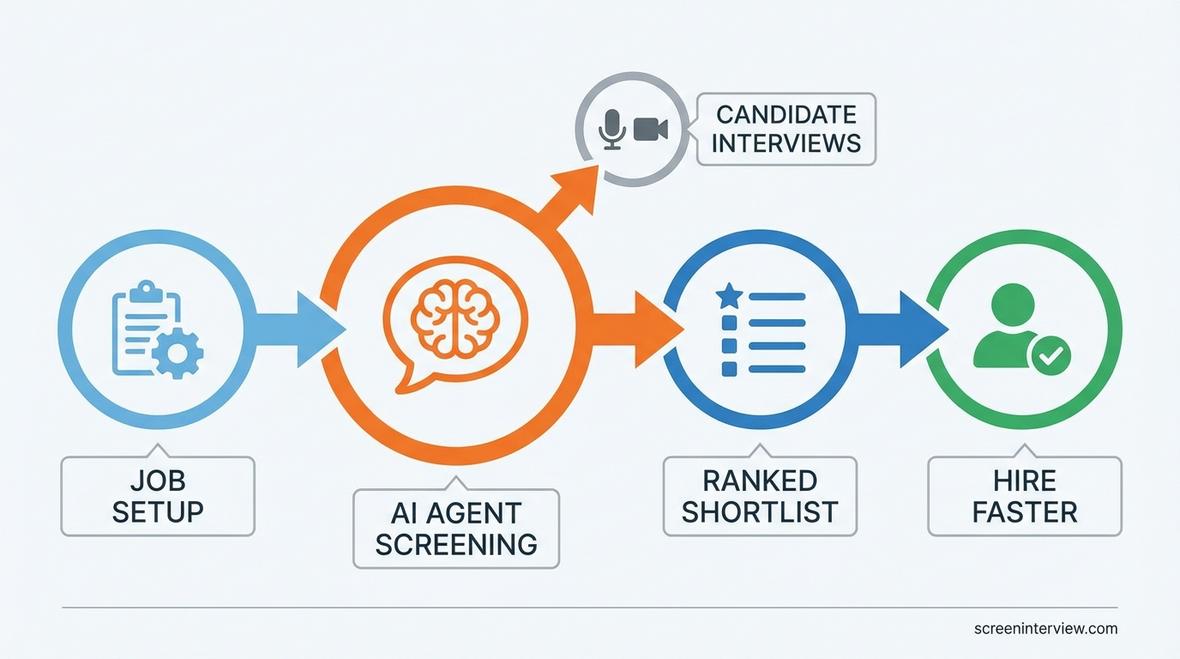
Modern AI recruiter agent platforms like ScreenInterview integrate multiple evaluation methodologies. The system begins with job setup, where recruiters define role requirements, must-have skills, and assessment criteria. The AI interviewer then conducts structured interviews with candidates, asking role-specific questions and evaluating responses in real-time. This process generates comprehensive candidate profiles that include skill assessments, communication evaluations, and behavioral insights.
What distinguishes advanced AI recruiter agent systems is their ability to conduct asynchronous, on-demand evaluations at scale. Candidates can complete screenings at their convenience, while the AI maintains consistent evaluation standards across thousands of interviews. The technology employs interview proctoring capabilities to ensure assessment integrity, while simultaneously analyzing verbal responses, technical competencies, and problem-solving approaches. The output is a ranked shortlist of candidates, prioritized by their fit for the specific role requirements.
Key Capabilities of Advanced AI Recruiter Agents
Contemporary AI recruiter agent solutions offer a comprehensive suite of capabilities that address the full spectrum of candidate screening challenges:
- Intelligent Question Generation: The system creates role-specific interview questions tailored to job requirements, technical skills, and experience levels
- Multi-format Assessment: Supports video interviews, coding challenges, situational judgment tests, and behavioral evaluations within a single platform
- Real-time Evaluation: Analyzes candidate responses immediately, providing instant scoring and feedback mechanisms
- Bias Mitigation: Implements structured evaluation criteria that reduce unconscious bias and promote fair candidate assessment
- Integration Capabilities: Seamlessly connects with existing ATS platforms and workflow automation systems
- Candidate Experience Optimization: Delivers mobile-friendly, user-centric interview experiences that reflect positively on employer branding
Measurable Benefits of Implementing an AI Recruiter Agent
Organizations implementing AI recruiter agent technology consistently report transformative improvements across key recruiting metrics. The most immediate impact manifests in time-to-hire reductions, with many teams cutting their screening timelines by 60-70% compared to traditional manual review processes. This efficiency gain enables recruiting teams to handle significantly higher candidate volumes without proportional increases in headcount or resources.
Beyond speed, AI recruiter agent platforms deliver substantial quality improvements in candidate selection. By applying consistent evaluation criteria across all applicants, these systems identify high-potential candidates who might otherwise be overlooked in resume-based screening. The technology excels at recognizing transferable skills, unconventional career paths, and candidates whose qualifications don't perfectly match keyword searches but demonstrate strong role fit through interview performance.
Operational Efficiency and Resource Optimization
The resource allocation benefits of AI recruiter agent implementation extend throughout the talent acquisition function. Recruiters liberated from hours of initial screening work can redirect their expertise toward high-value activities: building relationships with passive candidates, conducting in-depth final interviews, negotiating offers, and developing long-term talent pipelines. This shift transforms recruiting from an administrative function to a strategic business partnership.
Financial impact represents another compelling dimension. While specific cost savings vary by organization size and hiring volume, teams typically realize significant reductions in cost-per-hire metrics. The efficiency gains compound across multiple dimensions: reduced time-to-fill minimizes productivity losses from vacant positions, improved candidate quality decreases early turnover rates, and automation reduces dependency on external recruiting agencies. For high-volume hiring scenarios, these savings can reach hundreds of thousands of dollars annually.
Enhanced Candidate Experience and Employer Branding
Candidate experience improvements represent a frequently underestimated benefit of AI recruiter agent deployment. Modern job seekers expect responsive, efficient hiring processes that respect their time. On-demand interview capabilities allow candidates to complete screenings at their convenience, eliminating scheduling friction and reducing dropout rates. Immediate feedback mechanisms provide candidates with clear communication about next steps, significantly improving their perception of the employer brand.
The consistency and fairness inherent in AI recruiter agent evaluations also enhance diversity and inclusion outcomes. By focusing on demonstrated skills and capabilities rather than pedigree or subjective impressions, these systems help organizations build more diverse talent pools. This alignment with bias reduction in hiring objectives makes AI-powered screening an essential tool for companies committed to equitable talent acquisition practices.
Implementing an AI Recruiter Agent: Strategic Considerations
Successfully deploying an AI recruiter agent requires thoughtful planning and change management. Organizations should begin by identifying high-impact use cases typically high-volume roles or positions with clearly defined skill requirements where automated screening delivers maximum value. Technical positions like software engineer interviews, data scientist assessments, and DevOps engineer evaluations often serve as ideal initial implementations due to their objective skill assessment requirements.
Integration with existing recruitment technology stacks represents a critical success factor. The chosen AI recruiter agent platform should seamlessly connect with your ATS, HRIS, and communication tools to ensure data flows smoothly across systems. Leading solutions offer pre-built integrations with major platforms, minimizing implementation complexity and accelerating time-to-value. The interview builder functionality should allow customization to reflect your organization's specific evaluation criteria and cultural values.
Change Management and Stakeholder Alignment
Recruiting team adoption requires clear communication about how AI recruiter agent technology augments rather than replaces human judgment. Effective implementation strategies emphasize that automation handles repetitive screening tasks while elevating recruiters to more strategic roles. Providing comprehensive training on system capabilities, interpretation of AI-generated insights, and best practices for candidate engagement ensures teams maximize platform value.
Hiring manager buy-in represents another essential dimension. Demonstrating how AI recruiter agent technology delivers higher-quality candidate shortlists in shorter timeframes addresses the primary concerns of business stakeholders. Pilot programs with measurable success metrics such as reduced time-to-fill, improved candidate quality scores, or enhanced interview-to-offer ratios build confidence and support for broader rollout across the organization.
AI Recruiter Agent vs. Traditional Screening Methods
The comparison between AI recruiter agent technology and conventional screening approaches reveals stark differences in capability, efficiency, and outcomes. Traditional resume-based screening suffers from numerous limitations: inconsistent evaluation criteria, unconscious bias influence, limited scalability, and significant time investment. A typical recruiter might spend 6-8 seconds reviewing each resume, creating high risk that qualified candidates are overlooked due to formatting choices, career gaps, or non-traditional backgrounds.
In contrast, an AI recruiter agent applies identical evaluation standards to every candidate, focusing on demonstrated capabilities rather than resume keywords. The technology can assess hundreds or thousands of candidates simultaneously, conducting structured interviews that reveal problem-solving abilities, communication skills, and technical competencies that resumes cannot capture. This depth of evaluation, combined with scalability, fundamentally transforms what's possible in talent identification.
| Evaluation Criteria | Traditional Screening | AI Recruiter Agent |
|---|---|---|
| Time per Candidate | 15-30 minutes | Automated (minutes for AI analysis) |
| Consistency | Variable (recruiter-dependent) | Standardized across all candidates |
| Scalability | Limited by recruiter capacity | Unlimited concurrent assessments |
| Bias Risk | High (unconscious bias factors) | Reduced through structured criteria |
| Depth of Assessment | Resume-based surface evaluation | Comprehensive skill and capability testing |
| Candidate Experience | Slow, often no feedback | Fast, interactive, with clear communication |
Choosing the Right AI Recruiter Agent Platform
Selecting an AI recruiter agent solution requires evaluation across multiple dimensions. Assessment quality represents the foundation the platform must accurately evaluate candidates for the specific roles you hire. This means examining the question libraries, evaluation methodologies, and validation studies that demonstrate prediction of job performance. Solutions offering customizable assessment frameworks that align with your specific role requirements and company values deliver superior outcomes compared to one-size-fits-all approaches.
Technical capabilities and integration options form another critical evaluation area. The ideal AI recruiter agent should offer robust API connectivity, seamless ATS integration, and mobile-optimized candidate experiences. Features like telephone screening capabilities, video interview options, and secure browser technology for assessment integrity demonstrate platform maturity and versatility.
Key Features to Evaluate
When comparing AI recruiter agent platforms, recruiting leaders should prioritize:
- Assessment Versatility: Support for multiple evaluation formats including technical skills testing, behavioral interviews, and situational judgment assessments
- Customization Capabilities: Ability to tailor questions, evaluation criteria, and workflows to your specific hiring needs
- Bias Mitigation Features: Demonstrated commitment to fair hiring through transparent algorithms and structured evaluation approaches
- Candidate Experience: Intuitive interfaces, mobile compatibility, and clear communication throughout the process
- Analytics and Reporting: Comprehensive interview insights that enable data-driven hiring decisions
- Support and Training: Responsive customer success teams and comprehensive onboarding resources
Real-World AI Recruiter Agent Use Cases
The versatility of AI recruiter agent technology enables application across diverse hiring scenarios. High-volume recruiting environments such as retail, customer service, or seasonal hiring benefit enormously from automated screening capabilities that maintain quality while processing thousands of applications. Organizations can deploy AI-powered screening for entry-level positions while recruiters focus on specialized or senior-level roles requiring more nuanced evaluation.
Technical hiring represents another high-impact use case. Platforms offering specialized assessments for roles like Python developers, React engineers, or machine learning specialists enable objective evaluation of coding skills, problem-solving approaches, and technical knowledge. This capability proves particularly valuable for companies lacking in-house technical expertise to conduct preliminary assessments, democratizing access to quality technical talent evaluation.
Expanding Beyond Technical Roles
While technical assessments represent common initial implementations, AI recruiter agent platforms deliver equal value for business functions. Product manager screening, sales and marketing evaluations, and leadership assessment scenarios benefit from structured behavioral interviews and situational judgment testing that reveal soft skills, strategic thinking, and cultural alignment.
The geographic and temporal flexibility of AI recruiter agent systems proves invaluable for distributed hiring. Organizations building remote teams across multiple time zones can offer asynchronous screening experiences that eliminate scheduling complexity while maintaining consistent evaluation standards. This capability expands available talent pools and supports diversity objectives by removing geographic barriers to opportunity.
The Future of AI Recruiter Agent Technology
The trajectory of AI recruiter agent evolution points toward increasingly sophisticated capabilities. Emerging developments include enhanced emotional intelligence recognition, more nuanced evaluation of soft skills through conversation analysis, and predictive analytics that forecast long-term candidate success and retention likelihood. These advancements will enable even more accurate talent identification while further reducing time-to-hire metrics.
Integration depth represents another frontier. Future AI recruiter agent platforms will offer seamless connectivity across the entire talent lifecycle from candidate sourcing and attraction through onboarding and performance management. This holistic approach will enable recruiting teams to leverage AI insights not just for hiring decisions but for ongoing talent development and retention strategies.
Ethical AI and transparency will continue gaining prominence. Leading AI recruiter agent vendors are implementing explainable AI frameworks that clearly articulate how evaluation decisions are made, addressing regulatory requirements and candidate expectations for fairness. This commitment to unbiased candidate screening will differentiate premium platforms and drive industry standards for responsible AI deployment in recruitment contexts.
Frequently Asked Questions About AI Recruiter Agent Technology
What types of roles are best suited for AI recruiter agent screening?
AI recruiter agent technology delivers value across virtually all role types, but proves particularly effective for positions with clearly defined skill requirements, high application volumes, or technical competencies that can be objectively assessed. Entry to mid-level positions, technical roles requiring specific programming languages or tools, and customer-facing positions benefit significantly from automated screening.
How does an AI recruiter agent reduce bias in hiring?
By applying consistent, structured evaluation criteria to all candidates, an AI recruiter agent minimizes unconscious bias that affects human reviewers. The technology focuses on demonstrated skills and capabilities rather than subjective factors like name, appearance, or educational pedigree. Leading platforms implement fairness testing and regular audits to ensure equitable outcomes across demographic groups.
Can AI recruiter agents integrate with existing ATS systems?
Yes, modern AI recruiter agent platforms offer robust integration capabilities with major applicant tracking systems. These integrations enable seamless data flow, automatic candidate profile updates, and synchronized workflow management. Implementation typically involves API connections that require minimal technical configuration while maintaining data security standards.
What is the typical ROI timeframe for AI recruiter agent implementation?
Most organizations realize measurable return on investment within 3-6 months of AI recruiter agent deployment. Initial time-to-hire reductions manifest immediately, while quality improvements and cost savings compound over subsequent hiring cycles. High-volume hiring environments often achieve ROI even faster due to the scale of efficiency gains.
How do candidates respond to AI-powered screening?
When implemented thoughtfully with clear communication and user-friendly interfaces, candidates generally respond positively to AI recruiter agent screening. The convenience of on-demand scheduling, faster feedback, and consistent treatment appeals to modern job seekers. Transparency about the evaluation process and human involvement in final decisions addresses candidate concerns about automation.
Conclusion
The AI recruiter agent represents a fundamental evolution in talent acquisition methodology, offering recruiting professionals the tools to dramatically improve efficiency, quality, and fairness in candidate screening. As organizations navigate increasingly competitive talent markets and mounting pressure to reduce time-to-hire, these intelligent automation platforms deliver measurable competitive advantages. The technology's ability to scale consistent, bias-reduced evaluations across unlimited candidate volumes while enhancing rather than replacing human judgment positions it as an essential component of modern recruiting infrastructure. For talent acquisition leaders committed to operational excellence and strategic hiring outcomes, implementing an AI recruiter agent solution has transitioned from innovation to imperative in 2026's recruitment landscape.
Ready to Transform Your Interview Process?
See how ScreenInterview can help you automate phone screens, reduce bias, and hire better candidates faster.