
AI Phone Screening: Complete Guide To Automated Recruitment Technology In 2026

Understanding AI Phone Screening in Modern Recruitment
The recruiting landscape has fundamentally transformed over the past few years, with ai phone screening emerging as a critical solution for talent acquisition teams facing unprecedented hiring volumes. Modern recruiting professionals from Heads of Talent to People Operations Managers are discovering that manual phone screening simply cannot keep pace with the demands of today's competitive talent market. According to the U.S. Bureau of Labor Statistics: HR Specialist Data, recruiters spend up to 63% of their time on candidate screening activities, creating a significant bottleneck in the hiring process.
AI phone screening represents a paradigm shift in how organizations conduct initial candidate evaluations. By leveraging conversational AI, natural language processing, and machine learning algorithms, these platforms automate the traditionally time-consuming first-round screening calls. This technology doesn't just save time it fundamentally improves the quality, consistency, and fairness of candidate assessments while delivering a superior candidate experience.
For tech-savvy recruiting professionals already utilizing Applicant Tracking Systems (ATS), ai phone screening integrates seamlessly into existing workflows, providing an intelligent layer that enhances rather than replaces human decision-making. The result is a dramatically reduced time-to-hire, improved candidate quality, and the ability to scale screening operations without proportionally increasing headcount.
How AI Phone Screening Technology Works
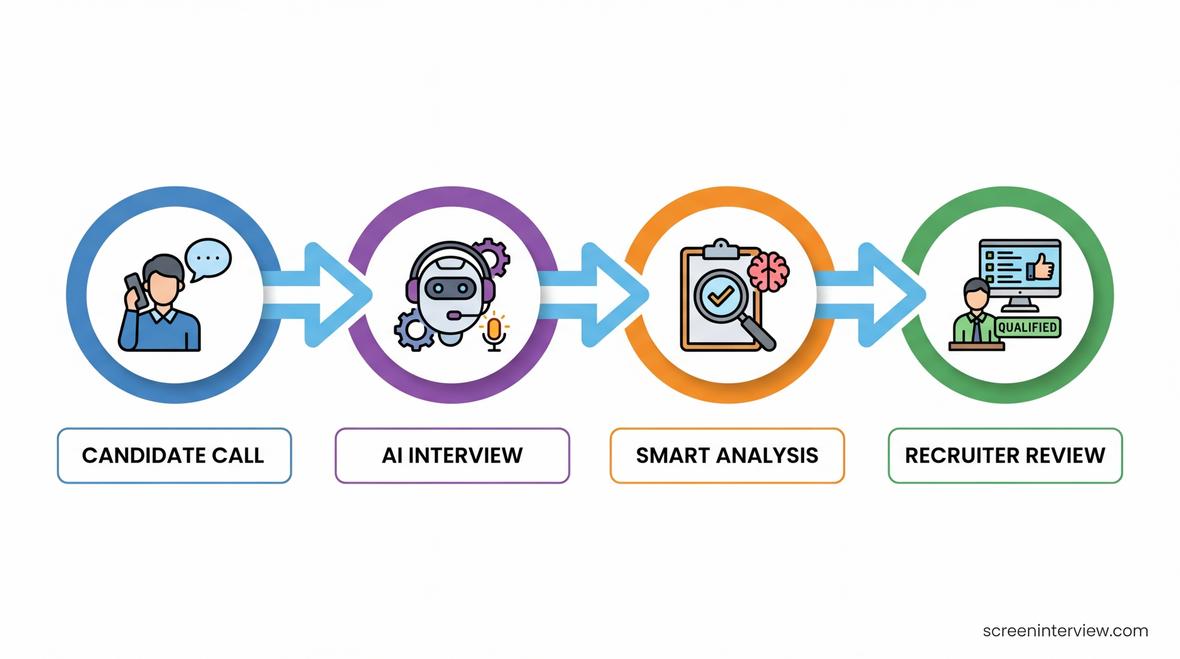
The mechanics behind ai phone screening combine several sophisticated technologies to create a conversational experience that feels natural to candidates while capturing structured data for recruiters. Understanding this process helps recruiting professionals evaluate platforms and implement them effectively within their organizations.
Conversational AI and Natural Language Processing
At the core of modern telephone screening platforms lies conversational AI that can conduct natural, engaging phone conversations with candidates. These systems use advanced natural language processing (NLP) to understand candidate responses, ask appropriate follow-up questions, and adapt the conversation flow based on answers received. Unlike rigid interactive voice response (IVR) systems of the past, today's AI phone screening solutions create dialogues that feel remarkably human.
The AI interviewer can handle various accents, speech patterns, and conversation styles while maintaining consistent evaluation criteria. This ensures every candidate receives the same quality of screening experience regardless of when they're interviewed or which recruiter would have otherwise conducted the call.
Structured Data Extraction and Analysis
While the conversation unfolds naturally, the AI system simultaneously extracts structured data from unstructured responses. When a candidate discusses their experience with project management, the AI identifies relevant skills, years of experience, team sizes managed, and specific methodologies mentioned. This information is automatically organized into searchable, comparable data fields that recruiters can review.
Advanced interview insights platforms go beyond simple keyword matching. They analyze communication patterns, enthusiasm indicators, and response quality to provide nuanced assessments that help identify top-tier talent more effectively than traditional resume screening alone.
Integration with Existing Recruitment Systems
Modern ai phone screening solutions integrate directly with popular ATS platforms, creating seamless workflow automation throughout the recruitment process. When a candidate applies, the system can automatically trigger a screening call invitation, conduct the interview, score the candidate based on predefined criteria, and update the ATS with results all without manual intervention.
This integration ensures that recruiting teams maintain a single source of truth for candidate information while benefiting from AI-enhanced screening capabilities. Candidates who meet threshold scores can be automatically advanced to the next stage, while detailed transcripts and analysis remain available for recruiter review.
Key Benefits of AI Phone Screening for Recruitment Teams
The adoption of ai phone screening delivers measurable improvements across multiple dimensions of the recruitment process. Understanding these benefits helps justify investment and set appropriate expectations for implementation outcomes.
Dramatic Time Savings and Increased Capacity
The most immediate benefit recruiting professionals experience is the reclamation of time previously spent on initial screening calls. A typical recruiter might spend 15-30 minutes per screening call, plus additional time for scheduling and note-taking. With AI automation, this process requires zero recruiter time until the review stage. For teams screening hundreds of candidates monthly, this translates to dozens of hours returned to higher-value activities like relationship building with hiring managers and top candidates.
Research from Statista: AI Market Size and Adoption Statistics indicates that organizations implementing AI recruitment technologies report reducing time-to-hire by an average of 40-50%, with phone screening automation being a primary contributor to these gains.
Enhanced Candidate Experience
Contrary to concerns about 'robotic' experiences, well-implemented ai phone screening often improves candidate satisfaction. Candidates appreciate the flexibility to complete screenings at their convenience rather than coordinating schedules for live calls. The consistency of questions and evaluation criteria also ensures fair treatment across all applicants.
Platforms offering on-demand interviews allow candidates to choose when they're most prepared and comfortable, leading to better performance and more authentic representation of their capabilities. Additionally, faster feedback loops enabled by automated processing keep candidates engaged and reduce drop-off rates.
Reduction of Unconscious Bias
One of the most significant advantages of ai phone screening is its potential to reduce unconscious bias in early-stage candidate evaluation. Human screeners, despite best intentions, can be influenced by factors like accent, speech patterns, or conversational chemistry that have little correlation with job performance.
AI systems, when properly designed and monitored, evaluate candidates based solely on the content of their responses against predetermined criteria. This creates more equitable screening processes, particularly valuable for organizations committed to diversity and inclusion initiatives. The technology supports candidate screening without bias by standardizing evaluation methodology across all applicants.
Unlimited Scalability
For organizations experiencing growth, seasonal hiring surges, or high-volume recruitment needs, ai phone screening provides the ability to maintain quality while scaling screening capacity infinitely. Whether you're screening 50 candidates or 5,000, the technology handles the load without degradation in quality or candidate experience.
This scalability proves particularly valuable for high volume recruiting scenarios like retail seasonal hiring, contact center staffing, or rapid expansion initiatives where manual screening would require unsustainable recruiter headcount increases.
Implementing AI Phone Screening: A Strategic Approach
Successfully deploying ai phone screening technology requires more than simply purchasing a platform. Strategic implementation ensures adoption, effectiveness, and continuous improvement of the screening process.
Assessing Your Organization's Needs
Begin by analyzing your current screening process to identify specific pain points and opportunities. Questions to consider include: What percentage of applicants currently pass phone screens? How much recruiter time is consumed by screening? What are common reasons for candidate rejection at this stage? Where do inconsistencies appear in screening outcomes?
This assessment helps you define success metrics and select an ai interview platform with features aligned to your specific requirements. Organizations screening primarily for technical roles may prioritize different capabilities than those focused on customer-facing positions.
Selecting the Right AI Phone Screening Platform
The market offers numerous ai phone screening solutions with varying capabilities, pricing models, and integration options. Key evaluation criteria should include:
- Conversation Quality: How natural and engaging are the AI-conducted interviews?
- Customization Capabilities: Can you tailor questions, evaluation criteria, and conversation flows to your specific roles?
- Integration Options: Does the platform connect seamlessly with your existing ATS and HR systems?
- Analytics and Reporting: What insights does the platform provide about candidate quality and screening effectiveness?
- Bias Mitigation Features: How does the platform address fairness and equity in candidate evaluation?
- Candidate Experience: What do candidates report about their experience with the platform?
Platforms like screeninterview.com offer comprehensive solutions specifically designed for modern recruiting professionals, with features addressing each of these critical evaluation dimensions.
Starting with a Pilot Program
Rather than organization-wide deployment, begin with a pilot program focused on specific roles or departments. This approach allows you to refine configurations, train recruiters, and demonstrate value before broader rollout. Select pilot roles with sufficient volume to generate meaningful data but manageable enough to closely monitor outcomes.
During the pilot phase, maintain parallel processes conducting both AI and human screenings for a subset of candidates to validate that the AI system's assessments align with human judgment and to identify areas requiring adjustment.
Training and Change Management
Successful ai phone screening implementation requires recruiter buy-in and proper training. Some team members may initially resist automation, fearing job displacement or quality concerns. Address these concerns through transparent communication about how the technology augments rather than replaces human judgment.
Training should cover how to review AI-generated assessments, interpret confidence scores, identify candidates for advancement, and provide feedback to continuously improve the system. Emphasize that the technology handles repetitive screening tasks so recruiters can focus on relationship-building and strategic activities that truly require human expertise.
Best Practices for AI Phone Screening Success
Organizations achieving the greatest return from ai phone screening investments follow several proven best practices that maximize effectiveness while maintaining candidate experience quality.
Designing Effective Screening Questions
The quality of insights generated by AI phone screening depends heavily on question design. Effective screening questions are:
- Open-ended: Allowing candidates to demonstrate thinking and communication skills
- Role-specific: Directly connected to key competencies required for success
- Behavioral: Focused on past experiences rather than hypothetical scenarios
- Structured: Consistent across candidates to enable fair comparison
Avoid yes/no questions or those with single correct answers. Instead, design prompts that encourage candidates to share detailed experiences, explain their approach to challenges, or describe how they've applied specific skills. The interview builder functionality in advanced platforms helps create effective question sets aligned to role requirements.
Setting Clear Evaluation Criteria
Define specific, measurable criteria for evaluating candidate responses before launching ai phone screening. What constitutes a strong versus weak answer? What keywords, concepts, or experiences indicate a qualified candidate? How should the AI weight different competencies?
This clarity ensures consistent, objective evaluation and enables the AI system to accurately score candidates. Regularly review and refine these criteria based on outcomes which candidates who scored highly actually succeeded in role versus those who didn't meet expectations.
Maintaining Transparency with Candidates
Candidates appreciate transparency about the use of AI in recruitment processes. Clearly communicate that the initial screening will be conducted by AI, explain how the technology works, and emphasize how it ensures fair, consistent evaluation. Provide technical support resources for candidates who may have questions or encounter issues.
This transparency builds trust and reduces candidate anxiety about the process. It also demonstrates your organization's commitment to innovation and efficiency qualities that appeal to top talent.
Monitoring and Continuous Improvement
Treat ai phone screening as an evolving system requiring ongoing optimization. Regularly analyze metrics like:
- Candidate completion rates
- Correlation between AI scores and subsequent hiring decisions
- Time-to-hire improvements
- Candidate satisfaction feedback
- Diversity metrics in advancement rates
Use these insights to refine questions, adjust scoring algorithms, and improve the candidate experience. The most effective organizations establish quarterly review processes to assess performance and implement improvements.
AI Phone Screening Use Cases Across Industries
While ai phone screening delivers value across nearly all industries and roles, certain applications demonstrate particularly compelling returns on investment.
Technical and Engineering Roles
For organizations hiring software engineers, data scientists, or other technical professionals, AI phone screening efficiently assesses foundational technical knowledge, problem-solving approaches, and communication skills. The technology can evaluate responses to technical questions, identify candidates with appropriate experience levels, and screen for specific programming languages or frameworks.
Specialized screening for roles like software engineer ai interview or data scientist ai interview ensures candidates possess the baseline technical competencies before advancing to more intensive technical assessments.
Customer-Facing Positions
For customer service, sales, and client-facing roles where communication skills are paramount, ai phone screening assesses verbal communication ability, enthusiasm, and customer orientation. The conversational nature of phone screening provides more relevant evaluation than resume review alone for these positions.
AI analysis can identify communication patterns associated with successful customer interactions, helping predict on-the-job performance more accurately than traditional screening methods.
Healthcare and Nursing Recruitment
Healthcare organizations facing critical staffing shortages benefit tremendously from ai phone screening to efficiently process high application volumes. The technology can verify credentials, assess clinical knowledge, evaluate patient care philosophy, and screen for specific certifications or specializations.
Resources like ai nurse screening healthcare hiring demonstrate how healthcare recruiters leverage automation to maintain quality while dramatically increasing screening capacity during periods of high demand.
Measuring ROI and Success Metrics
Demonstrating the value of ai phone screening investments requires tracking specific metrics that connect technology adoption to business outcomes.
Time and Cost Efficiency Metrics
Calculate time savings by measuring recruiter hours previously spent on phone screening versus post-implementation levels. Multiply hours saved by recruiter hourly cost (including benefits and overhead) to determine direct cost savings. Additionally, track cost-per-hire reductions resulting from process efficiencies.
Organizations typically see 60-80% reductions in time spent on initial screening activities, translating to substantial cost savings even after accounting for platform subscription fees.
Quality of Hire Improvements
Track whether candidates screened through AI phone screening demonstrate better performance, longer tenure, or higher hiring manager satisfaction compared to those screened through traditional methods. Quality of hire improvements represent the most significant long-term value but require several months of data to measure accurately.
Candidate Experience Indicators
Monitor candidate satisfaction scores, completion rates, and feedback specifically related to the ai phone screening experience. High satisfaction and completion rates indicate the technology enhances rather than detracts from your employer brand.
The Future of AI Phone Screening Technology
The ai phone screening landscape continues evolving rapidly, with several emerging trends shaping the future of recruitment technology.
Multimodal Assessment Capabilities
Next-generation platforms are expanding beyond voice-only screening to incorporate video analysis, enabling assessment of non-verbal communication, presentation skills, and other visual cues. This multimodal approach provides richer candidate insights while maintaining the efficiency benefits of automation.
Advanced Predictive Analytics
AI systems are increasingly leveraging historical hiring data to predict candidate success probability with greater accuracy. By analyzing patterns in successful hires' screening responses, the technology identifies subtle indicators of future performance that may not be apparent to human screeners.
Hyper-Personalization
Future ai phone screening systems will dynamically adapt conversations based on candidate responses, job requirements, and organizational culture. Rather than following rigid scripts, these adaptive systems will conduct truly personalized interviews that feel more human while gathering more relevant information.
Frequently Asked Questions About AI Phone Screening
How do candidates typically respond to AI phone screening?
When properly implemented with transparency and user-friendly design, candidates generally respond positively to ai phone screening. Most appreciate the scheduling flexibility and consistent evaluation process. Organizations should provide clear communication about the AI screening process and offer technical support to address any candidate concerns.
Can AI phone screening really reduce bias in hiring?
Yes, when properly designed and monitored, ai phone screening can significantly reduce certain forms of unconscious bias by evaluating candidates solely on response content against predetermined criteria. However, it's essential to regularly audit AI systems to ensure they don't perpetuate biases present in training data. Combining AI screening with human oversight creates the most equitable process.
What happens if a candidate doesn't have access to a phone?
Modern platforms offer multiple interaction modalities beyond traditional phone calls, including web-based voice interviews, video options, and even text-based alternatives. This flexibility ensures accessibility for candidates regardless of their specific technology access.
How long does an AI phone screening typically take?
Most ai phone screening sessions range from 10-20 minutes, depending on the role complexity and number of competencies being assessed. The duration is typically shorter than traditional recruiter-conducted phone screens due to the efficiency of AI-guided conversations.
Can AI phone screening work for senior-level positions?
Absolutely. While some organizations initially implement ai phone screening for high-volume entry and mid-level roles, the technology is equally effective for senior positions. The key is designing appropriately sophisticated questions that assess strategic thinking, leadership experience, and other executive competencies.
Conclusion
AI phone screening represents a transformative advancement in recruitment technology, enabling modern recruiting professionals to dramatically improve efficiency, reduce bias, and enhance candidate experience simultaneously. For Heads of Talent, Recruiting Leads, and People Operations Managers working in fast-paced environments with high candidate volumes, this technology addresses critical operational challenges while supporting strategic hiring objectives. By thoughtfully implementing ai phone screening with clear evaluation criteria, proper training, and continuous optimization, organizations position themselves to identify top-tier talent more effectively than ever before. The future of recruitment lies not in replacing human judgment but in augmenting it with intelligent automation that handles repetitive tasks and surfaces the insights that matter most. As the technology continues evolving with enhanced predictive capabilities and multimodal assessment features, early adopters will maintain competitive advantages in the increasingly challenging war for talent.
Ready to Transform Your Interview Process?
See how ScreenInterview can help you automate phone screens, reduce bias, and hire better candidates faster.