
AI Phone Screen: Complete Guide To Automated Recruitment Screening In 2026

Understanding AI Phone Screen Technology
An AI phone screen represents a revolutionary shift in how organizations conduct initial candidate evaluations. This technology leverages artificial intelligence to automate phone-based interviews, analyzing both verbal responses and conversational patterns to identify qualified candidates. For modern recruiting professionals, AI phone screen solutions offer a scalable way to handle high-volume hiring while maintaining consistent evaluation standards across all candidates.
The technology works by conducting natural, conversational interviews through automated phone calls. Unlike traditional phone screens that require recruiter availability and manual note-taking, AI phone screen systems can simultaneously interview hundreds of candidates, transcribe responses in real-time, and generate comprehensive evaluation reports. This approach dramatically reduces time-to-hire while ensuring every candidate receives the same structured interview experience.
According to Gallup's AI phone interviewing response rates, pilot tests across four continents with over half a million call attempts demonstrate that AI-powered phone screening achieves comparable response and completion rates to traditional methods, validating the scalability of this approach across diverse candidate populations and languages.
How AI Phone Screen Works
The AI phone screen process begins when a candidate receives an automated call at their scheduled time or calls into the system at their convenience. Advanced natural language processing enables the AI to ask predetermined questions, listen to responses, and even ask contextual follow-up questions based on what candidates say. This creates a surprisingly natural conversation that feels personalized despite being fully automated.
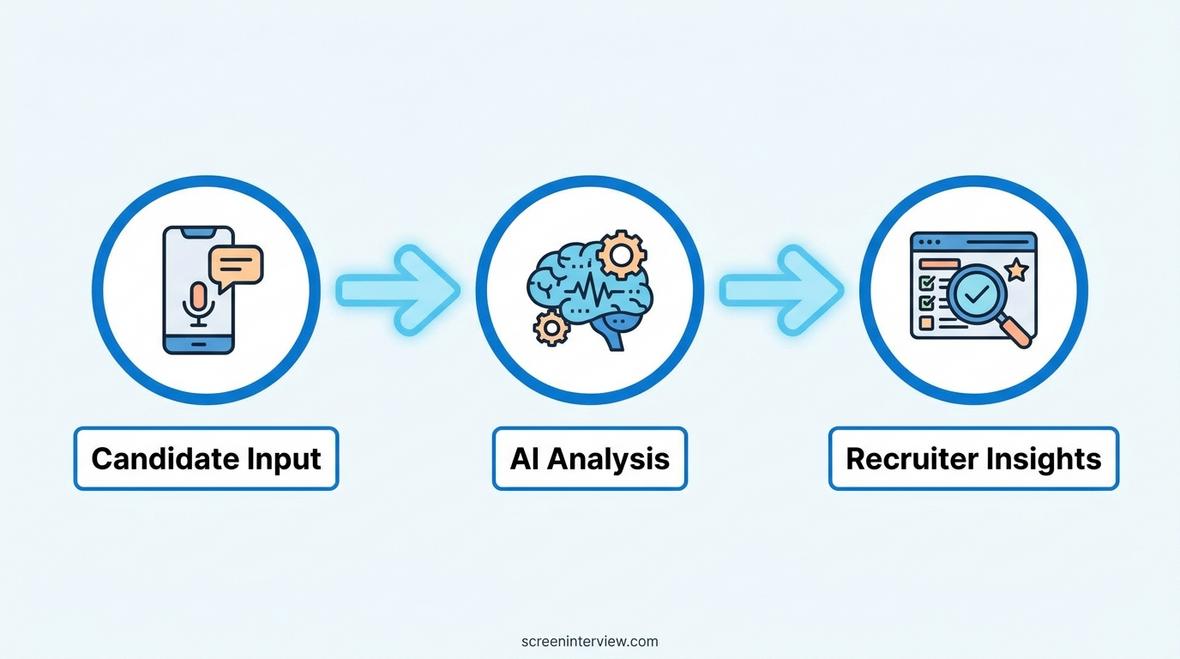
The three-stage workflow illustrated above shows how candidate input flows through AI analysis to deliver actionable recruiter insights. During the call, speech recognition technology converts verbal responses into text, while sentiment analysis evaluates tone, confidence, and communication clarity. The system identifies keywords, assesses answer completeness, and compares responses against ideal answer frameworks established during interview design.
Behind the scenes, machine learning algorithms trained on thousands of successful hires evaluate each response against role-specific criteria. The system generates structured data that recruiters can review through intuitive dashboards, complete with interview recordings, transcripts, and automatically calculated candidate scores. This data-driven approach removes subjective bias that often creeps into traditional phone screens.
Key Technologies Powering AI Phone Screens
- Natural Language Processing (NLP): Understands context, intent, and meaning behind candidate responses
- Speech Recognition: Converts spoken words into text with high accuracy across accents and dialects
- Sentiment Analysis: Evaluates emotional tone, enthusiasm, and confidence levels
- Machine Learning Models: Continuously improve evaluation accuracy based on hiring outcomes
- Conversational AI: Generates dynamic follow-up questions based on candidate responses
However, recruiters must remain aware of current AI limitations. Research from Stanford AI Index 2026 hallucination benchmarks shows that hallucination rates across 26 top models range from 22% to 94%, highlighting the importance of human oversight in the final hiring decision. While AI phone screen technology significantly improves efficiency, it should complement rather than replace human judgment.
Benefits of AI Phone Screen for Recruiters
For Heads of Talent and Recruiting Leads managing high-volume pipelines, AI phone screen technology delivers transformative operational benefits. The most immediate impact is time savings what once required 30-45 minutes of recruiter time per candidate now happens automatically, freeing recruiters to focus on relationship-building with top candidates and strategic hiring initiatives.
Operational Efficiency Gains
Time-to-hire reductions of 40-60% are common when organizations implement AI-powered telephone screening. The technology eliminates scheduling friction by allowing candidates to complete screens at their convenience, reducing no-show rates and accelerating pipeline velocity. Recruiters can review completed screens asynchronously, prioritizing the most promising candidates first based on AI-generated scores.
The scalability advantages become particularly evident during high-volume hiring periods. A single recruiter might traditionally handle 20-30 phone screens per week; an AI phone screen system can conduct thousands simultaneously. This means organizations can open requisitions to larger candidate pools without proportionally increasing recruiting headcount, fundamentally changing the economics of talent acquisition.
Enhanced Candidate Experience
Contrary to concerns about impersonal automation, candidates often prefer AI phone screens for their convenience and consistency. The KFF poll on AI chatbot usage trends indicates that 32% of U.S. adults now use AI chatbots, with younger adults under 30 showing three times higher adoption rates, suggesting growing comfort with conversational AI interactions across demographics.
Candidates appreciate the elimination of calendar coordination, the ability to complete screens outside business hours, and the consistent evaluation framework that ensures their responses receive equal consideration. For passive candidates hesitant to take recruiting calls during work hours, the flexibility of AI phone screen systems dramatically improves accessibility.
Bias Reduction and Fair Evaluation
One of the most compelling advantages of AI phone screen technology is its potential to reduce unconscious bias in initial screening. When properly designed, these systems evaluate candidates solely on response content and relevant competencies, blind to demographic information that might trigger human biases. Every candidate receives identical questions in the same order with the same evaluation rubric applied.
Organizations can implement bias-free candidate screening practices by carefully designing interview questions focused on job-relevant skills and structured evaluation criteria. The consistent application of standards across all candidates creates a more equitable screening process, particularly important for organizations with diversity and inclusion commitments.
Implementing AI Phone Screen in Your Recruitment Process
Successfully deploying AI phone screen technology requires thoughtful planning and integration with existing recruitment workflows. The implementation process typically involves four key phases: interview design, system configuration, candidate communication strategy, and continuous optimization based on outcomes.
Designing Effective AI Phone Screen Interviews
The quality of your AI phone screen depends entirely on interview design. Start by identifying the 5-7 most important screening criteria for each role these might include technical knowledge, communication skills, work authorization, salary expectations, and role-specific competencies. Work with hiring managers to define what 'good' answers look like for each question.
Structure questions to elicit substantive responses rather than simple yes/no answers. Instead of 'Do you have JavaScript experience?' ask 'Describe a recent project where you used JavaScript and the challenges you solved.' Open-ended questions provide richer data for AI analysis and better predict on-the-job performance. The interview builder tools available in modern platforms help structure questions for optimal AI evaluation.
Integration with Existing Recruitment Technology
Your AI phone screen solution should integrate seamlessly with your existing Applicant Tracking System to maintain a single source of truth for candidate data. Look for platforms offering native integrations or robust APIs that automatically sync candidate information, trigger phone screens based on application status changes, and push completed interview results back to your ATS.
The best implementations create automated recruitment workflows where candidates automatically receive phone screen invitations when they meet minimum qualifications, complete the screen at their convenience, and advance to the next stage based on their scores all without manual recruiter intervention. This end-to-end automation can reduce administrative burden by 70% or more.
Candidate Communication Best Practices
Transparent communication about the AI phone screen process sets proper expectations and improves completion rates. Your invitation should clearly explain that the screen will be conducted by an AI system, provide estimated duration, offer technical requirements and support resources, and emphasize that human recruiters will review results before making advancement decisions.
Consider offering candidates a choice between AI phone screens and traditional recruiter calls for senior roles or positions where candidate experience is particularly critical. This hybrid approach respects candidate preferences while still capturing efficiency gains for the majority who opt for automated screening.
Measuring Success of AI Phone Screen Programs
Data-driven recruiting professionals need clear metrics to evaluate AI phone screen program effectiveness. Establish baseline measurements before implementation, then track key performance indicators monthly to quantify impact and identify optimization opportunities.
Essential Metrics to Track
| Metric | Target Benchmark | What It Measures |
|---|---|---|
| Screen Completion Rate | 75-85% | Percentage of invited candidates completing screens |
| Time-to-Screen | 24-48 hours | Average time from application to completed screen |
| Screen-to-Interview Ratio | 20-30% | Percentage advancing to live interviews |
| Offer Acceptance Rate | Maintain or improve | Quality of candidates progressed by AI screening |
| Recruiter Time Savings | 10-15 hours/week | Hours saved per recruiter on screening activities |
Monitor quality metrics closely during the first 90 days. Are candidates who score well in AI phone screens performing equally well in subsequent interview stages? Are hiring managers satisfied with candidate quality? Use this feedback to refine interview questions, adjust scoring weights, and optimize the evaluation model.
Continuous Improvement Strategies
The most successful AI phone screen implementations treat the system as continuously evolving rather than 'set and forget.' Quarterly reviews should analyze which questions best predict interview success, identify demographic patterns that might indicate bias, and incorporate feedback from hiring managers and candidates.
Advanced platforms offer A/B testing capabilities where you can experiment with different question phrasings, interview structures, or evaluation criteria to empirically determine what drives better hiring outcomes. This data-driven optimization approach, similar to methodologies used in conversational AI recruiting, ensures your screening process continuously improves over time.
AI Phone Screen vs. Traditional Phone Screening
Understanding the tradeoffs between AI phone screen technology and traditional recruiter-conducted phone screens helps organizations make informed implementation decisions. Each approach has distinct advantages depending on role type, volume, and organizational priorities.
When AI Phone Screen Excels
AI phone screen technology delivers maximum value in high-volume recruiting scenarios where consistent evaluation matters more than nuanced relationship-building. Entry-level positions, technical roles with clear skill requirements, and hourly worker hiring are ideal use cases. The technology excels at asking the same questions consistently, evaluating responses objectively, and processing large candidate volumes without quality degradation.
Organizations recruiting for roles with well-defined requirements and structured career paths see the fastest ROI from AI phone screen implementation. The technology is particularly effective for high-volume recruiting where manual screening creates bottlenecks that slow time-to-hire and increase candidate drop-off.
When Human Touch Remains Important
Executive searches, highly specialized technical roles, and positions requiring complex stakeholder management may warrant traditional recruiter-conducted screens. These scenarios benefit from the recruiter's ability to build rapport, probe ambiguous responses with spontaneous follow-ups, assess cultural fit through conversational nuance, and sell candidates on unique organizational opportunities.
The optimal approach for many organizations combines both methods: AI phone screens handle initial qualification screening, while human recruiters focus their time on relationship-building conversations with top-scoring candidates. This hybrid model captures efficiency gains while preserving the human connection that matters for candidate experience and employer branding.
Selecting the Right AI Phone Screen Platform
The AI phone screen market has expanded rapidly, with platforms offering varying capabilities, pricing models, and integration options. Selecting the right solution requires evaluating technical capabilities against your specific organizational needs and existing technology ecosystem.
Essential Platform Capabilities
Look for platforms offering robust natural language processing that handles diverse accents and speech patterns, customizable interview templates for different roles and departments, ATS integration to automate workflows, real-time transcription and recording for compliance and review, and configurable scoring models aligned with your evaluation criteria.
The platform should support both inbound and outbound calling models. Inbound systems provide candidates a number to call at their convenience, while outbound systems place automated calls to candidates at scheduled times. The most flexible platforms, like AI interviewer solutions, support both approaches to accommodate different candidate preferences and use cases.
Compliance and Security Considerations
AI phone screen platforms must meet stringent data protection and employment law requirements. Verify that platforms offer GDPR and CCPA compliance for data protection, call recording consent management, secure data storage with encryption, audit trails for compliance documentation, and adverse action prevention features to support fair hiring practices.
Request information about the platform's AI training data and bias testing protocols. Responsible vendors conduct regular fairness audits and provide transparency about how their algorithms make evaluation decisions. The AI interview technology should be explainable, allowing you to understand why candidates received specific scores.
Pricing Models and ROI Calculation
AI phone screen platforms typically charge per completed screen, monthly subscriptions based on hiring volume, or annual licenses for enterprise deployments. Calculate your expected ROI by estimating recruiter time saved (hours per week × hourly cost), reduced time-to-fill impact on revenue, improved quality of hire reducing turnover costs, and candidate experience improvements supporting employer brand.
Most organizations achieve positive ROI within 3-6 months of implementation for high-volume roles. The key is ensuring sufficient utilization underutilized platforms waste money, so focus initial deployment on roles with consistent hiring needs where you'll complete dozens of screens monthly.
Advanced AI Phone Screen Capabilities
Leading AI phone screen platforms now offer sophisticated capabilities beyond basic question-and-answer screening. These advanced features provide deeper candidate insights and support more nuanced evaluation approaches.
Dynamic Conversational Flows
Next-generation systems use conversational AI to create adaptive interview experiences where follow-up questions dynamically adjust based on previous responses. If a candidate mentions specific technology experience, the AI probes deeper with technical questions. If they indicate salary expectations outside the range, the system can gracefully conclude the screen early, saving everyone time.
This adaptive approach, similar to how humans conduct conversations, creates more engaging candidate experiences while extracting more relevant information. The technology underlying these capabilities draws from the same conversational AI recruiting principles used in customer service chatbots and virtual assistants.
Multilingual Screening Capabilities
For organizations hiring globally or in multilingual markets, advanced AI phone screen platforms support interviews in dozens of languages with automatic translation for recruiter review. This capability dramatically expands accessible talent pools while ensuring candidates can interview in their preferred language, reducing language barriers that might otherwise mask qualified candidates.
Sentiment and Soft Skill Analysis
Beyond transcribing words, sophisticated AI phone screen systems analyze vocal characteristics to assess soft skills like enthusiasm, confidence, communication clarity, and professionalism. Speech pattern analysis can identify hesitation, over-rehearsed responses, or conversational fluency that might indicate cultural fit or customer-facing role suitability.
While these capabilities provide valuable data points, they should be used judiciously and validated against actual job performance to ensure they predict success rather than introducing new forms of bias. Responsible implementation requires ongoing monitoring and adjustment based on hiring outcomes.
Overcoming Common Implementation Challenges
Organizations implementing AI phone screen technology commonly encounter several challenges. Anticipating these obstacles and planning mitigation strategies ensures smoother deployment and faster value realization.
Managing Hiring Manager Concerns
Hiring managers accustomed to traditional processes may initially resist AI phone screen technology, concerned about losing control or missing qualified candidates. Address these concerns through pilot programs demonstrating results, transparency about how the AI evaluates candidates, involvement in interview design to ensure relevant criteria, and maintaining human review before final decisions.
Position AI phone screen as a tool that augments rather than replaces human judgment. Emphasize that the technology handles repetitive qualification verification while freeing hiring managers to focus on deeper assessment of top candidates during in-person interviews.
Ensuring Candidate Adoption
Some candidates, particularly older demographics or those unfamiliar with AI technology, may feel uncomfortable with automated screening. Improve adoption rates by offering clear technical support resources, providing alternative screening options for those who prefer them, emphasizing the fairness and consistency benefits, and gathering feedback to continuously improve the experience.
Proactively communicate the 'why' behind AI phone screen adoption candidates generally respond positively when they understand the technology helps ensure fair evaluation and faster hiring processes that respect their time.
Future Trends in AI Phone Screen Technology
The AI phone screen landscape continues evolving rapidly as natural language processing, machine learning, and conversational AI technologies advance. Several emerging trends will shape how organizations use this technology over the next few years.
Integration with Skills Assessment
Future platforms will seamlessly blend conversational screening with real-time skills testing. During an AI phone screen for a developer role, candidates might receive a coding challenge via SMS to complete while on the call, with the AI discussing their approach afterward. This integration of on-demand interview formats with skills validation creates comprehensive screening in a single candidate interaction.
Predictive Analytics and Success Modeling
As organizations accumulate AI phone screen data over time, machine learning models will identify patterns correlating specific responses, communication styles, or behavioral indicators with long-term job success. These predictive capabilities will enable increasingly accurate screening that goes beyond qualification verification to predict performance, cultural fit, and retention likelihood.
Video-Enhanced Phone Screening
While traditional phone-only screening protects against appearance bias, some organizations are experimenting with optional video components in AI phone screens. These hybrid approaches might use video for specific assessment needs while maintaining voice-only evaluation for most questions, balancing additional data with bias mitigation priorities.
Best Practices for AI Phone Screen Success
Organizations achieving the greatest success with AI phone screen technology follow several consistent best practices that maximize ROI while maintaining positive candidate experiences and hiring quality.
Start with High-Volume Roles
Launch your AI phone screen program with positions where you conduct dozens of screens monthly customer service representatives, sales development representatives, or entry-level technical roles. High volume provides rapid feedback on system performance, faster ROI justification, and more data for optimization. Once refined, expand to additional role types.
Involve Stakeholders in Design
Collaborative interview design involving recruiters, hiring managers, and diversity/inclusion stakeholders creates buy-in and ensures the screening evaluates truly relevant criteria. Regular review sessions where stakeholders listen to sample AI phone screens and provide feedback helps continuously refine the process.
Maintain Human Oversight
Even with sophisticated AI phone screen technology, maintain human review before making advancement decisions. Recruiters should spot-check transcripts, listen to recordings of borderline candidates, and override AI scores when contextual factors warrant. This human-in-the-loop approach combines efficiency with judgment, similar to best practices in AI interview automation.
Gather Continuous Feedback
Implement feedback mechanisms capturing candidate experience ratings, hiring manager satisfaction with candidate quality, and recruiter observations about system performance. Use this qualitative feedback alongside quantitative metrics to guide ongoing optimization efforts.
Frequently Asked Questions
How accurate are AI phone screens compared to human recruiters?
AI phone screen accuracy depends on interview design quality and the AI model's training. Well-designed systems achieve 85-95% agreement with expert human evaluators on qualification decisions. The key advantage is consistency AI applies the same standards to every candidate, while human screeners may vary in rigor or be influenced by unconscious biases.
Do candidates prefer AI phone screens to traditional phone interviews?
Candidate preference varies by demographic and role level. Surveys show 60-70% of candidates appreciate the convenience and flexibility of AI phone screens, particularly for initial screening conversations. However, candidates generally prefer human interaction for later-stage interviews where relationship-building and company culture assessment become important.
How long does implementation typically take?
Basic AI phone screen implementation takes 2-4 weeks for initial setup, interview design, and system configuration. Organizations typically run pilot programs for 30-60 days before full deployment. Complete rollout across multiple roles and departments usually occurs over 3-6 months as you refine processes and expand use cases.
Can AI phone screens effectively evaluate soft skills?
Advanced AI phone screen platforms can assess certain soft skills like communication clarity, enthusiasm, and professionalism through speech pattern analysis and response content evaluation. However, nuanced soft skills like leadership potential, creativity, or complex interpersonal abilities are better evaluated through human interaction in later interview stages.
What compliance considerations exist for AI phone screening?
AI phone screens must comply with employment discrimination laws, data protection regulations like GDPR, call recording consent requirements, and adverse action notification rules. Organizations should conduct regular bias audits, maintain detailed documentation of evaluation criteria, and ensure candidates can request human review of AI decisions. Consult employment counsel to ensure your implementation meets all applicable legal requirements.
Conclusion
The AI phone screen represents a transformative advancement in recruitment technology, offering modern talent acquisition teams the ability to scale screening operations while maintaining consistency and reducing bias. By automating initial qualification conversations, these systems free recruiters to focus on relationship-building with top candidates and strategic hiring initiatives that drive organizational success.
Successful implementation requires thoughtful interview design, stakeholder engagement, integration with existing recruitment workflows, and ongoing optimization based on outcomes. Organizations that approach AI phone screen technology as a complement to rather than replacement for human judgment achieve the best results, combining operational efficiency with the relationship-building that remains central to effective recruiting. As the technology continues advancing, forward-thinking recruiting leaders who master AI-powered screening solutions will gain significant competitive advantages in the war for talent.
Ready to Transform Your Interview Process?
See how ScreenInterview can help you automate phone screens, reduce bias, and hire better candidates faster.