
AI Interview Software: Complete Guide To Automated Hiring In 2026

Understanding AI Interview Software in 2026
AI interview software has transformed from a novel hiring tool into an essential component of modern recruitment strategies. These platforms leverage artificial intelligence to automate, optimize, and enhance the candidate screening process, enabling organizations to evaluate talent at scale while maintaining consistency and reducing unconscious bias. As we navigate 2026, the adoption of ai interview software continues to accelerate across industries, driven by the need for faster hiring cycles and data-driven decision-making.
At its core, ai interview software automates various stages of the interview process from initial screening to comprehensive candidate evaluation. These systems utilize natural language processing, machine learning algorithms, and advanced analytics to assess candidates' responses, communication skills, technical competencies, and cultural fit. The technology has matured considerably, with platforms now offering sophisticated features like sentiment analysis, predictive performance modeling, and integration capabilities with existing applicant tracking systems.
According to Grand View Research AI HR market benchmarks, AI in HR market valued at USD 6.25 billion in 2026, with strong growth in recruitment applications. This substantial market valuation underscores the widespread confidence in AI-powered recruitment technologies and their ability to deliver measurable ROI through reduced time-to-hire, improved candidate quality, and enhanced recruiter productivity.
How AI Interview Software Works
Modern ai interview software operates through a multi-layered technological framework designed to replicate and enhance human judgment while eliminating common pitfalls in traditional interviewing. The process typically begins with job setup, where recruiters configure role-specific parameters, competency requirements, and evaluation criteria within the platform.
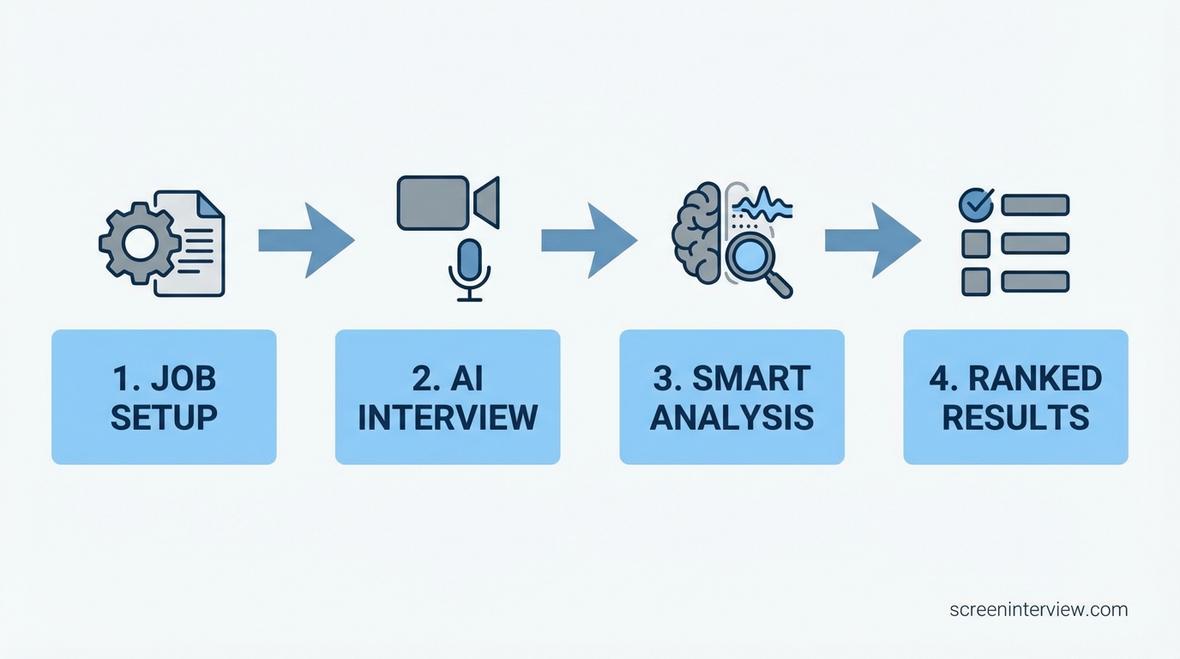
The workflow follows a systematic approach:
- Job Setup: Hiring managers define position requirements, establish question banks, and configure assessment parameters aligned with organizational needs.
- AI Interview: Candidates participate in on-demand interviews where they respond to pre-recorded or dynamically generated questions through video, audio, or text interfaces.
- Smart Analysis: The platform's AI engine processes responses using speech recognition, natural language understanding, facial expression analysis, and contextual evaluation to generate comprehensive candidate profiles.
- Ranked Results: Candidates are scored and ranked based on predefined criteria, with detailed insights provided to recruiters for final decision-making.
Advanced systems incorporate interview proctoring capabilities to ensure assessment integrity, detecting potential cheating behaviors through environmental monitoring, tab-switching detection, and identity verification protocols. This multi-dimensional approach ensures that organizations receive reliable, actionable data about each candidate's qualifications and potential.
Key Features of Leading AI Interview Software Platforms
The most effective ai interview software platforms in 2026 share several distinguishing characteristics that set them apart from legacy recruitment tools. Understanding these features helps organizations select solutions aligned with their specific hiring needs and organizational culture.
Intelligent Question Generation
Leading platforms offer dynamic interview question generation capabilities that adapt to specific roles, seniority levels, and organizational contexts. Rather than relying on static question banks, these systems utilize AI to craft relevant, non-discriminatory questions that probe essential competencies while avoiding repetitive or legally problematic inquiries.
Comprehensive Candidate Assessment
Modern ai interview software evaluates candidates across multiple dimensions simultaneously. Beyond transcribing and analyzing verbal responses, these platforms assess communication patterns, problem-solving approaches, emotional intelligence indicators, and technical proficiency. For technical roles, integration with coding environments enables real-time evaluation of programming skills, as demonstrated in specialized software engineer AI interviews.
Workflow Automation Capabilities
Efficiency gains represent one of the primary value propositions of ai interview software. Top-tier platforms provide extensive workflow automation features that handle candidate communication, interview scheduling, reminder notifications, and post-interview follow-up without manual intervention. This automation liberates recruiting teams to focus on strategic relationship-building and high-value decision-making activities.
Bias Mitigation Mechanisms
Addressing unconscious bias remains a critical priority for organizations committed to diversity and inclusion. Advanced ai interview software incorporates candidate screening without bias methodologies that standardize evaluation criteria, remove demographic identifiers during initial screening, and apply consistent assessment frameworks across all applicants. These features support more equitable hiring practices while helping organizations meet compliance requirements.
Analytics and Reporting
Data-driven recruitment requires robust analytics capabilities. Modern platforms deliver comprehensive interview insights through customizable dashboards, trend analysis, predictive modeling, and benchmarking reports that enable continuous improvement of hiring processes and outcomes.
Benefits of Implementing AI Interview Software
Organizations that strategically implement ai interview software realize multiple advantages that extend beyond simple efficiency gains. These benefits compound over time, creating sustainable competitive advantages in talent acquisition.
Dramatic Time Savings
Traditional interview processes consume enormous amounts of recruiter and hiring manager time. AI interview software compresses screening timelines from weeks to days by enabling parallel candidate evaluation, eliminating scheduling coordination overhead, and automating administrative tasks. Organizations commonly report 60-75% reductions in time-to-first-interview metrics after implementation.
Improved Candidate Quality
By applying consistent, objective evaluation criteria across all applicants, ai interview software identifies high-potential candidates who might be overlooked in resume-based screening processes. The technology excels at recognizing transferable skills, growth potential, and cultural alignment indicators that correlate with long-term performance success.
Enhanced Candidate Experience
Modern candidates appreciate the flexibility and transparency that ai interview software provides. The ability to complete interviews on their own schedule, receive prompt feedback, and experience standardized evaluation processes contributes to positive employer brand perceptions. Platforms offering intelligent scheduling further enhance convenience by automatically coordinating follow-up interviews based on mutual availability.
Scalability for High-Volume Recruitment
Organizations facing seasonal hiring surges or rapid expansion can leverage ai interview software to maintain quality standards while processing dramatically higher candidate volumes. The technology enables recruitment teams to evaluate hundreds or thousands of applicants without proportional increases in headcount or budget.
Cost Efficiency
While implementation requires upfront investment, ai interview software typically delivers rapid ROI through reduced recruiter workload, lower cost-per-hire metrics, decreased time-to-productivity for new hires, and improved retention rates resulting from better candidate-role matching.
Selecting the Right AI Interview Software for Your Organization
The ai interview software market offers numerous solutions with varying capabilities, pricing models, and implementation requirements. Organizations should approach vendor selection systematically to ensure optimal alignment with their specific needs.
Assessment of Organizational Needs
Begin by documenting current recruitment challenges, volume projections, role diversity, technical requirements, and integration prerequisites. Organizations hiring predominantly technical talent may prioritize platforms with robust coding assessment capabilities, while those focused on customer-facing roles might emphasize communication and personality evaluation features.
Evaluation Criteria
Establish weighted criteria addressing functionality, user experience, compliance capabilities, integration options, vendor stability, support quality, and total cost of ownership. Request demonstrations focused on your specific use cases rather than generic product tours.
Compliance and Security Considerations
Ensure prospective platforms meet relevant regulatory requirements including GDPR, EEOC guidelines, ADA accommodations, and data protection standards. Review security certifications, data handling protocols, and vendor audit practices to protect candidate information and organizational interests.
Integration Capabilities
Seamless integration with existing HR technology stacks particularly applicant tracking systems, HRIS platforms, and communication tools maximizes value and user adoption. Evaluate API documentation, pre-built connectors, and implementation support offered by vendors.
Implementation Best Practices for AI Interview Software
Successful ai interview software deployment requires thoughtful change management, stakeholder engagement, and continuous optimization. Organizations should approach implementation as a strategic initiative rather than a simple technology swap.
Pilot Programs
Launch with controlled pilot programs targeting specific roles, departments, or geographic regions. This approach enables refinement of evaluation criteria, identification of integration challenges, and development of internal expertise before full-scale rollout.
Stakeholder Training
Invest in comprehensive training for recruiters, hiring managers, and candidates. Recruiters need to understand platform capabilities, interpretation of AI-generated insights, and appropriate use of automation. Hiring managers require guidance on incorporating AI recommendations into holistic candidate evaluation. Candidates benefit from clear instructions and practice opportunities.
Continuous Calibration
AI models improve through iterative refinement. Regularly review assessment outcomes, validate predictive accuracy against actual hire performance, and adjust evaluation parameters based on empirical results. Establish feedback loops between hiring managers and the recruitment team to capture qualitative insights that inform system optimization.
Transparency and Communication
Maintain transparency with candidates about AI involvement in the screening process. Clear communication about evaluation methodology, data usage, and decision-making frameworks builds trust and supports positive candidate experience even for those not selected.
Common Challenges and Solutions
Despite substantial benefits, organizations implementing ai interview software encounter predictable challenges. Proactive awareness and strategic responses mitigate these obstacles.
Resistance to Change
Hiring managers accustomed to traditional interviewing may resist AI-driven approaches. Address this through education about bias in human judgment, demonstration of AI as augmentation rather than replacement, and involvement of skeptics in pilot programs where they can experience benefits firsthand.
Technical Integration Complexity
Legacy systems and fragmented technology stacks can complicate implementation. Work closely with IT teams and vendors to develop phased integration plans, prioritize critical connections, and establish data synchronization protocols that maintain information consistency across platforms.
Candidate Accessibility Concerns
Ensure ai interview software accommodates candidates with disabilities, language differences, and technology access limitations. Select platforms offering multiple interview modalities, accommodation workflows, and alternative assessment options that comply with accessibility regulations.
Future Trends in AI Interview Software
The ai interview software landscape continues evolving rapidly, with several emerging trends poised to reshape recruitment practices in coming years.
Conversational AI Advancement
Next-generation platforms will feature increasingly sophisticated AI interviewers capable of dynamic, contextual conversations that adapt in real-time to candidate responses. These systems will provide experiences closely mimicking human interaction while maintaining standardization and objectivity.
Predictive Analytics Enhancement
Advanced machine learning models will deliver increasingly accurate predictions about candidate success, retention probability, and cultural fit based on interview performance combined with broader workforce data patterns. These predictive capabilities will enable more strategic talent acquisition decisions.
Integration with Skills Platforms
AI interview software will increasingly integrate with continuous learning platforms, skills assessment tools, and internal mobility systems to support holistic talent management beyond initial hiring. This convergence enables organizations to identify development opportunities, succession candidates, and internal talent for new roles.
Frequently Asked Questions
Is AI interview software legal and compliant with employment regulations?
Yes, when properly implemented. Reputable ai interview software platforms are designed to comply with employment laws including EEOC guidelines, GDPR, and ADA requirements. Organizations should verify vendor compliance certifications, conduct adverse impact analyses, and maintain human oversight in final hiring decisions to ensure regulatory adherence.
Can candidates cheat during AI interviews?
Advanced platforms incorporate multiple anti-cheating mechanisms including environmental monitoring, identity verification, tab-switching detection, and behavioral analysis. While no system is completely foolproof, modern AI proctor technology significantly reduces cheating opportunities compared to unmonitored assessments.
How much does AI interview software cost?
Pricing varies considerably based on platform capabilities, candidate volume, and deployment model. Most vendors offer subscription-based pricing ranging from $200-$800 per month for small organizations to enterprise agreements exceeding $50,000 annually for high-volume recruiters. Many platforms offer tiered pricing aligned with usage levels.
Does AI interview software replace human recruiters?
No. AI interview software augments rather than replaces human judgment. These platforms handle repetitive screening tasks, data analysis, and administrative coordination, enabling recruiters to focus on relationship-building, candidate engagement, complex assessment, and strategic talent planning activities that benefit from human insight and empathy.
What types of roles work best with AI interview software?
AI interview software effectively evaluates candidates across diverse role types, from entry-level positions to senior leadership. The technology proves particularly valuable for high-volume recruitment, technical roles requiring skills assessment, and positions where standardized evaluation reduces bias. Specialized configurations support everything from data scientist AI interviews to customer service screening.
Conclusion
AI interview software represents a fundamental evolution in recruitment methodology, enabling organizations to identify and engage top talent more efficiently, objectively, and strategically than traditional approaches allow. As the technology continues maturing and adoption accelerates, companies that thoughtfully implement these solutions position themselves for sustainable competitive advantage in talent acquisition. Success requires careful vendor selection, strategic implementation, continuous optimization, and commitment to maintaining human judgment in final hiring decisions. Organizations embracing ai interview software while addressing legitimate concerns about bias, accessibility, and candidate experience will realize substantial benefits in hiring quality, speed, and cost-effectiveness throughout 2026 and beyond.
Ready to Transform Your Interview Process?
See how ScreenInterview can help you automate phone screens, reduce bias, and hire better candidates faster.