
AI Interview Scheduler: Complete Guide To Automated Interview Scheduling In 2026

What is an AI Interview Scheduler?
An AI interview scheduler is an automated recruitment tool that uses artificial intelligence to streamline the complex process of coordinating interviews between candidates and hiring teams. Unlike traditional manual scheduling methods that require endless email exchanges, calendar checks, and administrative overhead, an AI interview scheduler intelligently manages availability, sends automated invitations, handles rescheduling requests, and integrates seamlessly with existing Applicant Tracking Systems (ATS) and calendar platforms.
For modern recruiting professionals, implementing an AI interview scheduler represents a fundamental shift from reactive administrative work to proactive talent engagement. These systems leverage machine learning algorithms to understand scheduling preferences, time zone differences, interviewer availability patterns, and candidate responsiveness to optimize the entire interview coordination workflow.
Why Modern Recruiting Teams Need AI Interview Scheduling
The recruitment landscape in 2026 demands unprecedented efficiency. Recruiting professionals managing high-volume hiring pipelines face mounting pressure to reduce time-to-hire while maintaining exceptional candidate experiences. Traditional scheduling methods create bottlenecks that delay hiring decisions and frustrate both candidates and internal teams.
Research demonstrates the transformative impact of AI scheduling tools. According to a Phenom study, 80% of organizations using AI tools to schedule interviews saved 36% of their time, allowing recruiters to redirect efforts toward strategic talent engagement rather than administrative coordination. Furthermore, AI interview solutions have been shown to deliver 70% time-to-hire cut for high-volume hiring scenarios such as seasonal recruitment drives.
Beyond time savings, the financial benefits are substantial. Productivity gains from AI scheduling translate to meaningful cost reductions. Studies indicate that recruiter time savings of 4–7 hours per week can generate $15K-$28K annual recruiter savings per team member, making AI interview schedulers a compelling investment for talent acquisition budgets.
Essential Features of an Effective AI Interview Scheduler
Not all AI interview schedulers deliver equal value. When evaluating solutions, recruiting professionals should prioritize platforms that offer comprehensive functionality aligned with modern hiring workflows.
Intelligent Availability Matching
The core capability of any ai interview scheduler is its ability to automatically detect optimal meeting times by analyzing multiple calendars simultaneously. Advanced systems consider interviewer preferences, candidate time zones, business hours across regions, and even historical scheduling patterns to propose ideal time slots without human intervention.
Seamless ATS Integration
Enterprise-grade AI schedulers integrate directly with popular Applicant Tracking Systems like Greenhouse, Lever, Workday, and others. This connectivity ensures candidate data flows automatically, eliminates duplicate data entry, and maintains a single source of truth throughout the recruitment lifecycle.
Automated Communication Workflows
Professional AI scheduling platforms handle all candidate and interviewer communications through customizable email templates, SMS notifications, and calendar invitations. These systems send confirmation messages, reminder notifications, and rescheduling options automatically while maintaining your employer brand voice.
Self-Service Scheduling Portals
Modern candidates expect convenience. Leading AI interview schedulers provide branded self-service portals where candidates can view available time slots and book interviews based on their preferences, dramatically reducing coordination friction and improving candidate satisfaction.
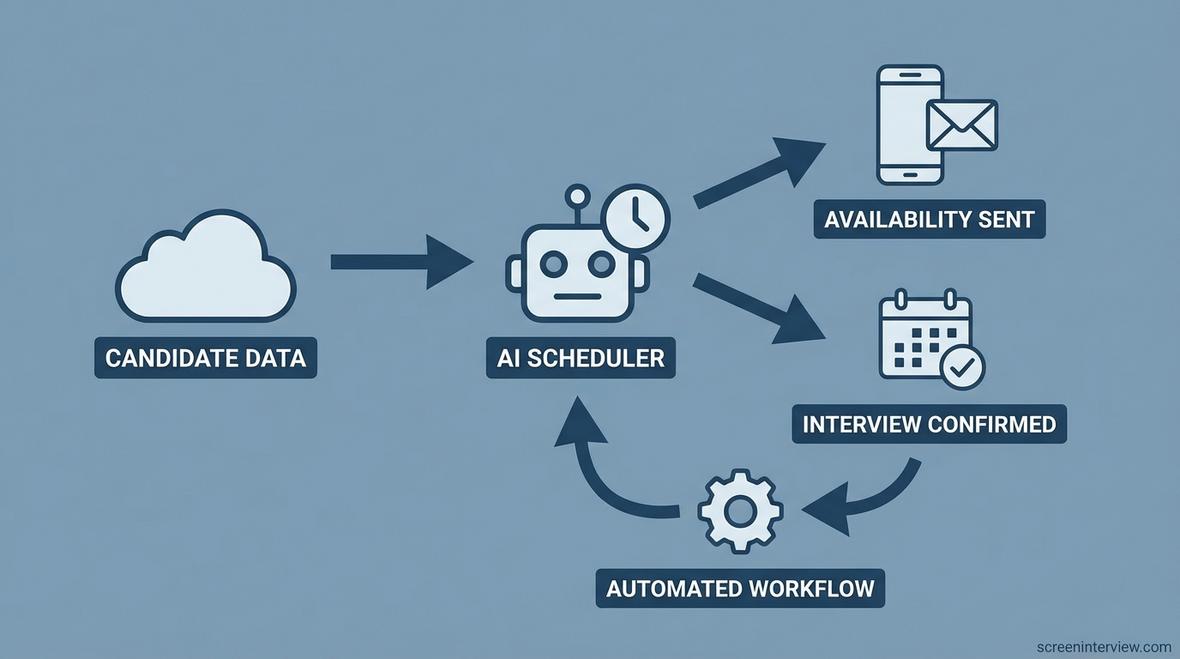
How AI Interview Schedulers Work: The Technology Behind Automation
Understanding the technical foundation of AI interview scheduling helps recruiting professionals appreciate the sophistication of these platforms and set appropriate expectations for implementation.
Calendar Synchronization Engine
AI schedulers connect to calendar systems (Google Calendar, Outlook, Office 365) via secure APIs to continuously monitor real-time availability. The system identifies open time blocks across multiple participants while respecting buffer times, meeting preparation periods, and personal preferences.
Machine Learning Optimization
Advanced platforms employ machine learning algorithms that continuously improve scheduling accuracy. These systems analyze historical data such as candidate response rates, interviewer availability patterns, optimal meeting durations, and time-of-day preferences to make increasingly intelligent scheduling recommendations.
Natural Language Processing
Sophisticated AI interview schedulers incorporate natural language processing to understand candidate email responses, identify scheduling conflicts from unstructured text, and even detect sentiment to prioritize urgent rescheduling requests.
Workflow Automation Logic
The platform's automation engine manages complex scheduling sequences including multi-round interview processes, panel interviews with multiple stakeholders, and coordinated interview days with sequential sessions. This orchestration ensures every participant receives appropriate notifications and calendar invitations without manual intervention.
Top Benefits of Implementing an AI Interview Scheduler
The advantages of AI-powered interview scheduling extend across operational efficiency, candidate experience, and strategic recruitment outcomes.
Dramatic Time Savings for Recruiting Teams
Manual scheduling consumes approximately 30-40% of a recruiter's workweek. An ai interview scheduler reclaims this time by automating coordination tasks, allowing talent acquisition professionals to focus on relationship building, candidate sourcing, and strategic workforce planning activities that directly impact hiring quality.
Accelerated Time-to-Hire
Speed matters in competitive talent markets. AI schedulers eliminate the delays inherent in back-and-forth email coordination, reducing the time between candidate application and first interview from days to hours. This acceleration is particularly critical for in-demand roles where top candidates receive multiple offers quickly.
Enhanced Candidate Experience
Candidates judge potential employers by every interaction. AI scheduling delivers professional, responsive communication that respects candidate time and preferences. Self-service booking options empower candidates with control over their interview timing, creating positive impressions that strengthen employer brand perception.
Reduced No-Shows and Last-Minute Cancellations
Automated reminder systems significantly decrease interview no-shows. AI schedulers send strategically timed notifications via email and SMS, keeping interviews top-of-mind for busy candidates and reducing wasted interviewer preparation time.
Improved Interviewer Satisfaction
Hiring managers and interview panel members benefit from streamlined coordination. AI schedulers respect their calendar constraints, provide adequate preparation time, and minimize scheduling conflicts, improving their willingness to participate in recruitment activities.
Data-Driven Recruitment Insights
Advanced AI scheduling platforms generate valuable analytics on scheduling patterns, candidate responsiveness, interviewer availability, and process bottlenecks. These insights enable continuous recruitment process optimization and informed decision-making.
AI Interview Scheduler vs. Traditional Scheduling Methods
The contrast between AI-powered and manual scheduling approaches illustrates the transformative value of automation.
| Aspect | Traditional Manual Scheduling | AI Interview Scheduler |
|---|---|---|
| Time Investment | 15-30 minutes per interview | 30 seconds per interview |
| Email Exchanges | 8-12 emails average | Fully automated communication |
| Rescheduling Effort | Restart entire coordination process | Automatic alternative suggestions |
| Multi-Round Coordination | Exponentially complex | Sequential automation |
| Candidate Wait Time | 2-5 business days | Same day scheduling possible |
| Error Rate | High (double bookings, time zone mistakes) | Minimal (algorithmic precision) |
Choosing the Right AI Interview Scheduler for Your Organization
Selecting an optimal AI interview scheduling platform requires careful evaluation of organizational needs, technical requirements, and integration capabilities.
Integration Requirements
Ensure the platform integrates seamlessly with your existing technology stack, including your ATS, calendar systems, video conferencing tools (Zoom, Microsoft Teams, Google Meet), and communication platforms. Native integrations deliver superior reliability compared to third-party connectors.
Scalability Considerations
Choose a solution that accommodates your current hiring volume while supporting future growth. Enterprise organizations conducting hundreds of interviews monthly require different capabilities than smaller teams managing dozens of candidates.
Customization Flexibility
Evaluate how extensively you can customize communication templates, scheduling rules, branding elements, and workflow logic. The best AI schedulers allow tailored configurations that reflect your unique recruitment processes and employer brand.
User Experience Design
Both recruiter-facing interfaces and candidate-facing booking portals should be intuitive and professionally designed. Request demonstrations to assess usability before committing to a platform.
Security and Compliance
Verify that the platform maintains appropriate data security standards, including SOC 2 compliance, GDPR readiness, and robust data encryption. Candidate information requires careful protection throughout the scheduling process.
Support and Training
Comprehensive onboarding, responsive customer support, and ongoing training resources ensure successful adoption across your recruiting team. Evaluate vendor support quality during the evaluation process.
Implementation Best Practices for AI Interview Schedulers
Successful deployment of an ai interview scheduler requires thoughtful planning and change management.
Stakeholder Alignment
Secure buy-in from recruiting teams, hiring managers, and IT departments before implementation. Address concerns about automation, demonstrate efficiency benefits, and clearly communicate how the system supports rather than replaces human judgment.
Process Documentation
Document your current scheduling workflows, identifying pain points and inefficiencies. Map desired future-state processes that leverage AI automation while maintaining necessary human touchpoints for candidate relationship building.
Phased Rollout Strategy
Begin with a pilot program for a specific role type or department before organization-wide deployment. This approach allows process refinement, user training, and demonstration of value before broader adoption.
Communication Template Optimization
Invest time crafting professional, on-brand email and SMS templates that convey your employer value proposition while maintaining efficiency. Test messaging with candidates to ensure clarity and positive reception.
Continuous Monitoring and Optimization
Regularly review scheduling analytics, candidate feedback, and recruiter satisfaction to identify optimization opportunities. The most effective organizations treat AI scheduling as an evolving capability requiring ongoing refinement.
Future Trends in AI Interview Scheduling Technology
The AI interview scheduling landscape continues evolving with emerging capabilities that will further transform recruitment operations.
Predictive Scheduling Intelligence
Next-generation platforms will predict optimal interview timing based on candidate profile characteristics, role requirements, and historical conversion data, automatically proposing schedules most likely to result in successful hires.
Conversational AI Assistants
Natural language chatbots will handle increasingly sophisticated scheduling negotiations, answering candidate questions, addressing special accommodation requests, and managing complex multi-stakeholder coordination through conversational interfaces.
Integrated Candidate Assessment
AI schedulers will increasingly incorporate preliminary screening capabilities, combining scheduling automation with AI-powered interviews that assess candidate qualifications before human interviewer involvement.
Holistic Recruitment Orchestration
Future platforms will extend beyond interview scheduling to orchestrate entire candidate journeys, automatically progressing candidates through application review, screening, multiple interview rounds, offer generation, and onboarding based on intelligent workflow logic.
Common Challenges and Solutions When Adopting AI Schedulers
Organizations implementing AI interview scheduling occasionally encounter obstacles that require proactive management.
Interviewer Resistance
Challenge: Hiring managers accustomed to manual coordination may resist automated scheduling that limits their perceived control.
Solution: Demonstrate how AI scheduling respects their calendar constraints while eliminating coordination burden. Provide override capabilities for exceptional circumstances while encouraging system adoption as the default approach.
Complex Scheduling Scenarios
Challenge: Unique interview formats such as on-site interview days with facility tours, executive interviews requiring specific conference rooms, or international candidates across extreme time zones may challenge basic automation.
Solution: Select platforms offering advanced customization and configure specialized workflows for complex scenarios. Maintain manual override options for truly exceptional cases.
Candidate Technology Access
Challenge: Some candidates may lack consistent email access or experience technical difficulties with self-service scheduling portals.
Solution: Provide alternative scheduling methods including phone-based coordination while encouraging digital self-service as the primary option. Ensure mobile-optimized interfaces for candidates using smartphones.
ATS Integration Limitations
Challenge: Legacy ATS platforms may offer limited API capabilities, restricting data synchronization between systems.
Solution: Evaluate AI schedulers with robust integration frameworks supporting various connection methods including APIs, webhooks, and even email parsing as fallback options.
Measuring ROI from Your AI Interview Scheduler Investment
Demonstrating tangible return on investment justifies continued platform investment and supports budget allocation for additional recruitment technology.
Time Savings Quantification
Calculate hours reclaimed by multiplying average interviews scheduled monthly by time saved per interview (typically 20-25 minutes). Multiply by recruiter hourly cost to determine monthly financial value.
Time-to-Hire Reduction
Track average days from application to first interview and application to offer before and after AI scheduler implementation. Shortened time-to-hire reduces risk of losing candidates to competing offers and decreases vacancy costs.
Candidate Satisfaction Scores
Monitor candidate experience survey responses specifically addressing scheduling convenience and communication quality. Improved scores correlate with stronger employer brand and higher offer acceptance rates.
Recruiter Productivity Metrics
Measure changes in interviews scheduled per recruiter, requisitions managed simultaneously, and time allocated to strategic sourcing activities. Enhanced productivity enables leaner teams or expanded hiring capacity without proportional headcount increases.
Interviewer Participation Rates
Track hiring manager and panel member willingness to participate in interviews. Reduced scheduling friction typically increases interviewer availability and engagement.
Frequently Asked Questions About AI Interview Schedulers
Will an AI interview scheduler replace human recruiters?
No. An ai interview scheduler eliminates administrative scheduling tasks, allowing recruiters to focus on high-value activities like candidate relationship building, strategic sourcing, and hiring manager consultation. The technology augments rather than replaces human expertise.
How do candidates perceive AI-powered scheduling?
Research shows candidates appreciate the convenience, speed, and professionalism of automated scheduling. Self-service booking options are viewed positively, provided communications maintain personal tone and offer human contact when needed.
How long does implementation typically take?
Basic implementation with standard integrations typically requires 2-4 weeks including system configuration, integration testing, template customization, and team training. Complex enterprise deployments may extend to 6-8 weeks.
Can AI schedulers handle video interview coordination?
Yes. Modern AI interview schedulers integrate with video conferencing platforms to automatically generate meeting links, distribute them to participants, and include connection details in calendar invitations.
How do AI schedulers manage multi-round interview processes?
Advanced platforms support sequential interview workflows, automatically triggering subsequent round scheduling upon completion of prior stages. This capability ensures coordinated candidate progression through complex hiring processes.
What cost should organizations expect for AI scheduling tools?
Pricing varies based on hiring volume, feature requirements, and vendor models. Solutions typically range from $200-$500 per user monthly for mid-market platforms to custom enterprise pricing for large organizations conducting thousands of monthly interviews.
Conclusion
Implementing an AI interview scheduler represents a strategic investment that delivers measurable improvements across recruiter productivity, candidate experience, and time-to-hire metrics. For modern recruiting professionals managing high-volume hiring pipelines, automation eliminates administrative bottlenecks and enables focus on relationship-driven talent acquisition activities that truly differentiate organizations in competitive markets. By carefully selecting platforms aligned with organizational needs, thoughtfully managing implementation, and continuously optimizing based on performance data, talent acquisition teams can unlock substantial efficiency gains while enhancing both candidate and interviewer satisfaction throughout the recruitment journey.
Ready to Transform Your Interview Process?
See how ScreenInterview can help you automate phone screens, reduce bias, and hire better candidates faster.