
AI Interview: Complete Guide To Automated Hiring Technology In 2026

Introduction to AI Interview Technology
The recruitment landscape has undergone a seismic transformation, with AI interview technology emerging as the cornerstone of modern talent acquisition. For recruiting professionals managing high-volume hiring pipelines, the traditional interview process has become a significant bottleneck. In 2026, organizations are leveraging artificial intelligence to conduct structured, unbiased, and scalable candidate assessments that dramatically reduce time-to-hire while improving the quality of talent identification.
An AI interview represents more than just automation it's a fundamental reimagining of how companies evaluate candidates. These intelligent systems conduct real-time conversations with applicants, analyzing verbal responses, assessing competencies, and providing data-driven insights that empower recruiting teams to make faster, more informed decisions. The technology has matured significantly, with advanced AI interview platforms now capable of evaluating technical skills, behavioral traits, and cultural fit with remarkable accuracy.
According to research from Forrester ROI data for AI interview platforms, organizations implementing AI-powered recruitment solutions experience quantifiable savings in recruitment labor hours, with some companies reporting up to 70% reduction in initial screening time. This efficiency gain allows talent acquisition teams to redirect their focus toward strategic activities like candidate engagement and employer branding.
Understanding AI Interview Technology
At its core, an AI interview system leverages natural language processing, machine learning algorithms, and predictive analytics to simulate human interview interactions. These platforms can conduct structured interviews across various formats text-based chat, voice conversations, or video assessments adapting their questioning strategies based on candidate responses.
Modern AI interview solutions incorporate several key technological components. The conversational AI engine interprets candidate responses in real-time, understanding context, sentiment, and relevance. Machine learning models trained on thousands of successful hiring outcomes can predict candidate performance and cultural alignment. Additionally, these systems integrate seamlessly with existing workflow automation tools and applicant tracking systems, creating a unified recruitment ecosystem.
How AI Interviews Work in Practice
The AI interview process typically follows a structured workflow that ensures consistency and fairness. When a candidate applies, the system automatically triggers an interview invitation based on predefined criteria. Candidates can complete the interview at their convenience, eliminating scheduling conflicts that often delay traditional hiring processes.
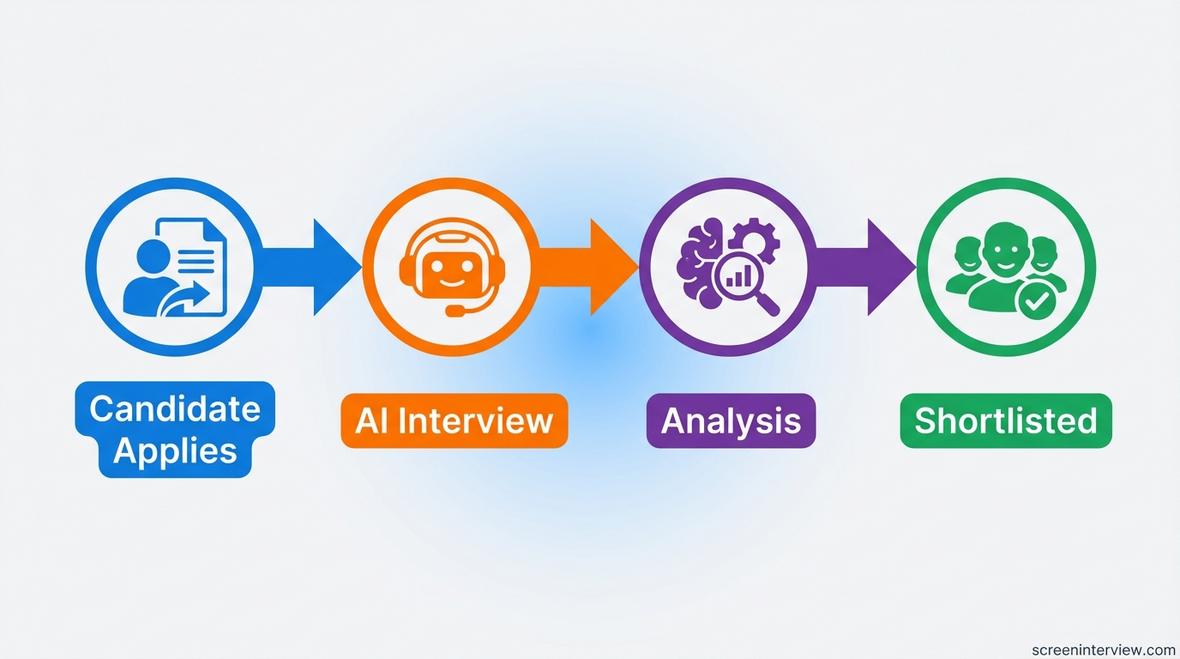
During the interaction, the AI interviewer asks role-specific questions, probes for deeper understanding when needed, and evaluates responses against competency frameworks. The system captures not just what candidates say, but how they communicate analyzing response patterns, problem-solving approaches, and domain expertise. Upon completion, recruiting teams receive comprehensive candidate reports with scoring breakdowns, strengths assessments, and comparison metrics against other applicants.
Different Types of AI Interview Formats
Organizations can deploy several AI interview formats depending on their specific hiring requirements. On-demand interviews allow candidates to record video responses to preset questions, which AI then analyzes for content quality and presentation skills. Conversational chatbot interviews engage candidates in text-based dialogues, ideal for initial screening and qualification verification.
For technical roles, software engineer AI interviews incorporate live coding challenges and algorithm assessments. Similarly, specialized interviews exist for data scientists, product managers, and other specialized positions. Each format is optimized to evaluate the competencies most critical for role success.
Key Benefits of AI Interviews for Recruiting Professionals
The adoption of AI interview technology delivers transformative advantages for talent acquisition teams. The most immediate benefit is the dramatic reduction in time-to-hire. What once required days of coordination and hours of interviewer time now happens automatically, with candidates completing assessments within 24 hours of application.
Operational Efficiency and Scale
For recruiting leaders managing high-volume hiring initiatives, AI interview platforms provide unprecedented scalability. A single system can simultaneously interview hundreds of candidates, maintaining consistent evaluation standards across all interactions. This capability is particularly valuable during peak hiring seasons or when launching new business units that require rapid team building.
The technology also eliminates geographical constraints. Organizations can assess global talent pools without the logistical challenges of coordinating across time zones. Candidates in different continents can complete their AI interview during their preferred hours, dramatically expanding the available talent pool while improving the candidate experience.
Reducing Unconscious Bias in Hiring
One of the most compelling advantages of AI interview technology is its potential to mitigate unconscious bias. Traditional interviews are susceptible to numerous cognitive biases affinity bias, halo effect, and confirmation bias can all influence interviewer assessments. AI systems, when properly designed and monitored, evaluate candidates based strictly on relevant qualifications and demonstrated competencies.
The structured nature of AI interviews ensures every candidate receives identical questions in the same sequence, eliminating interviewer variability. By focusing analysis on objective criteria rather than subjective impressions, organizations can build more diverse, merit-based teams. However, it's essential that recruiting teams work with vendors who prioritize ethical AI development and continuous bias monitoring.
Enhanced Data-Driven Decision Making
Modern recruiting professionals increasingly rely on metrics and analytics to optimize their hiring strategies. AI interview platforms generate rich datasets that provide insights far beyond pass/fail determinations. Recruiting teams can analyze which question types best predict job performance, identify competency gaps across candidate pools, and benchmark candidates against historical hiring success patterns.
These analytics capabilities transform recruitment from an art into a science. Organizations using interview insights platforms can continuously refine their evaluation criteria, improving hiring outcomes over time. The data also supports strategic workforce planning, helping leadership understand talent availability and skills trends in their target markets.
Implementing AI Interviews: Best Practices for Success
Successfully deploying AI interview technology requires thoughtful planning and execution. Organizations should begin by clearly defining their hiring objectives and identifying the specific bottlenecks in their current recruitment process. Is the primary challenge initial screening volume? Interview scheduling logistics? Inconsistent candidate evaluation? Different pain points require different AI solutions.
Selecting the Right AI Interview Platform
The market offers numerous AI interview solutions, each with distinct capabilities and specializations. Recruiting professionals should evaluate platforms based on several critical factors: integration capabilities with existing ATS systems, customization options for role-specific assessments, candidate experience quality, and transparency regarding AI decision-making processes.
When comparing vendors, consider platforms like ScreenInterview that offer comprehensive features including interview proctoring, intelligent scheduling, and customizable interview builders. The right solution should adapt to your organization's unique hiring workflows rather than forcing you to adapt to rigid system constraints.
Designing Effective AI Interview Questions
The quality of an AI interview depends heavily on the questions it asks. Effective interview design begins with thorough job analysis to identify the competencies that truly drive performance. Rather than generic questions, focus on behavioral scenarios, technical challenges, and situational judgments that reveal how candidates think and problem-solve.
Collaborate with hiring managers and subject matter experts to develop question banks that accurately reflect role requirements. For technical positions, incorporate practical assessments that evaluate hands-on skills. For leadership roles, design scenarios that explore decision-making approaches and people management philosophies. The most effective AI interview platforms allow you to mix question types multiple choice for knowledge verification, open-ended for critical thinking, and interactive simulations for applied skills.
Maintaining Positive Candidate Experience
While efficiency drives AI interview adoption, organizations must balance automation with human touch. Candidates should receive clear communication about what to expect, including the interview format, duration, and evaluation criteria. Transparency builds trust and reduces candidate anxiety about interacting with AI systems.
Technical accessibility is equally important. Ensure your AI interview platform works seamlessly across devices and internet connection qualities. Provide technical support resources for candidates who encounter difficulties. Remember that the candidate experience during the interview process significantly influences employer brand perception and offer acceptance rates.
Advanced AI Interview Features for Modern Recruiting
Beyond basic question-and-answer functionality, sophisticated AI interview platforms offer advanced capabilities that further enhance recruitment effectiveness. Understanding these features helps recruiting professionals maximize their technology investment.
AI Proctoring and Interview Integrity
For roles requiring specific certifications or verified skills, AI proctoring technology ensures interview integrity. These systems use computer vision and behavior analytics to verify candidate identity and detect potential dishonesty. While maintaining candidate privacy, proctoring features provide confidence that assessment results accurately reflect individual capabilities.
Adaptive Interview Intelligence
The most advanced AI interview systems employ adaptive questioning strategies, adjusting difficulty and focus areas based on candidate responses. If a candidate demonstrates strong technical knowledge, the system might probe deeper into advanced topics. Conversely, if foundational gaps emerge, the AI can explore alternative competency areas where the candidate might excel. This dynamic approach creates more nuanced candidate profiles than static question sets.
Multilingual and Cross-Cultural Assessment
Organizations hiring internationally benefit from AI interview platforms with multilingual capabilities. These systems can conduct interviews in dozens of languages, automatically translating responses for recruiting team review. Advanced platforms also account for cultural communication differences, ensuring evaluation criteria remain fair across diverse candidate populations.
Measuring AI Interview ROI and Success Metrics
Demonstrating the value of AI interview technology requires establishing clear success metrics. Recruiting leaders should track both efficiency gains and quality improvements to build comprehensive ROI cases.
Efficiency and Cost Savings
Primary efficiency metrics include time-to-hire reduction, cost-per-hire decreases, and recruiter productivity improvements. Organizations typically measure how many candidates AI systems can screen compared to manual processes, and how much recruiter time is freed for higher-value activities. Most implementations show significant cost savings within the first quarter of deployment.
Quality of Hire Improvements
Beyond efficiency, measure whether AI interview technology improves hiring outcomes. Track new hire performance ratings, retention rates at 90 days and one year, and hiring manager satisfaction scores. Compare these metrics for candidates hired through AI-assisted processes versus traditional methods. Organizations often discover that structured AI assessments predict job success more accurately than unstructured human interviews.
Future Trends in AI Interview Technology
The AI interview landscape continues evolving rapidly. Emerging trends include greater integration of emotional intelligence assessment, where AI analyzes vocal patterns and language choices to understand candidate motivations and work style preferences. Virtual reality interviews may soon allow candidates to demonstrate skills in simulated work environments.
Ethical AI and explainability will become increasingly important. Regulatory frameworks are emerging that require organizations to demonstrate fairness and provide candidates with transparency regarding how AI systems evaluate them. Forward-thinking platforms are already building explainable AI capabilities that show candidates exactly which response elements influenced their scores.
Overcoming Common AI Interview Implementation Challenges
While AI interview technology offers substantial benefits, implementation isn't without challenges. Common obstacles include internal resistance from recruiting teams accustomed to traditional methods, candidate skepticism about AI fairness, and technical integration complexities with legacy systems.
Address these challenges through comprehensive change management. Involve recruiting teams early in platform selection, providing hands-on training and demonstrating how AI augments rather than replaces their expertise. Communicate transparently with candidates about AI's role in your process, emphasizing how it enhances fairness and efficiency. Work closely with IT teams to ensure smooth technical integration with your existing recruitment technology stack.
AI Interviews Across Different Role Types
Different positions require different assessment approaches. Technical roles benefit from AI interviews that incorporate coding challenges, system design scenarios, and technical knowledge verification. Business roles might focus more on situational judgment, communication skills, and strategic thinking.
Platforms like ScreenInterview offer specialized interview templates for diverse positions including frontend developers, sales and marketing professionals, and leadership positions. This specialization ensures evaluation criteria align precisely with role requirements.
Frequently Asked Questions About AI Interviews
How accurate are AI interviews compared to human interviews?
Research indicates that well-designed AI interview systems often predict job performance more accurately than unstructured human interviews. The structured, consistent approach eliminates many sources of human bias and evaluation inconsistency. However, AI works best as part of a comprehensive hiring process rather than as the sole evaluation method.
Can AI interviews assess soft skills effectively?
Yes, modern AI interview platforms analyze communication patterns, problem-solving approaches, and behavioral indicators that reveal soft skills like collaboration, adaptability, and leadership potential. Natural language processing has advanced to the point where AI can understand nuance, context, and interpersonal competencies with impressive accuracy.
What happens if a candidate doesn't have reliable internet access?
Quality AI interview platforms offer multiple access options including mobile applications optimized for lower bandwidth, telephone-based interview options, and offline modes that sync when connectivity is restored. Recruiting teams should work with vendors who prioritize accessibility across diverse candidate circumstances.
How do you prevent AI interview systems from perpetuating historical biases?
Preventing bias requires continuous monitoring and validation. Organizations should regularly audit AI systems for disparate impact across demographic groups, use diverse training data sets, and work with vendors committed to ethical AI development. Transparency regarding AI decision factors and human oversight of AI recommendations are also critical safeguards.
What's the typical implementation timeline for AI interview technology?
Implementation timelines vary based on organizational complexity and customization requirements. Basic deployments can launch within 2-4 weeks, while enterprise implementations with extensive ATS integration and custom interview design might require 2-3 months. Most organizations see meaningful results within the first 30 days of going live.
Conclusion
The AI interview revolution represents a fundamental shift in how organizations identify and evaluate talent. For recruiting professionals managing high-volume hiring pipelines, these technologies deliver the efficiency, scalability, and insight necessary to compete for top talent in increasingly competitive markets. By automating initial screening while maintaining rigorous evaluation standards, AI empowers recruiting teams to focus on what humans do best building relationships, understanding organizational culture fit, and creating compelling candidate experiences. As the technology continues maturing and regulatory frameworks evolve, organizations that thoughtfully implement AI interview solutions will maintain significant competitive advantages in talent acquisition, building stronger teams faster while ensuring fair, unbiased evaluation processes that identify truly exceptional candidates.
Ready to Transform Your Interview Process?
See how ScreenInterview can help you automate phone screens, reduce bias, and hire better candidates faster.