
AI Interview Company: Complete Guide To Automated Hiring Platforms In 2026

The recruitment landscape has undergone a dramatic transformation in recent years, with AI interview companies emerging as essential partners for organizations seeking to streamline their hiring processes. As businesses face increasing pressure to identify top talent quickly while maintaining fairness and consistency, artificial intelligence has become the cornerstone of modern recruitment strategies. This comprehensive guide explores everything you need to know about AI interview companies, their capabilities, and how they're reshaping the future of talent acquisition.
What Is an AI Interview Company?
An ai interview company specializes in providing automated interviewing solutions that leverage artificial intelligence, machine learning, and natural language processing to conduct, analyze, and evaluate candidate interviews. These platforms replace or supplement traditional interview methods by offering scalable, consistent, and data-driven approaches to candidate assessment.
Unlike conventional recruitment tools, AI interview companies go beyond simple applicant tracking. They employ sophisticated algorithms to analyze verbal responses, communication patterns, technical competencies, and even behavioral indicators. The result is a comprehensive evaluation that helps hiring teams make informed decisions based on objective data rather than subjective impressions.
Leading platforms like ScreenInterview have pioneered this space by offering end-to-end solutions that handle everything from initial screening to final assessment. These companies typically provide features such as automated question generation, real-time proctoring, sentiment analysis, and detailed candidate scoring based on role-specific criteria.
How AI Interview Companies Transform the Hiring Process
Understanding the mechanics behind AI interview platforms helps organizations appreciate their value proposition. The process typically involves four interconnected stages that create a seamless recruitment workflow.
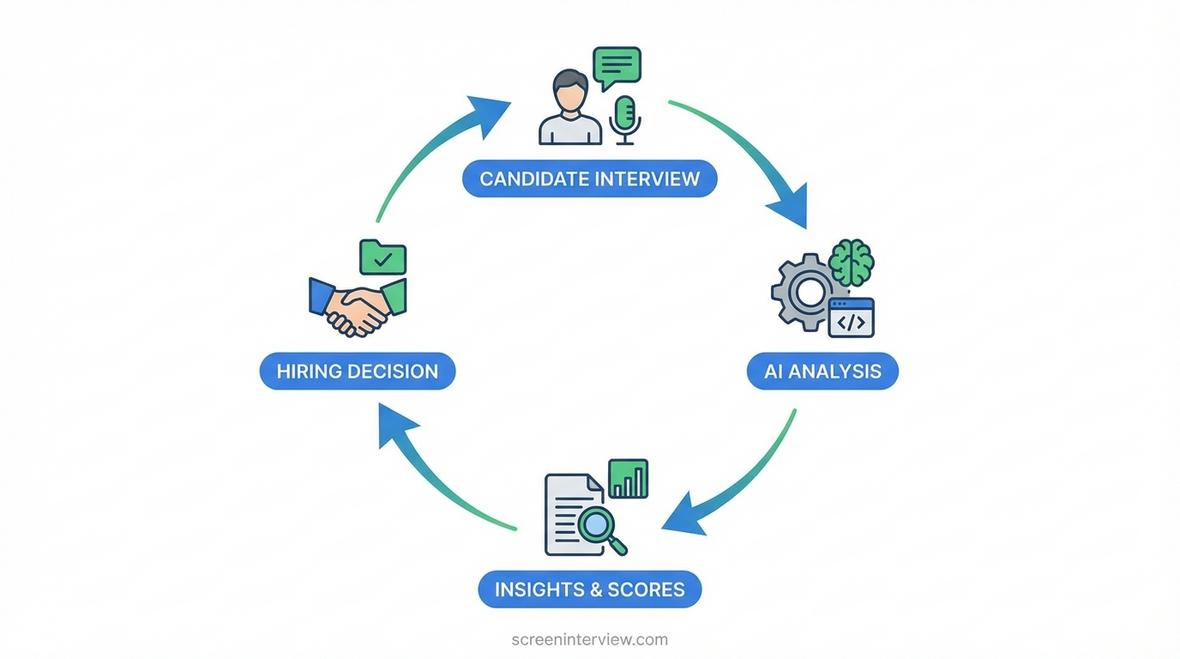
Stage 1: Candidate Interview
The journey begins when candidates engage with the AI interview platform. Depending on the configuration, this might involve video interviews, voice-based assessments, or text-based interactions. AI interviewers ask pre-determined or dynamically generated questions tailored to the specific role, ensuring every candidate faces relevant and challenging inquiries.
Modern platforms offer flexibility in interview formats, including asynchronous video interviews where candidates record responses at their convenience, or synchronous sessions where AI conducts real-time conversations. This flexibility dramatically improves candidate experience while accommodating different time zones and schedules.
Stage 2: AI Analysis
Once the interview concludes, sophisticated algorithms analyze multiple data points simultaneously. The AI examines verbal content for technical accuracy, communication clarity, and domain knowledge. Natural language processing engines parse responses to identify key competencies, while sentiment analysis tools assess confidence levels and emotional intelligence.
For technical roles, AI interview companies often integrate specialized assessments for software engineers and other technical positions, evaluating code quality, problem-solving approaches, and system design capabilities. This multi-dimensional analysis provides a holistic view of candidate capabilities that would be impossible to achieve through manual review alone.
Stage 3: Insights & Scores
The analysis phase culminates in actionable insights presented through intuitive dashboards. Hiring managers receive detailed scorecards that break down candidate performance across multiple dimensions technical skills, communication abilities, cultural fit indicators, and role-specific competencies.
These insights often include comparative analytics, showing how candidates stack up against peer groups or benchmark standards. Advanced platforms provide predictive analytics that estimate job performance likelihood, retention probability, and team compatibility. The interview insights generated by these systems enable data-driven decision-making that significantly reduces hiring risks.
Stage 4: Hiring Decision
Armed with comprehensive data, hiring teams make final decisions with greater confidence. The AI doesn't replace human judgment but augments it with objective information that might otherwise be overlooked. This collaborative approach between artificial intelligence and human expertise represents the ideal balance for modern recruitment.
Many organizations report that integrating AI interview companies into their workflows has reduced time-to-hire by 40-60% while simultaneously improving quality-of-hire metrics. The efficiency gains come from automating repetitive tasks, eliminating scheduling conflicts, and providing instant feedback on candidate suitability.
Essential Features of Leading AI Interview Companies
Not all AI interview platforms offer the same capabilities. Understanding the core features distinguishes market leaders from basic tools.
Automated Screening and Assessment
The foundation of any ai interview company lies in its ability to conduct comprehensive screenings without human intervention. Telephone screening capabilities, video assessments, and skills testing can all be automated, allowing recruiters to focus on high-value interactions rather than repetitive initial conversations.
These systems employ adaptive questioning techniques, where subsequent questions adjust based on previous responses. This dynamic approach ensures interviews remain relevant and challenging, providing deeper insights into candidate capabilities.
Advanced Proctoring and Security
Maintaining assessment integrity remains paramount, especially for remote hiring. Leading AI interview companies incorporate AI proctoring technologies that monitor candidate behavior during assessments, detecting potential cheating attempts through eye movement tracking, background noise analysis, and unusual activity patterns.
Security features extend to protecting candidate data through encryption, ensuring compliance with privacy regulations like GDPR and CCPA. The secure browser technology prevents candidates from accessing unauthorized resources during technical assessments, maintaining test validity.
Customizable Interview Builder
Organizations have unique hiring needs that generic assessments cannot address. Advanced platforms provide interview builder tools that allow recruiters to design custom question sets, configure evaluation criteria, and establish role-specific benchmarks.
This customization extends to branding, enabling companies to maintain consistent employer branding throughout the candidate journey. White-label options allow organizations to present the AI interview experience as a seamless extension of their recruitment process rather than a third-party tool.
Intelligent Workflow Automation
Beyond conducting interviews, leading AI companies automate the entire recruitment workflow. Workflow automation capabilities handle candidate communications, schedule interviews, send reminders, and trigger next steps based on assessment results.
Integration with applicant tracking systems (ATS) ensures seamless data flow between platforms, eliminating manual data entry and reducing administrative burden. This connectivity creates a unified recruitment ecosystem where information flows effortlessly from initial application to final offer.
Strategic Benefits of Partnering with an AI Interview Company
Organizations that embrace AI interview technology gain multiple competitive advantages in today's talent-scarce market.
Unprecedented Scalability and Efficiency
Traditional interview processes struggle with volume. When applications surge, hiring teams become overwhelmed, leading to delayed responses and candidate drop-off. AI interview companies eliminate this bottleneck by conducting unlimited simultaneous interviews without quality degradation.
Companies managing high-volume recruiting scenarios seasonal hiring, campus recruitment, or rapid expansion find AI solutions indispensable. The technology scales effortlessly from dozens to thousands of candidates without proportional cost increases.
Bias Reduction and Enhanced Fairness
Unconscious bias remains one of recruitment's most persistent challenges. Human interviewers, despite best intentions, bring subjective preferences that can disadvantage qualified candidates. AI interview companies address this through standardized evaluation criteria applied consistently across all candidates.
By focusing on objective performance indicators rather than demographic characteristics, these platforms promote candidate screening without bias. This approach not only supports diversity and inclusion initiatives but also ensures compliance with equal employment opportunity regulations.
Improved Candidate Experience
Contrary to concerns about dehumanized recruitment, properly implemented AI interviews enhance candidate experience. Applicants appreciate the flexibility of on-demand interviews that accommodate their schedules, eliminating the stress of coordinating multiple stakeholders for a single conversation.
Immediate feedback and transparent timelines keep candidates engaged throughout the process. When candidates understand how they're being evaluated and receive timely updates, satisfaction scores increase significantly, protecting employer brand reputation even among those not selected.
Comprehensive Data and Analytics
Perhaps the most transformative benefit is access to recruitment analytics that were previously unattainable. AI interview companies generate vast datasets about candidate quality, question effectiveness, interviewer performance, and process efficiency.
These insights enable continuous improvement of hiring strategies. Organizations can identify which questions best predict job success, which sourcing channels deliver the strongest candidates, and where bottlenecks slow the process. This data-driven approach transforms recruitment from an art into a science.
How to Choose the Right AI Interview Company
Selecting an AI interview partner requires careful evaluation across multiple dimensions.
Assess Technical Capabilities
Evaluate the underlying technology powering the platform. Does it use advanced natural language processing? Can it handle multiple languages? How accurate are its assessments across different demographics? Request detailed information about the AI models, training data, and validation studies supporting the platform's claims.
For technical hiring, ensure the platform supports role-specific assessments. If you're hiring data scientists, DevOps engineers, or frontend developers, the platform should offer specialized question banks and evaluation frameworks tailored to these disciplines.
Integration and Compatibility
An AI interview platform that operates in isolation creates more problems than it solves. Verify that the system integrates seamlessly with your existing HR technology stack ATS, HRIS, background check providers, and communication tools.
API availability, webhook support, and pre-built integrations with popular platforms indicate a mature product designed for enterprise environments. The ability to customize integrations ensures the solution adapts to your workflows rather than forcing you to adapt to the tool.
Compliance and Security Standards
Given the sensitive nature of candidate data, security cannot be compromised. Verify that the ai interview company maintains SOC 2 compliance, GDPR readiness, and follows industry best practices for data protection.
Understand where data is stored, how long it's retained, and what controls exist for access and deletion. Transparent privacy policies and clear data processing agreements protect both your organization and candidates from potential legal complications.
Vendor Support and Training
Technology is only valuable when properly utilized. Assess the vendor's commitment to customer success through onboarding programs, ongoing training, and responsive support channels.
Look for companies that offer dedicated customer success managers, comprehensive documentation, and active user communities. The quality of support often differentiates successful implementations from frustrated abandonments.
Best Practices for Implementing AI Interview Technology
Successful deployment of AI interview solutions requires strategic planning and change management.
Start with a Pilot Program
Rather than organization-wide rollouts, begin with a controlled pilot targeting specific roles or departments. This approach allows you to refine configurations, address technical issues, and build internal expertise before scaling.
Document lessons learned, gather feedback from recruiters and candidates, and measure key metrics against baseline performance. Use pilot results to build the business case for broader adoption.
Maintain Human Oversight
AI should augment, not replace, human judgment in hiring decisions. Establish clear protocols for when and how recruiters review AI recommendations. Ensure that final hiring decisions always involve human evaluation, particularly for subjective factors like cultural fit and long-term potential.
This balanced approach addresses ethical concerns while maximizing the efficiency benefits of automation. It also ensures compliance with regulations that may restrict fully automated employment decisions.
Continuous Monitoring and Optimization
AI interview platforms improve through iteration. Regularly review performance metrics candidate drop-off rates, assessment completion times, correlation between scores and job performance, and demographic fairness indicators.
Use these insights to refine question sets, adjust scoring algorithms, and improve the overall candidate experience. Leading organizations treat their AI interview systems as living tools that evolve alongside their hiring needs.
The Future of AI Interview Companies
The AI interview industry continues evolving rapidly, with several emerging trends reshaping capabilities.
Multimodal Assessment Capabilities
Next-generation platforms are moving beyond single-channel evaluations to analyze multiple data streams simultaneously video, audio, text, and even physiological signals. This holistic approach provides richer insights into candidate capabilities and potential.
Advanced Predictive Analytics
Machine learning models are becoming increasingly sophisticated at predicting not just job performance but also retention likelihood, promotion potential, and team dynamics. These predictive capabilities help organizations make strategic talent decisions that consider long-term value rather than just immediate fit.
Conversational AI Advances
The gap between AI and human interviewers continues narrowing as natural language generation improves. Future AI interview companies will conduct conversations indistinguishable from human interactions, asking follow-up questions, exploring nuances, and adapting in real-time to candidate responses.
Ethical AI and Transparency
As regulatory scrutiny increases, leading AI interview companies are prioritizing explainable AI systems that can articulate why they reached specific conclusions. This transparency builds trust with candidates and ensures compliance with emerging AI governance frameworks.
Comparing Top AI Interview Platforms
The market offers numerous options, each with distinct strengths. When evaluating providers, consider comparing specialized platforms like ScreenInterview with alternatives to understand feature sets, pricing models, and customer satisfaction levels.
Look beyond marketing claims to examine actual customer reviews, case studies demonstrating measurable results, and third-party analyst reports. The right ai interview company for your organization depends on your specific requirements, budget constraints, and strategic priorities.
Understanding the Investment: Pricing and ROI
While costs vary significantly based on features and volume, most AI interview companies operate on subscription or per-interview pricing models. Enterprise packages typically range from several thousand to tens of thousands of dollars annually, depending on candidate volume and feature requirements.
However, the return on investment often justifies the expense. Organizations report significant savings through reduced recruiter time spent on initial screenings, faster time-to-hire reducing vacancy costs, and improved quality-of-hire leading to better retention. When calculated holistically, AI interview solutions frequently deliver positive ROI within the first year of implementation.
Common Challenges and How to Overcome Them
Despite their benefits, AI interview implementations face predictable obstacles.
Candidate Resistance
Some applicants feel uncomfortable with AI-conducted interviews, preferring human interaction. Address this by clearly communicating the benefits flexibility, fairness, and faster feedback. Offer hybrid options where candidates interact with AI for initial screening but engage with humans for final rounds.
Internal Skepticism
Recruiters may resist tools they perceive as threats to their roles. Frame AI as a productivity enhancer that eliminates tedious tasks, allowing recruiters to focus on relationship-building and strategic activities. Involve recruiting teams in implementation planning to build ownership and buy-in.
Technical Integration Issues
Legacy systems and incompatible technologies can complicate deployment. Work closely with vendors during implementation, allocate adequate IT resources, and plan for phased rollouts that allow time to resolve integration challenges before full deployment.
Industry-Specific Applications of AI Interview Companies
Different sectors leverage AI interview technology in unique ways.
Technology Sector
Tech companies use specialized assessments for machine learning engineers, blockchain developers, and other technical roles. These assessments often include live coding challenges, system design exercises, and architecture discussions that AI platforms can facilitate and evaluate.
Healthcare
Healthcare organizations face unique compliance requirements and specialized skill assessments. AI interview companies adapted to this sector offer HIPAA-compliant solutions and healthcare-specific competency evaluations.
Retail and Hospitality
High-volume seasonal hiring in retail and hospitality benefits enormously from AI automation. These industries use AI interviews to quickly screen thousands of applicants for customer service skills, reliability indicators, and cultural alignment.
Frequently Asked Questions
How accurate are AI interview assessments?
Leading AI interview companies report accuracy rates exceeding 85% when predicting job performance, comparable to or better than traditional interview methods. However, accuracy depends on proper configuration, adequate training data, and ongoing validation against actual performance outcomes.
Can AI interviews eliminate bias completely?
While AI significantly reduces many forms of unconscious bias, no system is perfectly bias-free. AI models can inherit biases present in training data. Responsible AI interview companies actively monitor for bias, regularly audit outcomes across demographic groups, and adjust algorithms to ensure fairness.
Do candidates have negative perceptions of AI interviews?
Research shows mixed reactions. Younger candidates generally embrace AI interviews, appreciating their convenience and transparency. Older applicants sometimes prefer human interaction. Overall satisfaction correlates strongly with how well organizations communicate the process and provide timely feedback.
Will AI interview companies replace human recruiters?
No. AI handles repetitive, time-consuming tasks but cannot replicate human judgment on nuanced factors like cultural fit, long-term potential, and interpersonal chemistry. The future involves human-AI collaboration where each contributes their strengths to the hiring process.
How long does it take to implement an AI interview platform?
Implementation timelines vary from a few weeks for basic deployments to several months for complex enterprise integrations. Factors affecting duration include technical infrastructure, customization requirements, integration complexity, and organizational change management needs.
Conclusion
AI interview companies represent a fundamental shift in how organizations identify and evaluate talent. By combining advanced technology with human expertise, these platforms deliver scalable, fair, and data-driven recruitment processes that meet the demands of modern hiring. Whether you're managing high-volume recruitment, seeking to reduce bias, or simply looking to improve efficiency, partnering with the right ai interview company can transform your talent acquisition strategy. As the technology continues evolving, early adopters will gain competitive advantages in attracting and securing top talent in an increasingly challenging market. The key to success lies in selecting a platform aligned with your needs, implementing thoughtfully, and continuously optimizing based on results.
Ready to Transform Your Interview Process?
See how ScreenInterview can help you automate phone screens, reduce bias, and hire better candidates faster.