
8fold AI: Complete Guide To AI-Powered Recruitment Transformation In 2026

Understanding 8fold AI and the Recruitment Revolution
The recruitment landscape has undergone a seismic shift, with 8fold AI emerging as a transformative force in talent acquisition. Modern recruiting professionals face unprecedented challenges: high-volume candidate screening, unconscious bias, extended time-to-hire metrics, and the constant pressure to identify top-tier talent efficiently. Traditional manual screening methods simply cannot keep pace with the demands of 2026's competitive hiring environment.
8fold AI represents a comprehensive approach to intelligent recruitment automation, leveraging artificial intelligence to streamline every stage of the hiring funnel. From initial candidate engagement through final selection, AI-powered platforms are fundamentally reshaping how organizations discover, evaluate, and secure exceptional talent. For Heads of Talent, Recruiting Leads, and People Operations Managers, understanding this technology isn't optional it's essential for maintaining competitive advantage.
According to research from Forrester, Cost Per Hire Averages $4,700, with AI recruitment solutions delivering 25% savings through automated screening and unbiased evaluation. This substantial cost reduction, combined with dramatic improvements in candidate quality and experience, explains why forward-thinking organizations are rapidly adopting AI-driven recruitment solutions like those offered by ScreenInterview.
Core Components of 8fold AI Recruitment Systems
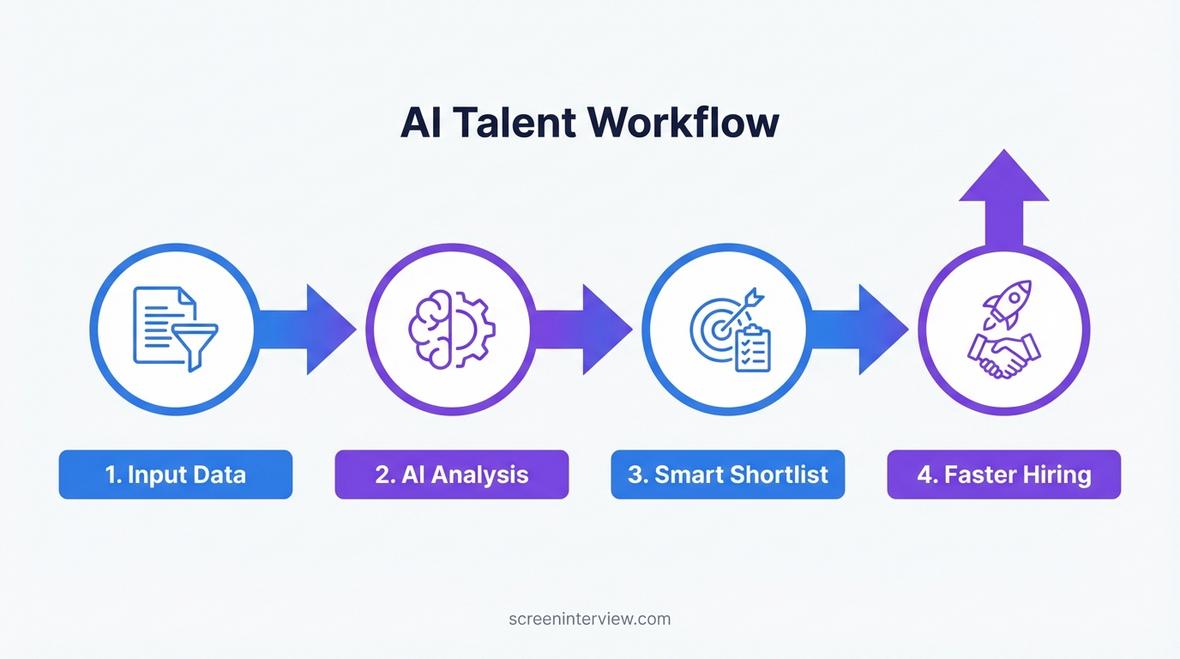
Understanding the architecture of 8fold AI recruitment technology helps recruiting professionals make informed implementation decisions. These systems typically comprise several interconnected components working in harmony to create a seamless, intelligent hiring workflow.
AI-Powered Candidate Screening
The foundation of any 8fold AI system lies in sophisticated candidate screening capabilities. Modern AI interview platforms utilize natural language processing, machine learning algorithms, and predictive analytics to evaluate candidates against precise job requirements. Unlike traditional resume screening that relies on keyword matching, advanced AI systems comprehend contextual relevance, transferable skills, and potential culture fit.
These intelligent screening mechanisms analyze multiple data points simultaneously: technical competencies, communication patterns, problem-solving approaches, and behavioral indicators. The technology processes structured and unstructured data from video responses, written assessments, and conversational interactions, creating comprehensive candidate profiles that far exceed traditional evaluation methods.
Intelligent Interview Automation
The interview stage represents a critical bottleneck in traditional recruitment. 8fold AI solutions address this through sophisticated AI interviewer technology that conducts initial screening conversations at scale. These systems engage candidates through natural, conversational interfaces whether text-based chat, voice calls, or video interactions asking relevant questions, probing deeper based on responses, and maintaining consistent evaluation standards across all applicants.
For technical roles, platforms like ScreenInterview offer specialized assessments for software engineers, data scientists, and DevOps engineers, evaluating practical skills through coding challenges, system design discussions, and technical problem-solving scenarios.
Bias Mitigation and Fairness Mechanisms
One of the most compelling advantages of 8fold AI recruitment systems is their capacity to reduce unconscious bias. Traditional hiring processes suffer from numerous cognitive biases affinity bias, halo effect, confirmation bias, and appearance-based judgments. AI systems, when properly designed and monitored, evaluate candidates based solely on relevant qualifications and demonstrated competencies.
Leading platforms implement multiple bias-reduction strategies: anonymized initial screening, standardized question sets, objective scoring rubrics, and diverse training data sets. The technology focuses evaluation on job-relevant criteria while systematically filtering out protected characteristics that shouldn't influence hiring decisions. Organizations implementing these systems report significantly improved diversity metrics and more equitable candidate experiences.
Strategic Implementation of 8fold AI Recruitment Technology
Successfully deploying 8fold AI recruitment solutions requires thoughtful planning, stakeholder alignment, and phased execution. Recruiting leaders should approach implementation as a transformative change management initiative rather than merely a technology upgrade.
Assessing Your Current Recruitment State
Begin by conducting a comprehensive audit of existing recruitment processes. Document current time-to-hire metrics, cost-per-hire figures, candidate satisfaction scores, and quality-of-hire indicators. Identify specific pain points: Where do candidates drop off? Which stages consume disproportionate recruiter time? What roles experience the longest vacancy periods?
This baseline assessment establishes measurable benchmarks against which you'll evaluate AI implementation success. Tech-savvy recruiting professionals should also inventory existing technology infrastructure your Applicant Tracking System capabilities, integration APIs, data storage systems, and reporting tools to ensure seamless integration with new AI components.
Selecting the Right AI Recruitment Platform
Not all 8fold AI recruitment solutions offer equivalent capabilities. Evaluation criteria should include: technical depth of AI algorithms, integration flexibility with existing HR tech stacks, customization options for your specific hiring workflows, compliance with data privacy regulations, and vendor support quality.
Platform comparison is essential. ScreenInterview's comparison tools allow recruiting professionals to evaluate multiple solutions side-by-side, examining feature sets, pricing models, and implementation requirements. Consider platforms that offer specialized capabilities for your most critical roles while maintaining broad applicability across your hiring portfolio.
Pilot Programs and Iterative Refinement
Launch 8fold AI implementation through focused pilot programs rather than organization-wide rollouts. Select 2-3 high-volume roles or positions with particularly challenging hiring dynamics. This approach minimizes risk while generating valuable learning insights that inform broader deployment.
Throughout the pilot phase, gather quantitative metrics (application completion rates, time-to-interview, candidate progression rates) and qualitative feedback from both candidates and hiring managers. Use this data to refine AI parameters, adjust evaluation criteria, and optimize the candidate experience before expanding implementation scope.
Advanced Capabilities of Modern AI Recruitment Platforms
Contemporary 8fold AI systems extend far beyond basic resume screening, offering sophisticated capabilities that address complex recruitment challenges facing modern organizations.
Conversational AI for Candidate Engagement
Modern platforms leverage conversational AI to maintain ongoing candidate engagement throughout the hiring journey. These intelligent chatbots answer applicant questions, provide status updates, schedule interviews, and collect additional information all without human intervention. The technology operates 24/7, eliminating delays that traditionally cause candidate drop-off and improving overall experience metrics.
For recruiting teams managing hundreds of simultaneous openings, conversational AI dramatically reduces administrative burden while ensuring every candidate receives timely, consistent communication. This capability proves particularly valuable for high-volume recruitment scenarios in retail, customer service, and seasonal hiring contexts.
Predictive Analytics for Hiring Success
8fold AI platforms employ predictive analytics to forecast candidate success probability based on historical hiring data. By analyzing patterns from previous hires correlating assessment results, interview performance, and subsequent job performance machine learning models identify the characteristics most strongly associated with long-term success in specific roles.
These predictive insights enable recruiting professionals to make more informed decisions, prioritizing candidates with the highest probability of thriving in your organization. The technology continuously learns from outcomes, refining predictions as more data accumulates and improving accuracy over time.
Skills Assessment and Validation
Technical hiring presents unique challenges that 8fold AI solutions address through sophisticated skills validation mechanisms. Platforms like ScreenInterview offer role-specific assessments for positions ranging from frontend developers to machine learning engineers, evaluating practical competencies through realistic scenarios and coding challenges.
These assessments go beyond theoretical knowledge, testing candidates' ability to solve actual problems they'll encounter on the job. AI-powered evaluation provides immediate, objective scoring while identifying specific skill gaps and development opportunities, creating valuable data for both hiring decisions and onboarding planning.
Measuring ROI and Success Metrics for 8fold AI Implementation
Demonstrating clear return on investment remains critical for sustaining executive support and budget allocation for 8fold AI recruitment initiatives. Forward-thinking recruiting leaders establish comprehensive measurement frameworks that capture both quantitative efficiency gains and qualitative improvements.
Efficiency and Productivity Metrics
Track time-to-hire reduction, measuring the decrease in days from requisition opening to offer acceptance. Leading organizations implementing AI recruitment solutions report 40-60% reductions in time-to-hire for high-volume positions. Similarly, monitor recruiter productivity metrics: candidates screened per recruiter hour, interviews conducted per open position, and administrative time saved through automation.
Cost savings represent another critical measurement dimension. Beyond the 25% cost-per-hire reduction mentioned earlier, calculate savings from reduced agency fees, decreased job board spending, and lower recruiter overtime costs. These tangible financial benefits typically justify AI platform investments within the first year of implementation.
Quality and Diversity Metrics
Quality-of-hire metrics capture the long-term value 8fold AI systems deliver. Track new hire performance ratings, retention rates at 90-day and one-year intervals, and hiring manager satisfaction scores. Superior AI platforms consistently deliver higher-performing hires because they evaluate candidates against precise success criteria rather than relying on subjective impressions.
Diversity metrics deserve particular attention. Monitor demographic composition of candidate pools at each hiring stage, comparing pre-AI and post-AI implementation patterns. Well-designed AI systems increase diversity by eliminating unconscious bias, resulting in more representative candidate slates and ultimately more diverse team compositions.
Candidate Experience Indicators
Candidate experience directly impacts employer brand strength and acceptance rates. Survey applicants about their experience with AI-powered screening processes, measuring Net Promoter Scores, satisfaction ratings, and specific feedback about interaction quality, clarity, and fairness perceptions.
Top-performing organizations achieve candidate satisfaction scores exceeding 4.5/5.0 with AI interview platforms, appreciating the convenience, transparency, and responsiveness these systems provide compared to traditional processes involving extended silences and opaque decision-making.
Integration with ATS and Broader HR Technology Ecosystem
Modern recruiting professionals operate within complex technology environments where 8fold AI solutions must integrate seamlessly with existing systems. Successful implementation depends on thoughtful integration planning that creates unified workflows rather than disconnected point solutions.
Applicant Tracking System Integration
Your ATS serves as the system of record for recruitment data, making robust integration non-negotiable. Leading 8fold AI platforms offer native integrations with major ATS providers, enabling bidirectional data flow: candidate information, assessment results, interview recordings, and evaluation scores automatically sync between systems without manual data entry.
This integration ensures recruiting teams maintain a single source of truth while leveraging AI capabilities for specific workflow stages. Candidates apply through your ATS, get routed to AI screening when appropriate, complete assessments or interviews, and return to the ATS with enriched profiles and scoring data that inform next steps.
Workflow Automation and Orchestration
Workflow automation capabilities extend 8fold AI value by connecting multiple recruitment activities into seamless sequences. When a candidate completes an AI interview and achieves a qualifying score, the system automatically triggers next actions: scheduling live interviews, sending assessment links, or advancing to hiring manager review all without recruiter intervention.
These automated workflows dramatically reduce administrative burden, ensure consistent candidate progression, and eliminate delays that traditionally occur when manual handoffs fail. Recruiting teams report 50-70% reductions in process administration time, allowing them to focus on high-value activities like candidate relationship building and strategic hiring planning.
Addressing Common Concerns and Implementation Considerations
Despite compelling benefits, 8fold AI adoption sometimes faces organizational resistance. Proactively addressing common concerns facilitates smoother implementation and broader stakeholder buy-in.
Candidate Acceptance and Experience
Some recruiting leaders worry candidates will react negatively to AI-driven interviews. Research indicates the opposite: candidates appreciate AI screening for its convenience, consistency, and flexibility. Unlike scheduling challenges with human interviewers, AI systems accommodate candidate preferences for timing and format, improving accessibility for working professionals and candidates in different time zones.
Transparency proves essential. Clearly communicate how AI evaluation works, what criteria matter, and how decisions get made. When candidates understand the process and perceive it as fair, acceptance rates remain high and employer brand benefits rather than suffers.
AI Ethics and Fairness Monitoring
Legitimate concerns about AI bias require ongoing vigilance and systematic monitoring. Responsible 8fold AI platforms implement multiple safeguards: diverse training data, regular bias audits, transparent evaluation criteria, and human oversight of AI recommendations rather than fully automated decision-making.
Establish governance frameworks that include regular review of AI outcomes across demographic groups, ensuring the technology delivers on its promise of reduced bias. Leading organizations form cross-functional oversight committees including HR, legal, diversity and inclusion, and technical stakeholders to monitor AI recruitment systems continuously.
Data Privacy and Security
Recruitment processes handle sensitive personal information, making data privacy and security paramount. Evaluate 8fold AI vendors' compliance with relevant regulations GDPR in Europe, various state-level privacy laws in the United States, and industry-specific requirements. Ensure platforms implement appropriate data encryption, access controls, retention policies, and candidate data rights including access, correction, and deletion.
Vendor security certifications (SOC 2, ISO 27001) provide additional confidence in data protection capabilities. For organizations in highly regulated industries, these certifications may represent non-negotiable requirements rather than merely preferred attributes.
Future Trends in AI-Powered Recruitment
The 8fold AI recruitment landscape continues evolving rapidly, with emerging capabilities that will further transform talent acquisition in coming years. Forward-thinking recruiting professionals should monitor these trends to maintain competitive advantage.
Multimodal Assessment Capabilities
Next-generation AI platforms will analyze multiple data streams simultaneously: verbal responses, facial expressions, voice patterns, written communication, and behavioral signals. This multimodal analysis creates richer candidate profiles while maintaining focus on job-relevant competencies rather than superficial characteristics.
Advanced natural language processing will enable more sophisticated conversational interactions, with AI interviewers conducting nuanced follow-up discussions that adapt dynamically to candidate responses, much like skilled human interviewers.
Personalized Candidate Journeys
AI systems will increasingly deliver personalized recruitment experiences tailored to individual candidate characteristics, preferences, and backgrounds. Rather than one-size-fits-all processes, adaptive platforms will adjust assessment difficulty, question formats, and communication styles based on candidate profile and real-time performance.
This personalization improves both candidate experience and evaluation accuracy, ensuring assessments appropriately challenge each individual while maintaining consistent standards across the applicant pool.
Continuous Learning and Improvement
8fold AI systems will become increasingly intelligent through continuous learning from outcomes. As platforms accumulate more hiring data correlating assessment results with subsequent job performance, retention, and advancement their predictive accuracy will improve, delivering progressively better hiring recommendations over time.
This continuous improvement cycle creates compounding value: the longer you use sophisticated AI recruitment platforms, the more precisely they identify candidates who will succeed in your specific organizational context.
Frequently Asked Questions About 8fold AI Recruitment
What exactly is 8fold AI in recruitment context?
8fold AI refers to comprehensive artificial intelligence systems that transform multiple dimensions of recruitment: candidate sourcing, screening, assessment, engagement, scheduling, evaluation, decision support, and analytics. These integrated platforms leverage machine learning, natural language processing, and predictive analytics to automate and optimize hiring workflows while reducing bias and improving candidate quality.
Will 8fold AI replace human recruiters?
No. 8fold AI augments rather than replaces recruiting professionals. The technology handles time-consuming, repetitive tasks resume screening, initial qualification conversations, scheduling coordination freeing recruiters to focus on high-value activities requiring human judgment: building candidate relationships, assessing culture fit nuances, negotiating offers, and providing strategic hiring counsel to business leaders.
How long does 8fold AI implementation typically take?
Implementation timelines vary based on organizational complexity and integration requirements. Simple deployments with standard ATS integrations can launch within 2-4 weeks. More complex implementations involving custom workflows, extensive integration requirements, and organization-wide rollouts typically require 8-12 weeks from initial planning through full deployment.
Can small companies benefit from 8fold AI or is it only for enterprises?
Organizations of all sizes benefit from 8fold AI recruitment technology. While enterprise-scale implementations offer dramatic efficiency gains given high hiring volumes, small and mid-sized companies gain competitive advantages by accessing capabilities previously available only to large organizations with extensive recruiting teams. Cloud-based platforms offer flexible pricing models that accommodate organizations at various scales.
How effective is 8fold AI for technical role screening?
Highly effective. Modern AI platforms excel at technical assessment through practical skills validation, coding challenges, and scenario-based problem-solving evaluations. These assessments often identify qualified candidates more accurately than traditional resume screening, which may overlook non-traditional backgrounds or focus excessively on credentials rather than demonstrated capabilities.
Conclusion
The adoption of 8fold AI recruitment technology represents a strategic imperative for modern talent acquisition organizations. From dramatic efficiency improvements and cost reductions to enhanced candidate quality and experience, AI-powered platforms deliver measurable value across every dimension of recruitment success. Forward-thinking recruiting professionals who embrace these capabilities position their organizations for competitive advantage in the ongoing war for talent. By implementing comprehensive AI solutions like ScreenInterview, recruiting teams transform from administrative processors into strategic talent advisors, focusing their expertise where it delivers maximum impact while technology handles repetitive, time-consuming tasks at scale.
Ready to Transform Your Interview Process?
See how ScreenInterview can help you automate phone screens, reduce bias, and hire better candidates faster.